Toyoshima Osamu, Tanikawa Chizu, Yamamoto Ryuta, Watanabe Hidenobu, Yamashita Hiroharu, Sakitani Kosuke, Yoshida Shuntaro, Kubo Michiaki, Matsuo Keitaro, Ito Hidemi, Koike Kazuhiko, Seto Yasuyuki, Matsuda Koichi
Gastroenterology, Toyoshima Endoscopy Clinic, Tokyo, Japan.
Laboratory of Molecular Medicine, Human Genome Center, Institute of Medical Science, The University of Tokyo, Tokyo, Japan.
Oncotarget. 2017 Dec 14;9(3):3936-3945. doi: 10.18632/oncotarget.23278. eCollection 2018 Jan 9.
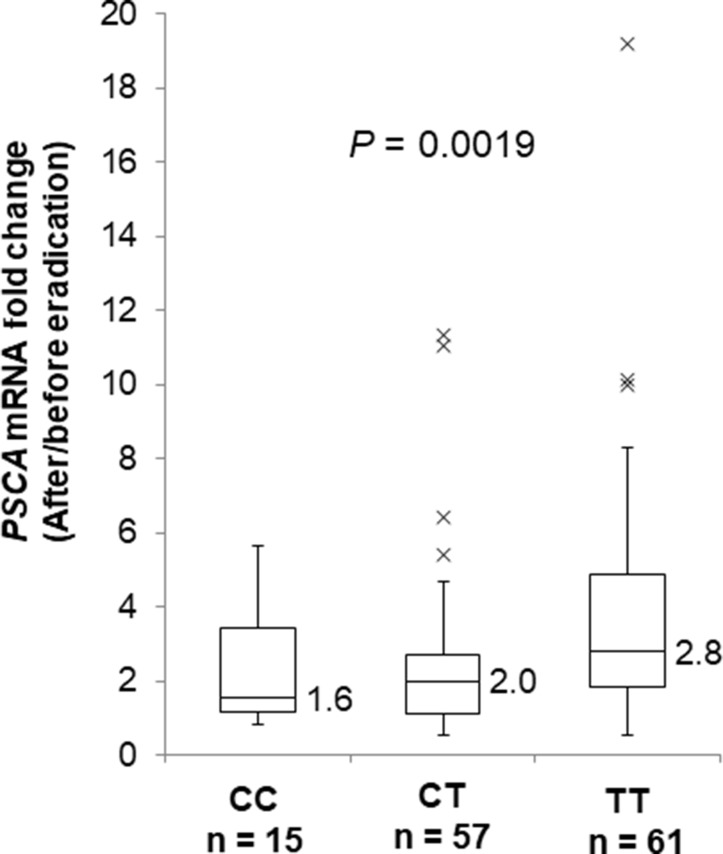
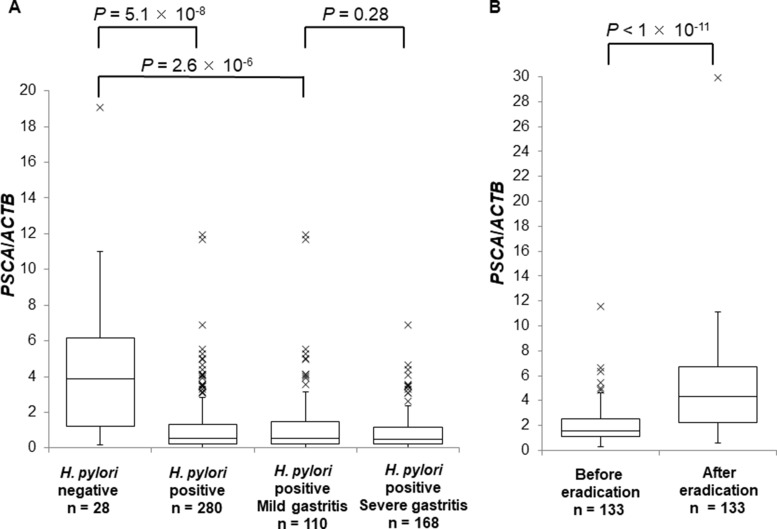
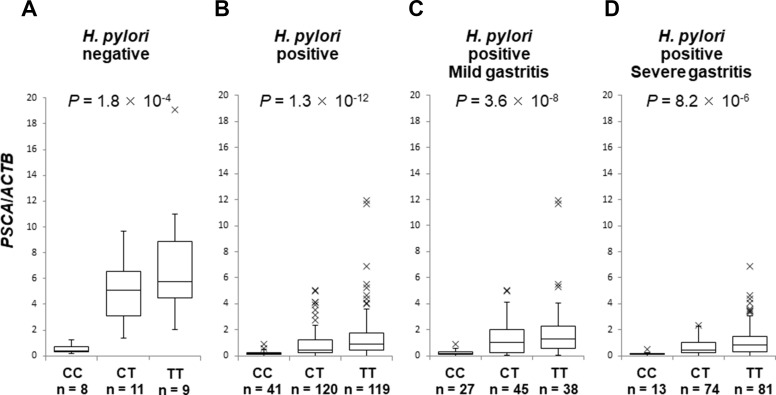
SNP rs2294008 in () and decreased expression are associated with gastric cancer. The objective of this study is to investigate the role of rs2294008 and expression in the gastritis-gastric cancer carcinogenic pathway. We conducted a case-control association study of -infected gastritis and gastric cancer. rs2294008 was associated with the progression to chronic active gastritis ( 9.4 × 10; odds ratio = 3.88, TT + TC vs CC genotype), but not with infection nor with the progression from active gastritis to gastric cancer. We also assessed the association of rs2294008 with mRNA expression in the gastric mucosa at various disease stages and found that rs2294008 was associated with expression ( 1.3 × 10). infection ( 5.1 × 10) and eradication therapy ( < 1 × 10) resulted in the reduced and increased expression, respectively, indicating negative regulation of expression by infection. expression was decreased in severe gastritis compared with mild gastritis only among T allele carriers. Our findings revealed the regulation of expression by host genetic variation and bacterial infection might contribute to gastritis progression after infection.
()中的单核苷酸多态性rs2294008以及[具体基因名称]表达降低与胃癌相关。本研究的目的是探讨rs2294008和[具体基因名称]表达在胃炎 - 胃癌致癌途径中的作用。我们对幽门螺杆菌感染的胃炎和胃癌进行了病例对照关联研究。rs2294008与进展为慢性活动性胃炎相关(P = 9.4×10⁻⁴;优势比 = 3.88,TT + TC基因型与CC基因型相比),但与幽门螺杆菌感染以及从活动性胃炎进展为胃癌均无关。我们还评估了rs2294008与不同疾病阶段胃黏膜中[具体基因名称]mRNA表达的关联,发现rs2294008与[具体基因名称]表达相关(P = 1.3×10⁻³)。幽门螺杆菌感染(P = 5.1×10⁻⁴)和根除治疗(P < 1×10⁻⁴)分别导致[具体基因名称]表达降低和升高,表明幽门螺杆菌感染对[具体基因名称]表达具有负调控作用。仅在T等位基因携带者中,与轻度胃炎相比,重度胃炎中[具体基因名称]表达降低。我们的研究结果揭示了宿主基因变异对[具体基因名称]表达的调控作用,并且细菌感染可能在幽门螺杆菌感染后促进胃炎进展。 (注:原文中部分基因名称缺失,已用[具体基因名称]表示)