College of Animal Science and Technology, Jilin Agricultural University, Xincheng Street No.2888, Changchun, 130118 China.
Antimicrob Resist Infect Control. 2018 Jan 29;7:17. doi: 10.1186/s13756-018-0303-7. eCollection 2018.
Bacterial infections have become more challenging to treat due to the emergence of multidrug-resistant pathogenic bacteria. Combined antibiotics prove to be a relatively effective method to control such resistant strains. This study aim to investigate synergistic activity of eugenol combined with colistin against a collection of clinical isolated () strains, and to evaluate potential interaction.
Antimicrobial susceptibility, minimum inhibitory concentration (MIC) and fractional inhibitory concentration index (FICI) of the bacteria were determined by disk diffusion assay, broth microdilution method and checkerboard assay, respectively. The mcr-1 mRNA expression was measured by Real-time PCR. To predict possible interactions between eugenol and MCR-1, molecular docking assay was taken.
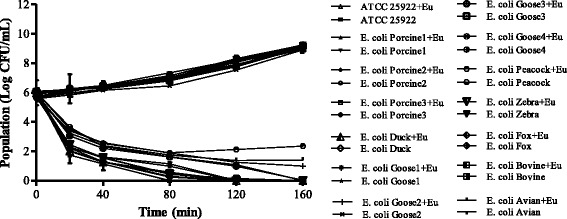
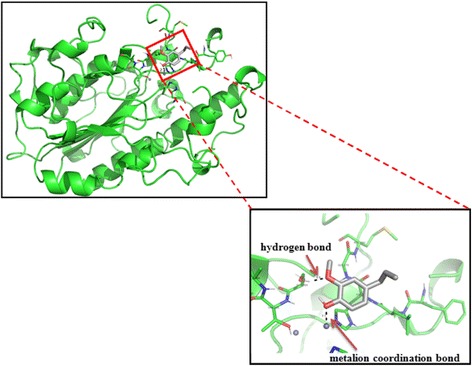
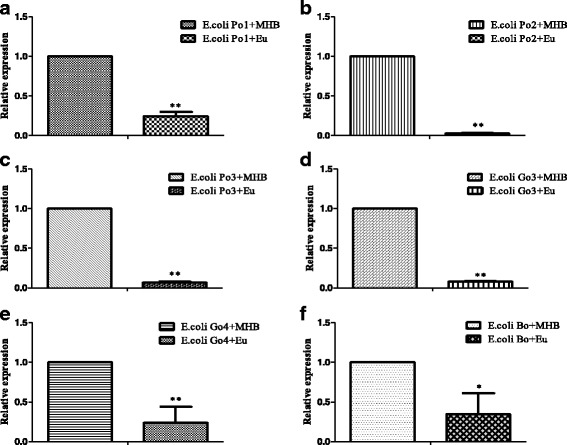
For total fourteen strains including eight colistin-resistant strains, eugenol was determined with MIC values of 4 to 8 μg/mL. Checkerboard dilution test suggested that eugenol exhibited synergistic activity when combined with colistin (FICI ranging from 0.375 to 0.625). Comparison analysis of Real-time PCR showed that synergy could significantly down-regulate expression of mcr-1 gene. A metal ion coordination bond with catalytic zinc atom and a hydrogen bond with crucial amino acid residue Ser284 of MCR-1 were observed after molecular docking, indicating antibacterial activity and direct molecular interactions of eugenol with MCR-1 protein.
Our results demonstrated that eugenol exhibited synergistic effect with colistin and enhanced its antimicrobial activity. This might further contribute to the antibacterial actions against colistin-resistant strains.
由于多药耐药病原菌的出现,细菌感染的治疗变得更加具有挑战性。联合使用抗生素被证明是控制这些耐药菌株的一种相对有效的方法。本研究旨在探讨丁香酚与黏菌素联合应用对一组临床分离的()菌株的协同活性,并评估其潜在的相互作用。
采用纸片扩散法、肉汤微量稀释法和棋盘微量稀释法分别测定细菌的抗菌药敏性、最小抑菌浓度(MIC)和部分抑菌浓度指数(FICI)。采用实时 PCR 法测定 mcr-1 mRNA 的表达。采用分子对接法预测丁香酚与 MCR-1 之间可能的相互作用。
共检测了 14 株菌,包括 8 株耐黏菌素菌株,丁香酚的 MIC 值为 4 至 8μg/ml。棋盘稀释试验表明,丁香酚与黏菌素联合使用时表现出协同作用(FICI 范围为 0.375 至 0.625)。实时 PCR 比较分析表明,协同作用可显著下调 mcr-1 基因的表达。分子对接后观察到丁香酚与 MCR-1 蛋白的催化锌原子形成金属离子配位键,并与关键氨基酸残基 Ser284 形成氢键,表明丁香酚具有抗菌活性,并与 MCR-1 蛋白直接发生分子相互作用。
本研究结果表明,丁香酚与黏菌素联合使用具有协同作用,增强了其抗菌活性。这可能进一步有助于发挥其对耐黏菌素()菌株的抗菌作用。