Department of Ecology and Evolution, University of Lausanne, Le Biophore, Unil Sorge, 1015, Lausanne, Switzerland.
Museum of Zoology, Place de la Riponne 6, 1005, Lausanne, Switzerland.
Malar J. 2018 Feb 9;17(1):77. doi: 10.1186/s12936-018-2219-3.
Plasmodium parasites are known to impose fitness costs on their vertebrate hosts. Some of these costs are due to the activation of the immune response, which may divert resources away from self-maintenance. Plasmodium parasites may also immuno-deplete their hosts. Thus, infected individuals may be less able to mount an immune response to a new pathogen than uninfected ones. However, this has been poorly investigated.
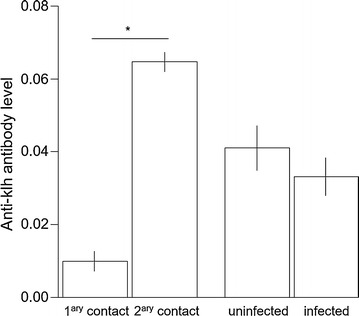
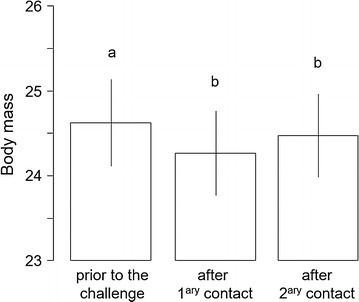
The effect of Plasmodium infection on bird humoral immune response when encountering a novel antigen was tested. A laboratory experiment was conducted on canaries (Serinus canaria) experimentally infected with Plasmodium relictum (lineage SGS1) under controlled conditions. Birds were immune challenged with an intra-pectoral injection of a novel non-pathogenic antigen (keyhole limpet haemocyanin, KLH). One week later they were challenged again. The immune responses to the primary and to the secondary contacts were quantified as anti-KLH antibody production via enzyme-linked immunosorbent assay (ELISA).
There was no significant difference in antibody production between uninfected and Plasmodium infected birds at both primary and secondary contact. However, Plasmodium parasite intensity in the blood increased after the primary contact with the antigen.
There was no effect of Plasmodium infection on the magnitude of the humoral immune response. However, there was a cost of mounting an immune response in infected individuals as parasitaemia increased after the immune challenge, suggesting a trade-off between current control of chronic Plasmodium infection and investment against a new immune challenge.
疟原虫已知会给其脊椎动物宿主带来适应度代价。其中一些代价是由于免疫反应的激活,这可能会将资源从自我维持中转移出去。疟原虫也可能使宿主免疫耗竭。因此,感染个体可能比未感染个体更难以对新病原体产生免疫反应。然而,这一点还没有得到充分的研究。
研究了疟原虫感染对鸟类在遇到新抗原时体液免疫反应的影响。在控制条件下,对实验感染疟原虫 relicta(SGS1 谱系)的金丝雀(Serinus canaria)进行了实验室实验。通过胸内注射新的非致病性抗原(血蓝蛋白,KLH)对鸟类进行免疫挑战。一周后再次进行挑战。通过酶联免疫吸附试验(ELISA)定量检测对初次和二次接触的免疫反应,即抗 KLH 抗体的产生。
在初次和二次接触时,未感染和感染疟原虫的鸟类之间的抗体产生没有显著差异。然而,在初次接触抗原后,血液中的疟原虫密度增加。
疟原虫感染对体液免疫反应的强度没有影响。然而,由于在免疫挑战后寄生虫血症增加,感染个体在免疫反应方面存在成本,这表明在控制慢性疟原虫感染和对新免疫挑战的投资之间存在权衡。