Sunada Shigeaki, Nakanishi Akira, Miki Yoshio
Department of Molecular Genetics, Medical Research Institute, Tokyo Medical and Dental University, Tokyo, Japan.
Cancer Sci. 2018 Apr;109(4):893-899. doi: 10.1111/cas.13530. Epub 2018 Mar 6.
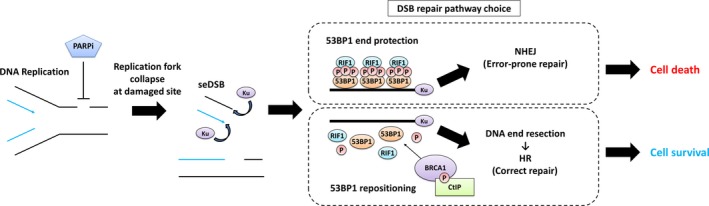
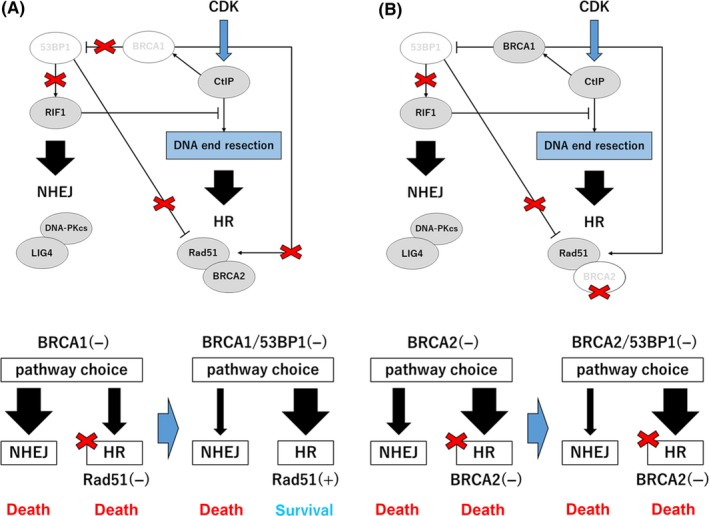
Germline mutations in breast cancer susceptibility gene 1 or 2 (BRCA1 or BRCA2) significantly increase cancer risk in hereditary breast and ovarian cancer syndrome (HBOC). Both genes function in the homologous recombination (HR) pathway of the DNA double-strand break (DSB) repair process. Therefore, the DNA-repair defect characteristic of cancer cells brings about a therapeutic advantage for poly(ADP-ribose) polymerase (PARP) inhibitor-induced synthetic lethality. PARP inhibitor-based therapeutics initially cause cancer lethality but acquired resistance mechanisms have been found and need to be elucidated. In particular, it is essential to understand in detail the mechanism of DNA damage and repair to PARP inhibitor treatment. Further investigations have shown the roles of BRCA1/2 and its associations to other molecules in the DSB repair system. Notably, the repair pathway chosen in BRCA1-deficient cells could be entirely different from that in BRCA2-deficient cells after PARP inhibitor treatment. The present review describes synthetic lethality and acquired resistance mechanisms to PARP inhibitor through the DSB repair pathway and subsequent repair process. In addition, recent knowledge of resistance mechanisms is discussed. Our model should contribute to the development of novel therapeutic strategies.
乳腺癌易感基因1或2(BRCA1或BRCA2)的种系突变会显著增加遗传性乳腺癌和卵巢癌综合征(HBOC)的癌症风险。这两个基因在DNA双链断裂(DSB)修复过程的同源重组(HR)途径中发挥作用。因此,癌细胞的DNA修复缺陷特性为聚(ADP-核糖)聚合酶(PARP)抑制剂诱导的合成致死带来了治疗优势。基于PARP抑制剂的疗法最初会导致癌细胞死亡,但已发现获得性耐药机制,需要对其进行阐明。特别是,详细了解PARP抑制剂治疗的DNA损伤和修复机制至关重要。进一步的研究表明了BRCA1/2在DSB修复系统中的作用及其与其他分子的关联。值得注意的是,PARP抑制剂治疗后,BRCA1缺陷细胞中选择的修复途径可能与BRCA2缺陷细胞中的完全不同。本综述描述了通过DSB修复途径及后续修复过程对PARP抑制剂的合成致死和获得性耐药机制。此外,还讨论了耐药机制的最新知识。我们的模型应有助于新型治疗策略的开发。