Division of Viral Diseases, National Center for Immunization and Respiratory Diseases, Centers for Disease Control and Prevention, Atlanta, GA, 30333, USA; Epidemic Intelligence Service, Centers for Disease Control and Prevention, Atlanta, GA, 30333, USA.
Division of Viral Diseases, National Center for Immunization and Respiratory Diseases, Centers for Disease Control and Prevention, Atlanta, GA, 30333, USA.
J Clin Virol. 2018 Apr;101:52-56. doi: 10.1016/j.jcv.2018.01.019. Epub 2018 Jan 31.
Human coronaviruses (HCoVs) -OC43, -229E, -NL63 and -HKU1 cause upper and lower respiratory tract infections. HCoVs are globally distributed and the predominant species may vary by region or year. Prior studies have shown seasonal patterns of HCoV species and annual variation in species prevalence but national circulation patterns in the US have not yet been described.
To describe circulation patterns of HCoVs -OC43, -229E, -NL63 and -HKU1 in the US.
We reviewed real-time reverse transcription polymerase chain reaction (rRT-PCR) test results for HCoV-OC43, -229E, -NL63 and -HKU1 reported to The National Respiratory and Enteric Virus Surveillance System (NREVSS) by U.S. laboratories from July 2014-June 2017. We calculated the total number of tests and percent positive by week. For a subset of HCoV positive submissions with age and sex of the patient available, we tested for differences in age and sex across the four HCoV species using Chi Square and Kruskal Wallace tests.
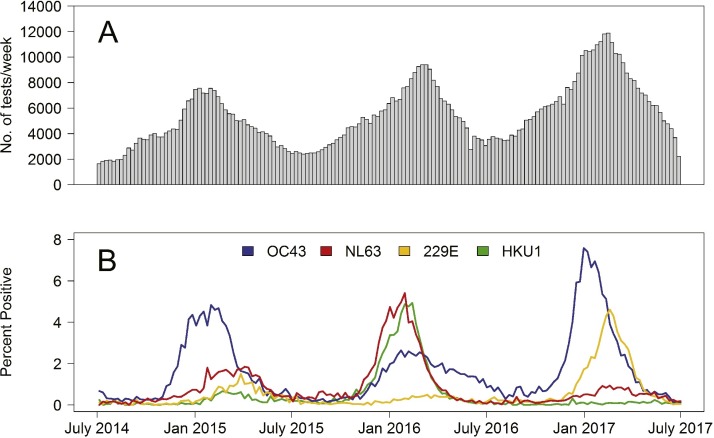
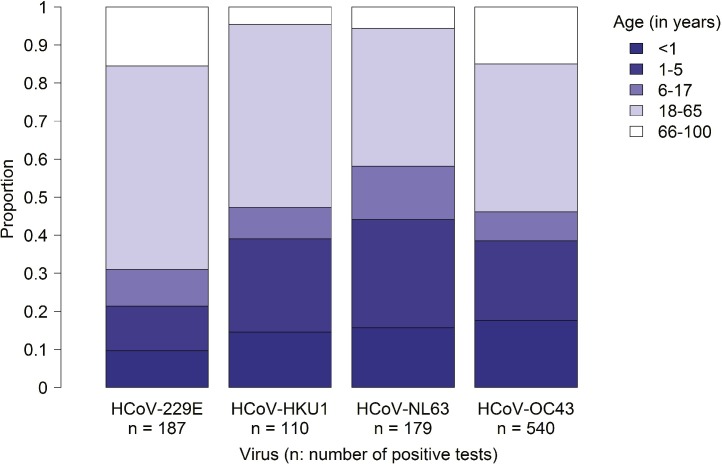
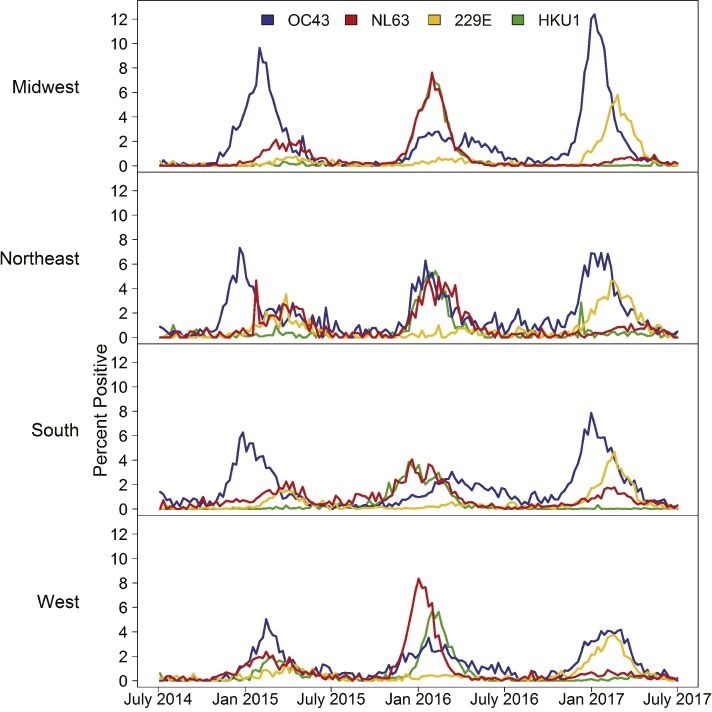
117 laboratories reported 854,575 HCoV tests; 2.2% were positive for HCoV-OC43, 1.0% for HCoV-NL63, 0.8% for HCoV-229E, and 0.6% for HCoV-HKU1. The percentage of positive tests peaked during December - March each year. No significant differences in sex were seen across species, although a significant difference in age distribution was noted.
Common HCoVs may have annual peaks of circulation in winter months in the US, and individual HCoVs may show variable circulation from year to year. Different HCoV species may be detected more frequently in different age groups. Further years of data are needed to better understand patterns of activity for HCoVs.
人类冠状病毒(HCoV)-OC43、-229E、-NL63 和 -HKU1 可引起上呼吸道和下呼吸道感染。HCoV 在全球范围内分布,优势种可能因地区或年份而异。先前的研究表明 HCoV 种的季节性模式和种流行率的年度变化,但尚未描述美国的国家循环模式。
描述美国 HCoV-OC43、-229E、-NL63 和 -HKU1 的循环模式。
我们回顾了美国实验室向国家呼吸道和肠道病毒监测系统(NREVSS)报告的 2014 年 7 月至 2017 年 6 月期间 HCoV-OC43、-229E、-NL63 和 -HKU1 的实时逆转录聚合酶链反应(rRT-PCR)检测结果。我们按周计算了总检测数和阳性百分比。对于 HCoV 阳性报告中年龄和性别信息可用的一个子集,我们使用卡方检验和克鲁斯卡尔-华莱士检验检验了四种 HCoV 中年龄和性别的差异。
117 个实验室报告了 854575 例 HCoV 检测;HCoV-OC43 的阳性率为 2.2%,HCoV-NL63 为 1.0%,HCoV-229E 为 0.8%,HCoV-HKU1 为 0.6%。阳性检测的百分比每年 12 月至 3 月达到峰值。尽管在年龄分布上存在显著差异,但在种间未观察到性别差异。
在美国,常见的 HCoV 可能在冬季月份有每年的循环高峰,而个别 HCoV 可能每年的循环情况不同。不同的 HCoV 种可能在不同的年龄组中更频繁地检测到。需要进一步的年度数据来更好地了解 HCoV 的活动模式。