Sipulwa Lenata A, Ongus Juliette R, Coldren Rodney L, Bulimo Wallace D
College of Health Sciences (COHES), Jomo Kenyatta University of Agriculture and Technology, (JKUAT), Nairobi, Kenya.
Department of Emerging Infectious Diseases, US Army Medical Research Unit-Kenya, P.O. Box 606 00621, Village Market, Nairobi, Kenya.
Virol J. 2016 Feb 1;13:18. doi: 10.1186/s12985-016-0474-x.
Human Coronaviruses (HCoV) are a common cause of respiratory illnesses and are responsible for considerable morbidity and hospitalization across all age groups especially in individuals with compromised immunity. There are six known species of HCoV: HCoV-229E, HCoV-NL63, HCoV-HKU1, HCoV-OC43, MERS-CoV and SARS-HCoV. Although studies have shown evidence of global distribution of HCoVs, there is limited information on their presence and distribution in Kenya.
HCoV strains that circulated in Kenya were retrospectively diagnosed and molecularly characterized. A total of 417 nasopharyngeal specimens obtained between January 2009 and December 2012 from around Kenya were analyzed by a real time RT-PCR using HCoV-specific primers. HCoV-positive specimens were subsequently inoculated onto monolayers of LL-CMK2 cells. The isolated viruses were characterized by RT-PCR amplification and sequencing of the partial polymerase (pol) gene.
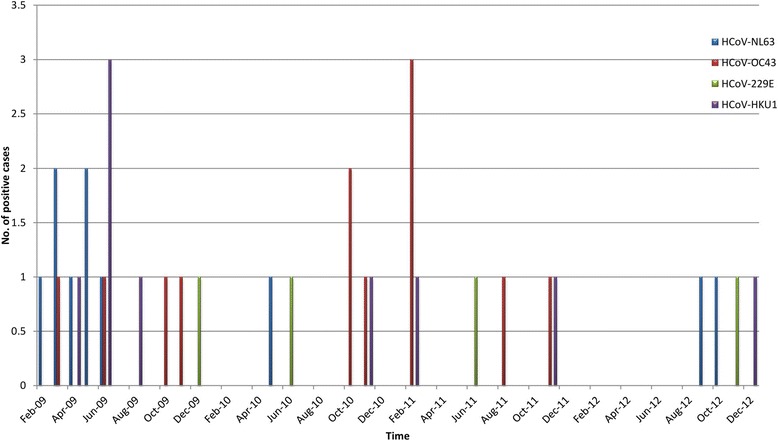
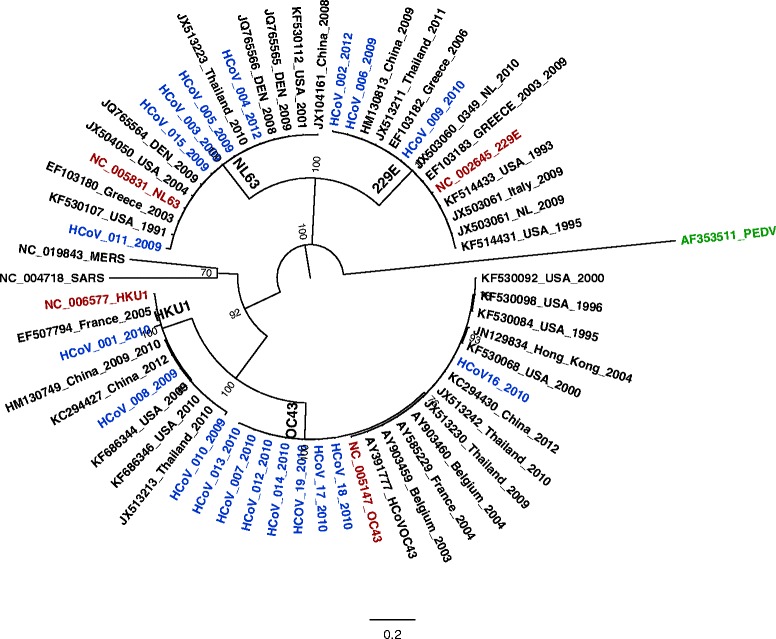
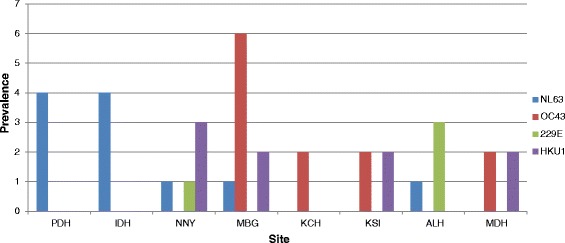
The prevalence of HCoV infection was as follows: out of the 417 specimens, 35 (8.4 %) were positive for HCoV, comprising 10 (2.4 %) HCoV-NL63, 12 (2.9 %) HCoV-OC43, 9 (2.1 %) HCoV-HKU1, and 4 (1 %) HCoV-229E. The Kenyan HCoV strains displayed high sequence homology to the prototypes and contemporaneous strains. Evolution analysis showed that the Kenyan HCoV-OC43 and HCoV-NL63 isolates were under purifying selection. Phylogenetic evolutionary analyses confirmed the identities of three HCoV-HKU1, five HCoV-NL63, eight HCoV-OC43 and three HCoV-229E.
There were yearly variations in the prevalence and circulation patterns of individual HCoVs in Kenya. This paper reports on the first molecular characterization of human Coronaviruses in Kenya, which play an important role in causing acute respiratory infections among children.
人类冠状病毒(HCoV)是呼吸道疾病的常见病因,在所有年龄组中都会导致相当高的发病率和住院率,尤其是免疫功能低下的个体。已知有六种HCoV:HCoV-229E、HCoV-NL63、HCoV-HKU1、HCoV-OC43、中东呼吸综合征冠状病毒(MERS-CoV)和严重急性呼吸综合征冠状病毒(SARS-HCoV)。尽管研究已证明HCoV在全球分布,但关于它们在肯尼亚的存在和分布情况的信息有限。
对在肯尼亚传播的HCoV毒株进行回顾性诊断并进行分子特征分析。使用HCoV特异性引物,通过实时逆转录聚合酶链反应(RT-PCR)对2009年1月至2012年12月期间从肯尼亚各地采集的417份鼻咽标本进行分析。随后将HCoV阳性标本接种到LL-CMK2细胞单层上。通过RT-PCR扩增和部分聚合酶(pol)基因测序对分离出的病毒进行特征分析。
HCoV感染的患病率如下:在417份标本中,35份(8.4%)HCoV呈阳性,其中包括10份(2.4%)HCoV-NL63、12份(2.9%)HCoV-OC43、9份(2.1%)HCoV-HKU1和4份(1%)HCoV-229E。肯尼亚的HCoV毒株与原型毒株和同期毒株显示出高度的序列同源性。进化分析表明,肯尼亚的HCoV-OC43和HCoV-NL63分离株处于纯化选择之下。系统发育进化分析证实了3株HCoV-HKU1、5株HCoV-NL63、8株HCoV-OC43和3株HCoV-229E的身份。
肯尼亚个体HCoV的患病率和传播模式存在年度变化。本文报道了肯尼亚人类冠状病毒的首次分子特征分析,这些病毒在导致儿童急性呼吸道感染中起重要作用。