Laboratory of Experimental Virology, Department of Medical Microbiology, Center for Infection and Immunity Amsterdam (CINIMA), Academic Medical Center of the University of Amsterdam, Meibergdreef 15, 1105 AZ Amsterdam, The Netherlands.
J Clin Virol. 2010 Jun;48(2):104-8. doi: 10.1016/j.jcv.2010.02.023. Epub 2010 Mar 29.
The disease burden caused by recently identified respiratory viruses like HCoV-NL63 is unknown.
We determined the burden of disease due to HCoV-NL63 infections using the population-based PRI.DE cohort of children under the age of 3 with lower respiratory tract infections (LRTIs).
In total 1756 respiratory samples, from hospitalized children or children who visited the outpatient clinic, were tested for HCoV-NL63. Sampling covered a period of 2 years and the frequency of infection in different years was compared to other Western European studies that tested for this virus in 2 or more consecutive years.
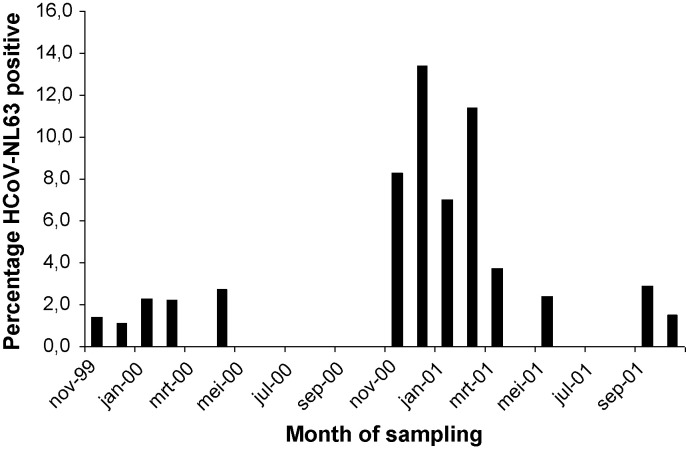
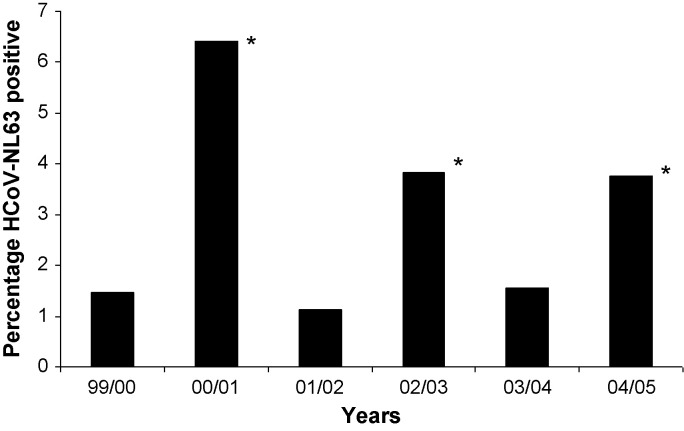
Sixty-nine samples were HCoV-NL63 positive, 35 were with high loads, and of these 25 were single HCoV-NL63 infections. Based on the number of children with high HCoV-NL63 infection and no additional infection, the overall annual incidence in outpatients was 7 per 1000 children per year (95% confidence interval (CI) 3-13 per 1000 children per year), which can be extrapolated to an absolute number of 16,929 visits to the physician due to an HCoV-NL63 infection in Germany per year. The estimated hospitalization rate is 22 per 100,000 children (95% CI: 7-49 per 100,000 children per year). This number reflects 522 HCoV-NL63 children in Germany per year. A large year-to-year difference in HCoV-NL63 infection frequency was observed. Combining these data with those of other studies in Western Europe revealed that HCoV-NL63 infections follow a 2-year inter-epidemic period with peaks of infection in the winters of 2000/2001, 2002/2003 and 2004/2005 (p<0.0001).
HCoV-NL63 infection in children below 3 years of age often requires a visit to the physician in an outpatient clinic, especially during peak-years, but hospitalizations are relatively infrequent.
最近发现的呼吸道病毒,如 HCoV-NL63,其造成的疾病负担尚不清楚。
我们使用基于人群的 PRI.DE 队列来评估儿童下呼吸道感染(LRTIs)中 HCoV-NL63 感染的疾病负担。
总共对 1756 份来自住院儿童或门诊患儿的呼吸道样本进行了 HCoV-NL63 检测。采样覆盖了 2 年的时间,并将不同年份的感染频率与其他在 2 年或更长时间内检测过该病毒的西欧研究进行了比较。
69 份样本 HCoV-NL63 阳性,35 份高载量,其中 25 份为单纯 HCoV-NL63 感染。根据高 HCoV-NL63 感染且无其他感染的患儿数量,门诊患儿的年发病率为每年每千名儿童 7 例(95%置信区间(CI)为每年每千名儿童 3-13 例),可外推至德国每年因 HCoV-NL63 感染而就诊的儿童人数为 16929 例。估计的住院率为每 10 万儿童 22 例(95%CI:每年每 10 万儿童 7-49 例)。这一数字反映了德国每年有 522 名 HCoV-NL63 患儿。我们观察到 HCoV-NL63 感染的频率存在较大的年度差异。将这些数据与西欧其他研究的数据相结合表明,HCoV-NL63 感染呈 2 年流行间隔,感染高峰出现在 2000/2001、2002/2003 和 2004/2005 年的冬季(p<0.0001)。
3 岁以下儿童的 HCoV-NL63 感染常需要在门诊就诊,但住院治疗相对较少,尤其是在高峰年份。