Barcelona Institute for Global Health, Hospital Clinic-University of Barcelona, Barcelona, Spain; Division of Public Health, School of Medicine and Health Sciences, University of Papua New Guinea, Port Moresby, Papua New Guinea; Lihir Medical Center, International SOS-Newcrest Mining, Lihir Island, Papua New Guinea.
Department of Medicine, University of Washington, Seattle, WA, USA.
Lancet. 2018 Apr 21;391(10130):1599-1607. doi: 10.1016/S0140-6736(18)30204-6. Epub 2018 Feb 7.
Yaws is a substantial cause of chronic disfiguring ulcers in children in at least 14 countries in the tropics. WHO's newly adopted strategy for yaws eradication uses a single round of mass azithromycin treatment followed by targeted treatment programmes, and data from pilot studies have shown a short-term significant reduction of yaws. We assessed the long-term efficacy of the WHO strategy for yaws eradication.
Between April 15, 2013, and Oct 24, 2016, we did a longitudinal study on a Papua New Guinea island (Lihir; 16 092 population) in which yaws was endemic. In the initial study, the participants were followed for 12 months; in this extended follow-up study, clinical, serological, and PCR surveys were continued every 6 months for 42 months. We used genotyping and travel history to identify importation events. Active yaws confirmed by PCR specific for Treponema pallidum was the primary outcome indicator. The study is registered with ClinicalTrials.gov, number NCT01955252.
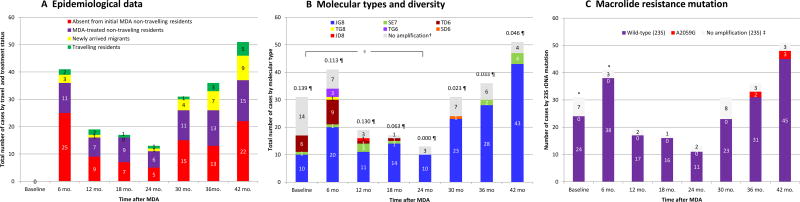
Mass azithromycin treatment (coverage rate of 84%) followed by targeted treatment programmes reduced the prevalence of active yaws from 1·8% to a minimum of 0·1% at 18 months (difference from baseline -1·7%, 95% CI, -1·9 to -1·4; p<0·0001), but the infection began to re-emerge after 24 months with a significant increase to 0·4% at 42 months (difference from 18 months 0·3%, 95% CI 0·1 to 0·4; p<0·0001). At each timepoint after baseline, more than 70% of the total community burden of yaws was found in individuals who had not had the mass treatment or as new infections in non-travelling residents. At months 36 and 42, five cases of active yaws, all from the same village, showed clinical failure following azithromycin treatment, with PCR-detected mutations in the 23S ribosomal RNA genes conferring resistance to azithromycin. A sustained decrease in the prevalence of high-titre latent yaws from 13·7% to <1·5% in asymptomatic children aged 1-5 years old and of genetic diversity of yaws strains from 0·139 to less than 0·046 between months 24 and 42 indicated a reduction in transmission of infection.
The implementation of the WHO strategy did not, in the long-term, achieve elimination in a high-endemic community mainly due to the individuals who were absent at the time of mass treatment in whom yaws reactivated; repeated mass treatment might be necessary to eliminate yaws. To our knowledge, this is the first report of the emergence of azithromycin-resistant T p pertenue and spread within one village. Communities' surveillance should be strengthened to detect any possible treatment failure and biological markers of resistance.
ISDIN laboratories, Newcrest Mining Limited, and US Public Health Service National Institutes of Health.
雅司病在热带地区至少 14 个国家是导致儿童慢性毁容性溃疡的一个重要病因。世界卫生组织(WHO)新采用的雅司病消除策略是使用一轮大规模阿奇霉素治疗,然后再进行有针对性的治疗规划,来自试点研究的数据显示雅司病的短期显著减少。我们评估了 WHO 雅司病消除策略的长期疗效。
在 2013 年 4 月 15 日至 2016 年 10 月 24 日期间,我们在巴布亚新几内亚的一个岛屿(利希尔;16092 人)进行了一项纵向研究,该岛雅司病流行。在最初的研究中,参与者随访 12 个月;在本次扩展随访研究中,每 6 个月进行一次临床、血清学和 PCR 调查,共持续 42 个月。我们使用基因分型和旅行史来确定输入性感染。聚合酶链反应(PCR)特异性检测梅毒密螺旋体的活动性雅司病是主要的结局指标。本研究在 ClinicalTrials.gov 注册,编号为 NCT01955252。
大规模阿奇霉素治疗(覆盖率 84%),随后是有针对性的治疗规划,将活动性雅司病的患病率从基线时的 1.8%降低到 18 个月时的最低 0.1%(与基线相比减少 1.7%,95%CI,-1.9 至-1.4;p<0.0001),但在 24 个月后感染开始再次出现,在 42 个月时显著增加到 0.4%(与 18 个月时相比增加 0.3%,95%CI,0.1 至 0.4;p<0.0001)。在基线后的每个时间点,在未接受大规模治疗的个体或非旅行者中的新感染中,都发现了超过 70%的雅司病总社区负担。在 36 个月和 42 个月时,5 例活动性雅司病,均来自同一个村庄,在接受阿奇霉素治疗后出现临床治疗失败,23S 核糖体 RNA 基因的 PCR 检测到的突变导致对阿奇霉素的耐药性。在无症状 1 至 5 岁儿童中,高滴度潜伏性雅司病的患病率从 13.7%持续下降到<1.5%,雅司病株的遗传多样性从 0.139 下降到<0.046(24 个月至 42 个月),表明感染传播减少。
在一个主要由未参与大规模治疗的个体和重新激活的个体组成的高度流行社区中,WHO 策略的实施并没有在长期内实现消除;可能需要重复大规模治疗来消除雅司病。据我们所知,这是第一份关于耐阿奇霉素梅毒密螺旋体的出现及其在一个村庄内传播的报告。应加强社区监测,以发现任何可能的治疗失败和耐药的生物学标志物。
ISDIN 实验室、纽克雷斯特矿业有限公司和美国公共卫生服务部国立卫生研究院。