Department of Biomedical Sciences, University of the Pacific Arthur A. Dugoni School of Dentistry, San Francisco, CA, USA.
Department of Biomedical Sciences, University of the Pacific Arthur A. Dugoni School of Dentistry, San Francisco, CA, USA.
Biomed J. 2017 Dec;40(6):313-316. doi: 10.1016/j.bj.2017.10.002. Epub 2017 Dec 21.
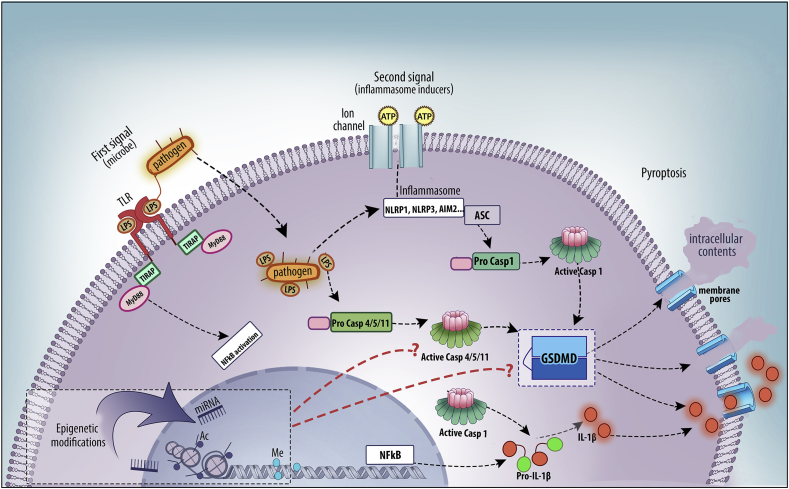
Pyroptosis is a lytic type of programmed cell death that was traditionally associated with the involvement of inflammatory caspases, such as caspase-1. These inflammatory caspases are activated within multi-protein complexes called inflammasomes that are assembled in response to invading pathogens and/or danger signals. Pyroptotic cell death was suggested to evolve via the formation of pores in the plasma membrane, but the exact mechanism underlying the formation of these pores remained unclear. Recently, gasdermin D, a member of the gasdermin protein family was identified as a caspase substrate and essential effector of pyroptosis, being identified as the protagonist of membrane pore formation. Gasdermins have emerged as a family of new class of cell death inducers, but many questions remain unanswered. Here, we present an overview of recent work being done in the area of programmed cell death and the latest evidence regarding the role and participation of gasdermin D as an effector of pyroptosis.
细胞焦亡是一种细胞程序性死亡方式,其特征是细胞发生肿胀并发生不可逆的破裂。细胞焦亡是机体一种重要的天然免疫反应,在抗感染天然免疫、炎症性疾病中发挥重要作用。细胞焦亡是由gasdermin 家族蛋白介导的。gasdermin 家族蛋白可以分为 gasdermin A、B、C、D 四个亚家族。gasdermin D 是目前研究最清楚的 gasdermin 家族蛋白。细胞焦亡发生时,gasdermin D 在 caspase-1 或 caspase-4/5 的作用下发生剪切,形成 N 端和 C 端两个片段。N 端片段插入细胞膜,形成离子通道,导致细胞渗透压改变,细胞发生肿胀并最终发生破裂。C 端片段可以作为细胞焦亡的标志物。