Gao Wei, Wu Meihong, Wang Ning, Zhang Yingyi, Hua Jing, Tang Gusheng, Wang Yajie
Department of Radiation Oncology, Shanghai 9th People's Hospital Affiliated to Shanghai Jiao Tong University School of Medicine, Shanghai 200433, P.R. China.
Department of Oncology, Changhai Hospital, The Second Military Medical University, Shanghai 200433, P.R. China.
Oncol Lett. 2018 Feb;15(2):1449-1458. doi: 10.3892/ol.2017.7487. Epub 2017 Nov 24.
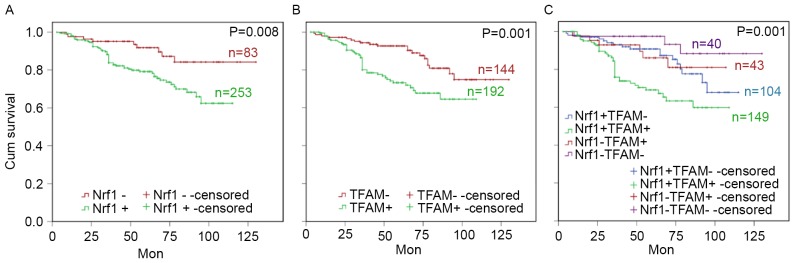
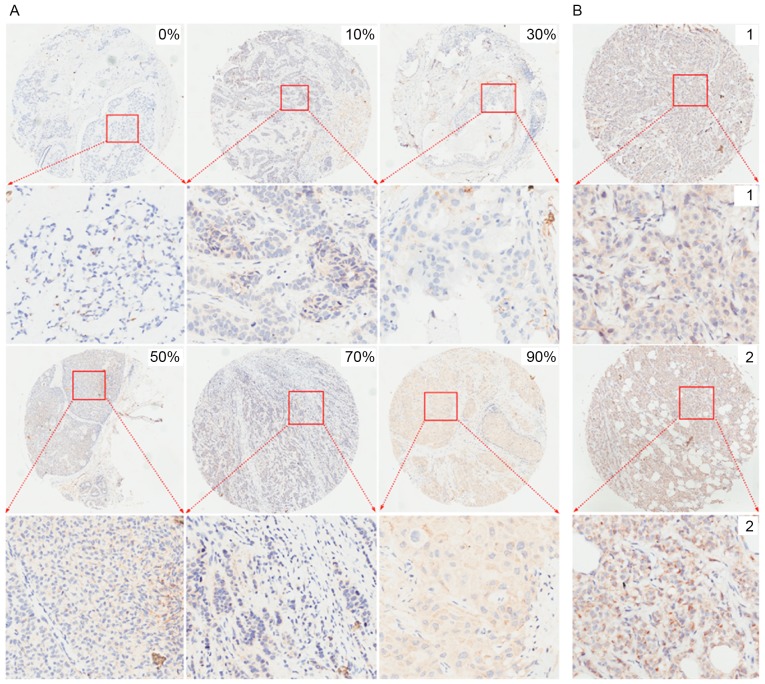
Nuclear respiratory factor-1 (Nrf1) and mitochondrial transcription factor A (TFAM) are involved in the regulation of a variety of mitochondrial functional genes, which are associated with decreased sensitivity of tumor cells to chemotherapy. However, the expression status of Nrf1 and TFAM, as well as their clinical significance in breast cancer, is unknown. In the present study, tumor tissues and corresponding adjacent normal tissues were collected from 336 patients with breast cancer, and Nrf1 and TFAM expression was analyzed by immunohistochemistry using a tissue microarray. Expression of Nrf1 and TFAM was significantly increased in breast cancer tissue compared with adjacent normal tissues. In addition, patients positive for Nrf1 or TFAM had a poorer clinical prognosis than patients who were negative, and those positive for Nrf1 and TFAM had the shortest survival time. These results suggest that Nrf1 and TFAM are potential biomarkers for the determination of individualized therapy and the prognosis of breast cancer, and molecular targeting of Nrf1 and TFAM is a promising strategy for the sensitization of breast cancer cells to chemotherapeutics.
核呼吸因子-1(Nrf1)和线粒体转录因子A(TFAM)参与多种线粒体功能基因的调控,这些基因与肿瘤细胞对化疗的敏感性降低有关。然而,Nrf1和TFAM的表达状态及其在乳腺癌中的临床意义尚不清楚。在本研究中,收集了336例乳腺癌患者的肿瘤组织及相应的癌旁正常组织,并使用组织芯片通过免疫组织化学分析Nrf1和TFAM的表达。与癌旁正常组织相比,乳腺癌组织中Nrf1和TFAM的表达显著增加。此外,Nrf1或TFAM阳性的患者临床预后比阴性患者差,而Nrf1和TFAM均阳性的患者生存时间最短。这些结果表明,Nrf1和TFAM是用于确定乳腺癌个体化治疗和预后的潜在生物标志物,对Nrf1和TFAM进行分子靶向是使乳腺癌细胞对化疗药物敏感的一种有前景的策略。