The Alexander Silberman Life Science Institute and the Wolfson Center for Applied Structural Biology, The Hebrew University of Jerusalem, Edmond J. Safra Campus at Givat Ram, 91904-0375, Jerusalem, Israel.
Computational Biomedicine Section, Institute of Advanced Simulation (IAS-5) and Institute of Neuroscience and Medicine (INM-9), Forschungszentrum Jülich GmbH, 52425, Jülich, Germany.
J Biol Inorg Chem. 2018 Jun;23(4):599-612. doi: 10.1007/s00775-018-1538-8. Epub 2018 Feb 12.
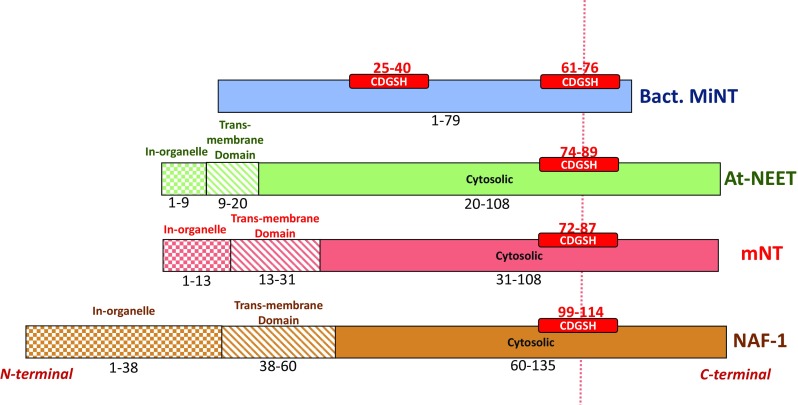
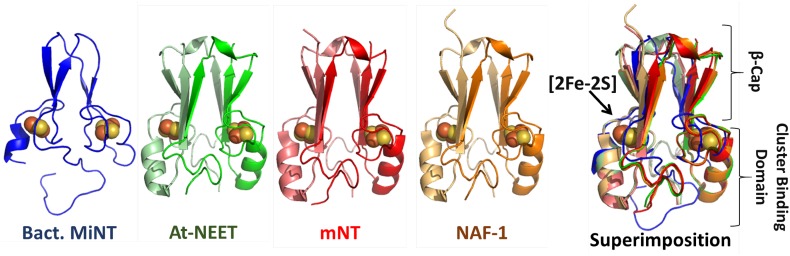
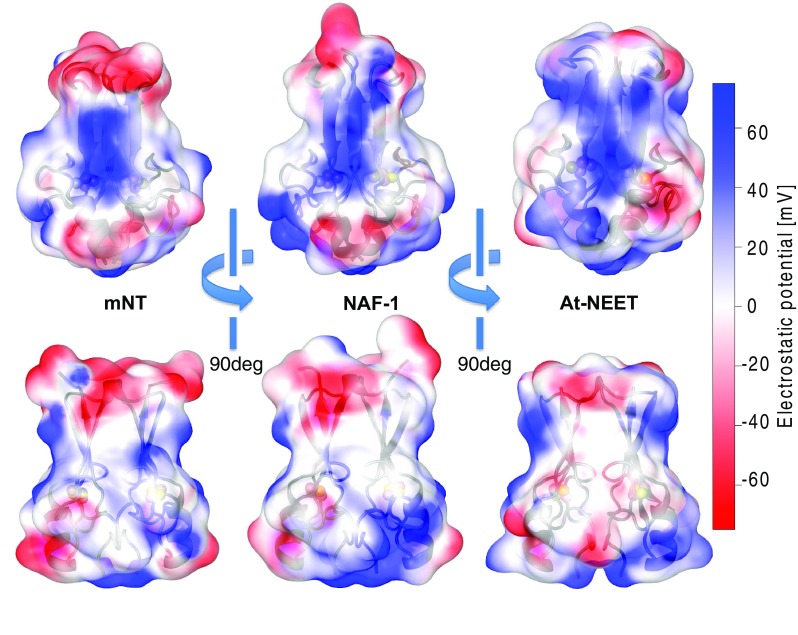
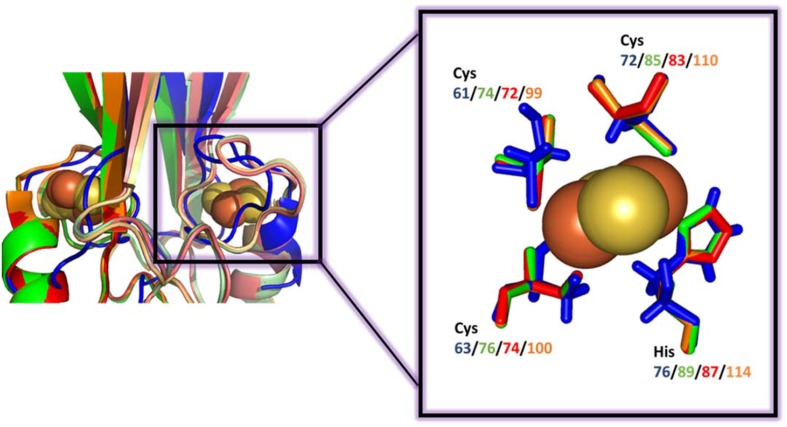
NEET proteins comprise a new class of [2Fe-2S] cluster proteins. In human, three genes encode for NEET proteins: cisd1 encodes mitoNEET (mNT), cisd2 encodes the Nutrient-deprivation autophagy factor-1 (NAF-1) and cisd3 encodes MiNT (Miner2). These recently discovered proteins play key roles in many processes related to normal metabolism and disease. Indeed, NEET proteins are involved in iron, Fe-S, and reactive oxygen homeostasis in cells and play an important role in regulating apoptosis and autophagy. mNT and NAF-1 are homodimeric and reside on the outer mitochondrial membrane. NAF-1 also resides in the membranes of the ER associated mitochondrial membranes (MAM) and the ER. MiNT is a monomer with distinct asymmetry in the molecular surfaces surrounding the clusters. Unlike its paralogs mNT and NAF-1, it resides within the mitochondria. NAF-1 and mNT share similar backbone folds to the plant homodimeric NEET protein (At-NEET), while MiNT's backbone fold resembles a bacterial MiNT protein. Despite the variation of amino acid composition among these proteins, all NEET proteins retained their unique CDGSH domain harboring their unique 3Cys:1His [2Fe-2S] cluster coordination through evolution. The coordinating exposed His was shown to convey the lability to the NEET proteins' [2Fe-2S] clusters. In this minireview, we discuss the NEET fold and its structural elements. Special attention is given to the unique lability of the NEETs' [2Fe-2S] cluster and the implication of the latter to the NEET proteins' cellular and systemic function in health and disease.
NEET 蛋白属于一类新的 [2Fe-2S] 簇蛋白。在人类中,有三个基因编码 NEET 蛋白:cisd1 编码线粒体 NEET(mNT),cisd2 编码营养剥夺自噬因子-1(NAF-1),cisd3 编码 MiNT(Miner2)。这些最近发现的蛋白质在许多与正常代谢和疾病相关的过程中发挥着关键作用。事实上,NEET 蛋白参与细胞内的铁、Fe-S 和活性氧稳态,并在调节细胞凋亡和自噬中发挥重要作用。mNT 和 NAF-1 是同源二聚体,位于线粒体外膜上。NAF-1 还存在于内质网相关线粒体膜(MAM)和内质网的膜上。MiNT 是一种单体,其分子表面围绕着簇的不对称性。与它的同源物 mNT 和 NAF-1 不同,它位于线粒体内部。NAF-1 和 mNT 与植物同源二聚体 NEET 蛋白(At-NEET)具有相似的骨架折叠,而 MiNT 的骨架折叠类似于细菌 MiNT 蛋白。尽管这些蛋白质的氨基酸组成存在差异,但所有 NEET 蛋白都保留了其独特的 CDGSH 结构域,通过进化来维持其独特的 3Cys:1His [2Fe-2S] 簇配位。已证明配位的暴露 His 赋予了 NEET 蛋白的 [2Fe-2S] 簇不稳定性。在这篇综述中,我们讨论了 NEET 折叠及其结构元件。特别关注 NEET 蛋白的 [2Fe-2S] 簇的独特不稳定性及其对 NEET 蛋白在健康和疾病中的细胞和全身功能的影响。