From the Department of Exercise Science, University of South Carolina, Columbia (M.A.S., J.J.R.-R., J.L.B.); Duke Molecular Physiology Institute, Duke University School of Medicine, Durham, NC (C.A.S., R.W.M., W.E.K.); Ingestive Behavior and Preventive Medicine Laboratories, Pennington Biomedical Research Center, Louisiana State University System, Baton Rouge, LA (J.W.A., M.N.H., T.S.C., C.K.M.); Center for Prevention of Obesity, Cardiovascular Disease & Diabetes, Children's Hospital Oakland Research Institute, Oakland, CA (M.S.B., Y.H., M.N.O.); and Division of Cardiology, Department of Internal Medicine, University of Texas Southwestern Medical Center, Dallas (A.R.).
Arterioscler Thromb Vasc Biol. 2018 Apr;38(4):943-952. doi: 10.1161/ATVBAHA.117.310307. Epub 2018 Feb 8.
Measures of HDL (high-density lipoprotein) function are associated with cardiovascular disease. However, the effects of regular exercise on these measures is largely unknown. Thus, we examined the effects of different doses of exercise on 3 measures of HDL function in 2 randomized clinical exercise trials.
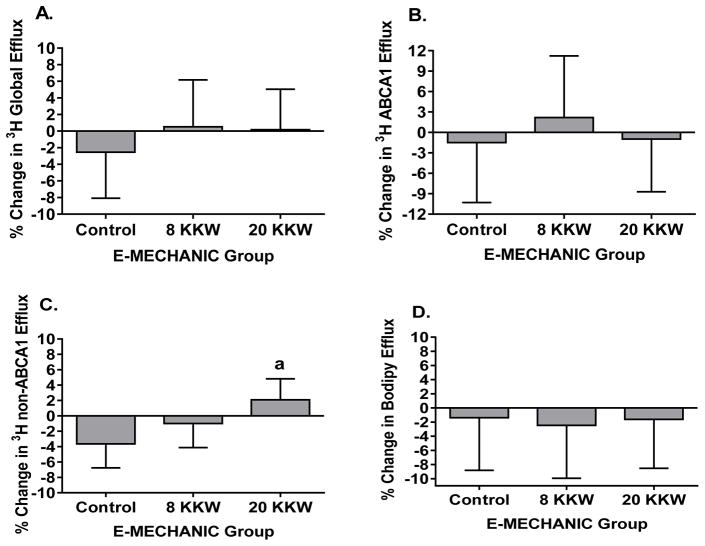
Radiolabeled and boron dipyrromethene difluoride-labeled cholesterol efflux capacity and HDL-apoA-I (apolipoprotein A-I) exchange were assessed before and after 6 months of exercise training in 2 cohorts: STRRIDE-PD (Studies of Targeted Risk Reduction Interventions through Defined Exercise, in individuals with Pre-Diabetes; n=106) and E-MECHANIC (Examination of Mechanisms of exercise-induced weight compensation; n=90). STRRIDE-PD participants completed 1 of 4 exercise interventions differing in amount and intensity. E-MECHANIC participants were randomized into 1 of 2 exercise groups (8 or 20 kcal/kg per week) or a control group. HDL-C significantly increased in the high-amount/vigorous-intensity group (3±5 mg/dL; =0.02) of STRRIDE-PD, whereas no changes in HDL-C were observed in E-MECHANIC. In STRRIDE-PD, global radiolabeled efflux capacity significantly increased 6.2% (SEM, 0.06) in the high-amount/vigorous-intensity group compared with all other STRRIDE-PD groups (range, -2.4 to -8.4%; SEM, 0.06). In E-MECHANIC, non-ABCA1 (ATP-binding cassette transporter A1) radiolabeled efflux significantly increased 5.7% (95% CI, 1.2-10.2%) in the 20 kcal/kg per week group compared with the control group, with no change in the 8 kcal/kg per week group (2.6%; 95% CI, -1.4 to 6.7%). This association was attenuated when adjusting for change in HDL-C. Exercise training did not affect BODIPY-labeled cholesterol efflux capacity or HDL-apoA-I exchange in either study.
Regular prolonged vigorous exercise improves some but not all measures of HDL function. Future studies are warranted to investigate whether the effects of exercise on cardiovascular disease are mediated in part by improving HDL function.
URL: https://www.clinicaltrials.gov. Unique identifiers: NCT00962962 and NCT01264406.
高密度脂蛋白(HDL)功能的测量值与心血管疾病相关。然而,有规律的运动对这些指标的影响在很大程度上尚不清楚。因此,我们在两项随机临床试验中研究了不同剂量的运动对 3 项 HDL 功能测量值的影响。
在 2 个队列中,在进行 6 个月的运动训练前后,使用放射性标记和硼二吡咯甲川荧光染料标记的胆固醇流出能力和 HDL-载脂蛋白 A-I(载脂蛋白 A-I)交换进行评估:STRIDE-PD(有前驱糖尿病个体的靶向风险降低干预研究,通过明确的运动;n=106)和 E-MECHANIC(运动诱导的体重补偿机制研究;n=90)。STRIDE-PD 参与者完成了 4 种运动干预措施中的 1 种,这些措施在量和强度上有所不同。E-MECHANIC 参与者被随机分配到 1 个运动组(每周 8 或 20 千卡/公斤)或对照组。HDL-C 在 STRIDE-PD 的高剂量/剧烈强度组中显著增加(3±5mg/dL;=0.02),而 E-MECHANIC 中 HDL-C 没有变化。在 STRIDE-PD 中,与其他所有 STRIDE-PD 组(范围为-2.4 至-8.4%;SEM,0.06)相比,高剂量/剧烈强度组的整体放射性标记流出能力显著增加了 6.2%(SEM,0.06)。在 E-MECHANIC 中,非 ABCA1(ATP 结合盒转运蛋白 A1)放射性标记流出量在每周 20 千卡/公斤组中比对照组显著增加了 5.7%(95%CI,1.2-10.2%),而每周 8 千卡/公斤组中没有变化(2.6%;95%CI,-1.4 至 6.7%)。当调整 HDL-C 的变化时,这种关联减弱了。在两项研究中,运动训练均未影响 BODIPY 标记的胆固醇流出能力或 HDL-载脂蛋白 A-I 交换。
长期有规律的剧烈运动可改善 HDL 功能的某些但不是所有测量值。有必要进行进一步的研究,以探讨运动对心血管疾病的影响是否部分是通过改善 HDL 功能来介导的。
网址:https://www.clinicaltrials.gov。唯一标识符:NCT00962962 和 NCT01264406。