Department of Nutrition, Harvard T.H. Chan School of Public Health, Boston, Massachusetts, United States of America.
Pennington Biomedical Research Center, Louisiana State University, Baton Rouge, Louisiana, United States of America.
PLoS Med. 2018 Feb 13;15(2):e1002502. doi: 10.1371/journal.pmed.1002502. eCollection 2018 Feb.
The potential endocrine-disrupting effects of perfluoroalkyl substances (PFASs) have been demonstrated in animal studies, but whether PFASs may interfere with body weight regulation in humans is largely unknown. This study aimed to examine the associations of PFAS exposure with changes in body weight and resting metabolic rate (RMR) in a diet-induced weight-loss setting.
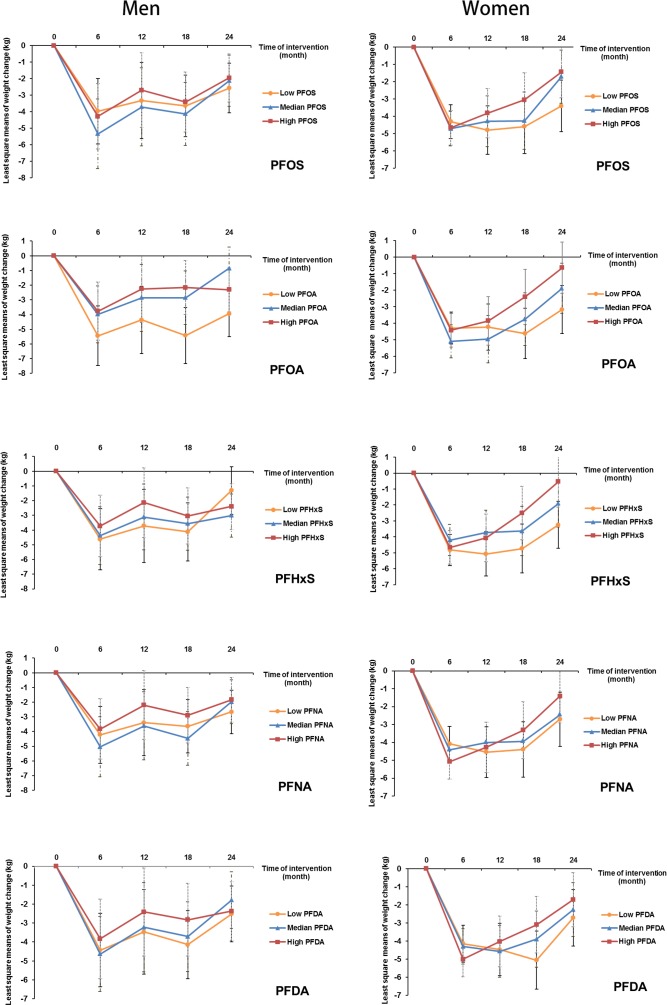
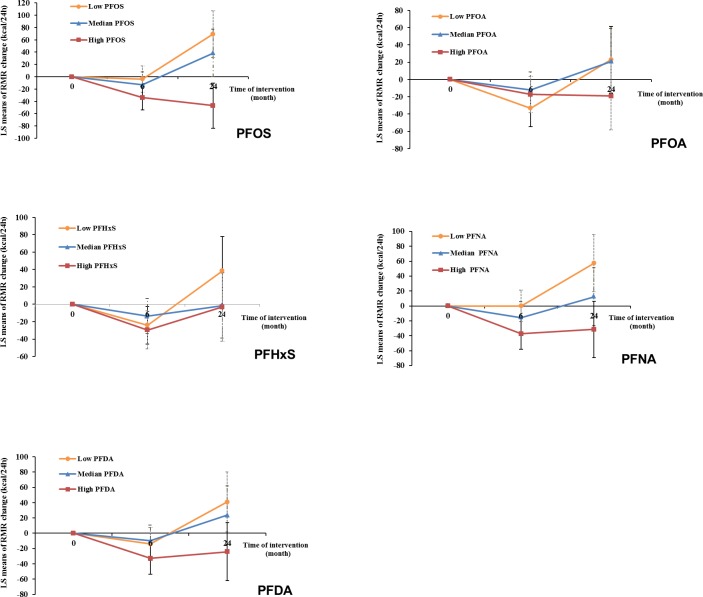
In the 2-year POUNDS Lost randomized clinical trial based in Boston, Massachusetts, and Baton Rouge, Louisiana, that examined the effects of energy-restricted diets on weight changes, baseline plasma concentrations of major PFASs were measured among 621 overweight and obese participants aged 30-70 years. Body weight was measured at baseline and 6, 12, 18, and 24 months. RMR and other metabolic parameters, including glucose, lipids, thyroid hormones, and leptin, were measured at baseline and 6 and 24 months. Participants lost an average of 6.4 kg of body weight during the first 6 months (weight-loss period) and subsequently regained an average of 2.7 kg of body weight during the period of 6-24 months (weight regain period). After multivariate adjustment, baseline PFAS concentrations were not significantly associated with concurrent body weight or weight loss during the first 6 months. In contrast, higher baseline levels of PFASs were significantly associated with a greater weight regain, primarily in women. In women, comparing the highest to the lowest tertiles of PFAS concentrations, the multivariate-adjusted mean weight regain (SE) was 4.0 (0.8) versus 2.1 (0.9) kg for perfluorooctanesulfonic acid (PFOS) (Ptrend = 0.01); 4.3 (0.9) versus 2.2 (0.8) kg for perfluorooctanoic acid (PFOA) (Ptrend = 0.007); 4.7 (0.9) versus 2.5 (0.9) kg for perfluorononanoic acid (PFNA) (Ptrend = 0.006); 4.9 (0.9) versus 2.7 (0.8) kg for perfluorohexanesulfonic acid (PFHxS) (Ptrend = 0.009); and 4.2 (0.8) versus 2.5 (0.9) kg for perfluorodecanoic acid (PFDA) (Ptrend = 0.03). When further adjusted for changes in body weight or thyroid hormones during the first 6 months, results remained similar. Moreover, higher baseline plasma PFAS concentrations, especially for PFOS and PFNA, were significantly associated with greater decline in RMR during the weight-loss period and less increase in RMR during the weight regain period in both men and women. Limitations of the study include the possibility of unmeasured or residual confounding by socioeconomic and psychosocial factors, as well as possible relapse to the usual diet prior to randomization, which could have been rich in foods contaminated by PFASs through food packaging and also dense in energy.
In this diet-induced weight-loss trial, higher baseline plasma PFAS concentrations were associated with a greater weight regain, especially in women, possibly explained by a slower regression of RMR levels. These data illustrate a potential novel pathway through which PFASs interfere with human body weight regulation and metabolism. The possible impact of environmental chemicals on the obesity epidemic therefore deserves attention.
ClinicalTrials.gov NCT00072995.
已有动物研究表明全氟烷基物质(PFAS)具有潜在的内分泌干扰效应,但 PFAS 是否会干扰人体的体重调节在很大程度上尚不清楚。本研究旨在探讨 PFAS 暴露与饮食诱导减重环境下体重和静息代谢率(RMR)变化的关系。
在基于马萨诸塞州波士顿和路易斯安那州巴吞鲁日的为期 2 年的 POUNDS Lost 随机临床试验中,该试验研究了能量限制饮食对体重变化的影响,在 621 名年龄在 30-70 岁的超重和肥胖参与者中测量了基线血浆中主要 PFAS 的浓度。在基线和 6、12、18 和 24 个月时测量体重。RMR 和其他代谢参数,包括葡萄糖、脂质、甲状腺激素和瘦素,在基线和 6 个月和 24 个月时进行测量。参与者在最初的 6 个月(减重期)平均减轻了 6.4 公斤的体重,随后在 6-24 个月的期间(体重恢复期)平均增加了 2.7 公斤的体重。在进行多变量调整后,基线 PFAS 浓度与同期体重或前 6 个月的减重无显著相关性。相反,较高的基线 PFAS 水平与更大的体重恢复显著相关,主要在女性中。在女性中,与 PFAS 浓度的最高三分位与最低三分位相比,多变量调整后的平均体重恢复(SE)为 4.0(0.8)与 2.1(0.9)kg 对于全氟辛烷磺酸(PFOS)(Ptrend = 0.01);4.3(0.9)与 2.2(0.8)kg 对于全氟辛酸(PFOA)(Ptrend = 0.007);4.7(0.9)与 2.5(0.9)kg 对于全氟壬酸(PFNA)(Ptrend = 0.006);4.9(0.9)与 2.7(0.8)kg 对于全氟己烷磺酸(PFHxS)(Ptrend = 0.009);4.2(0.8)与 2.5(0.9)kg 对于全氟癸酸(PFDA)(Ptrend = 0.03)。当进一步调整前 6 个月体重或甲状腺激素的变化时,结果仍然相似。此外,较高的基线血浆 PFAS 浓度,尤其是 PFOS 和 PFNA,与男性和女性在减重期间 RMR 下降更快以及在体重恢复期间 RMR 增加更慢显著相关。研究的局限性包括社会经济和心理社会因素的未测量或残留混杂的可能性,以及在随机分组前可能恢复到通常的饮食,这种饮食可能通过食物包装受到 PFAS 污染的食物以及富含能量而变得丰富。
在这项饮食诱导的减重试验中,较高的基线血浆 PFAS 浓度与更大的体重恢复相关,尤其是在女性中,这可能是由于 RMR 水平的恢复较慢所致。这些数据说明了 PFAS 干扰人体体重调节和新陈代谢的潜在新途径。因此,环境化学物质对肥胖流行的可能影响值得关注。
ClinicalTrials.gov NCT00072995。