Lamontagne-Godwin Frédérique, Burgess Caroline, Clement Sarah, Gasston-Hales Melanie, Greene Carolynn, Manyande Anne, Taylor Deborah, Walters Paul, Barley Elizabeth
School of Human and Social Sciences, University of West London, London, UK.
Primary Care and Public Health Sciences, King's College London, London, UK.
BMJ Open. 2018 Feb 10;8(2):e019412. doi: 10.1136/bmjopen-2017-019412.
To identify and evaluate interventions aimed at increasing uptake of, or access to, physical health screening by adults with severe mental illness; to examine why interventions might work.
Realist review.
Primary, secondary and tertiary care.
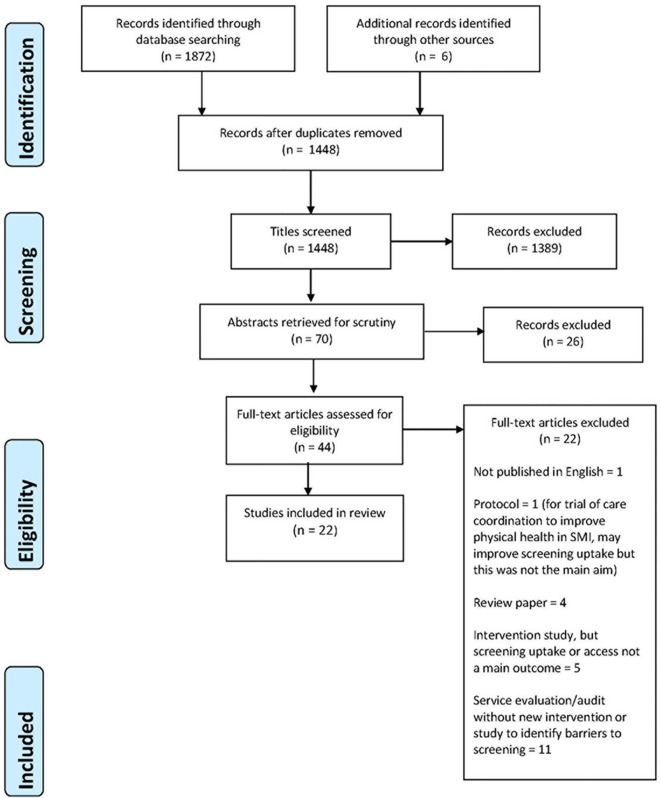
A systematic search identified 1448 studies, of which 22 met the inclusion criteria. Studies were from Australia (n=3), Canada (n=1), Hong Kong (n=1), UK (n=11) and USA (n=6). The studies focused on breast cancer screening, infection preventive services and metabolic syndrome (MS) screening by targeting MS-related risk factors. The interventions could be divided into those focusing on (1) health service delivery changes (12 studies), using quality improvement, randomised controlled trial, cluster randomised feasibility trial, retrospective audit, cross-sectional study and satisfaction survey designs and (2) tests of tools designed to facilitate screening (10 studies) using consecutive case series, quality improvement, retrospective evaluation and pre-post audit study designs. All studies reported improved uptake of screening, or that patients had received screening they would not have had without the intervention. No estimation of overall effect size was possible due to heterogeneity in study design and quality. The following factors may contribute to intervention success: staff and stakeholder involvement in screening, staff flexibility when taking physical measurements (eg, using adapted equipment), strong links with primary care and having a pharmacist on the ward.
A range of interventions may be effective, but better quality research is needed to determine any effect size. Researchers should consider how interventions may work when designing and testing them in order to target better the specific needs of this population in the most appropriate setting. Behaviour-change interventions to reduce identified barriers of patient and health professional resistance to screening this population are required. Resource constraints, clarity over professional roles and better coordination with primary care need to be addressed.
识别并评估旨在提高患有严重精神疾病的成年人进行身体健康筛查的接受度或可及性的干预措施;探究干预措施可能有效的原因。
实证性综述。
初级、二级和三级医疗保健机构。
系统检索共识别出1448项研究,其中22项符合纳入标准。这些研究来自澳大利亚(n = 3)、加拿大(n = 1)、中国香港(n = 1)、英国(n = 11)和美国(n = 6)。这些研究通过针对与代谢综合征相关的风险因素,聚焦于乳腺癌筛查、感染预防服务和代谢综合征(MS)筛查。干预措施可分为两类:(1)关注卫生服务提供变化的措施(12项研究),采用了质量改进、随机对照试验、整群随机可行性试验、回顾性审计、横断面研究和满意度调查设计;(2)旨在促进筛查的工具测试(10项研究),采用了连续病例系列、质量改进、回顾性评估和前后审计研究设计。所有研究均报告筛查接受度有所提高,或者患者接受了在无干预情况下本不会接受的筛查。由于研究设计和质量的异质性,无法估计总体效应大小。以下因素可能有助于干预成功:工作人员和利益相关者参与筛查、工作人员在进行身体测量时的灵活性(如使用适配设备)、与初级保健的紧密联系以及病房配备药剂师。
一系列干预措施可能有效,但需要开展质量更高的研究来确定效应大小。研究人员在设计和测试干预措施时应考虑其作用机制,以便在最合适的环境中更好地满足该人群的特定需求。需要采取行为改变干预措施来减少已识别出的患者和卫生专业人员抵制对该人群进行筛查的障碍。资源限制、专业角色的明确以及与初级保健的更好协调需要得到解决。