Joint Program on the Science and Policy of Global Change, Massachusetts Institute of Technology, 77 Massachusetts Ave, Cambridge, MA, 02139, USA.
University of North Carolina, Asheville, One University Heights, Asheville, NC, 28804, USA.
Nat Commun. 2018 Feb 13;9(1):660. doi: 10.1038/s41467-018-02984-9.
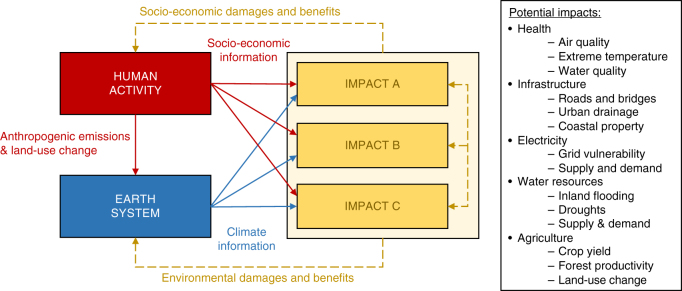
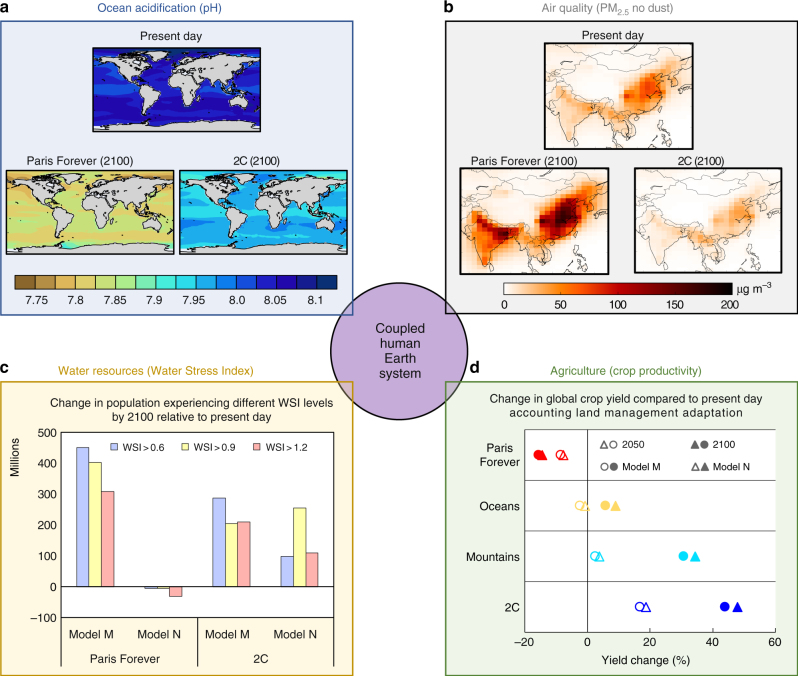
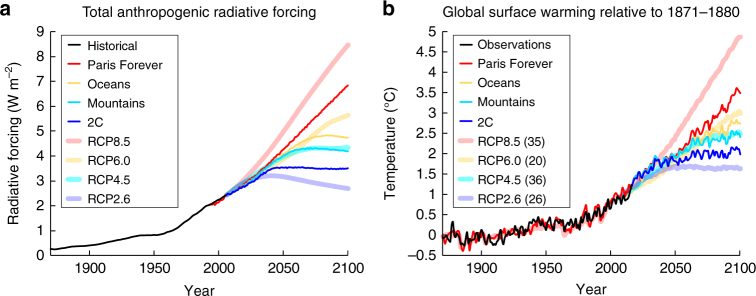
Efforts to estimate the physical and economic impacts of future climate change face substantial challenges. To enrich the currently popular approaches to impact analysis-which involve evaluation of a damage function or multi-model comparisons based on a limited number of standardized scenarios-we propose integrating a geospatially resolved physical representation of impacts into a coupled human-Earth system modeling framework. Large internationally coordinated exercises cannot easily respond to new policy targets and the implementation of standard scenarios across models, institutions and research communities can yield inconsistent estimates. Here, we argue for a shift toward the use of a self-consistent integrated modeling framework to assess climate impacts, and discuss ways the integrated assessment modeling community can move in this direction. We then demonstrate the capabilities of such a modeling framework by conducting a multi-sectoral assessment of climate impacts under a range of consistent and integrated economic and climate scenarios that are responsive to new policies and business expectations.
努力估计未来气候变化的物理和经济影响面临着巨大的挑战。为了丰富目前流行的影响分析方法,这些方法涉及对损害函数的评估或基于有限数量的标准化情景的多模型比较,我们建议将影响的地理空间分辨率物理表示集成到耦合的人类-地球系统建模框架中。大型国际协调工作不容易响应新的政策目标,而且模型、机构和研究界之间的标准情景的实施可能会产生不一致的估计。在这里,我们主张转向使用一致的综合建模框架来评估气候影响,并讨论综合评估建模界如何朝着这个方向发展。然后,我们通过在一系列一致和综合的经济和气候情景下进行多部门气候影响评估来展示这种建模框架的能力,这些情景对新政策和商业预期做出了响应。