West J Jason, Smith Steven J, Silva Raquel A, Naik Vaishali, Zhang Yuqiang, Adelman Zachariah, Fry Meridith M, Anenberg Susan, Horowitz Larry W, Lamarque Jean-Francois
University of North Carolina at Chapel Hill, Chapel Hill, NC 27599, USA.
Joint Global Change Research Institute, Pacific Northwest National Laboratory, College Park, MD 20740, USA.
Nat Clim Chang. 2013 Oct 1;3(10):885-889. doi: 10.1038/NCLIMATE2009.
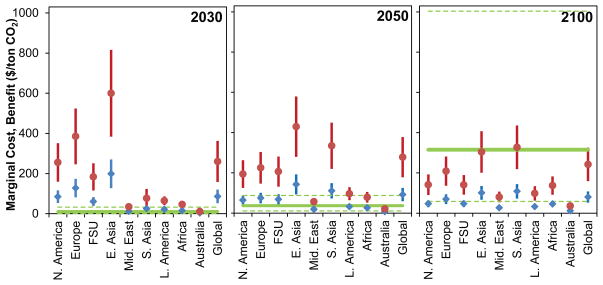
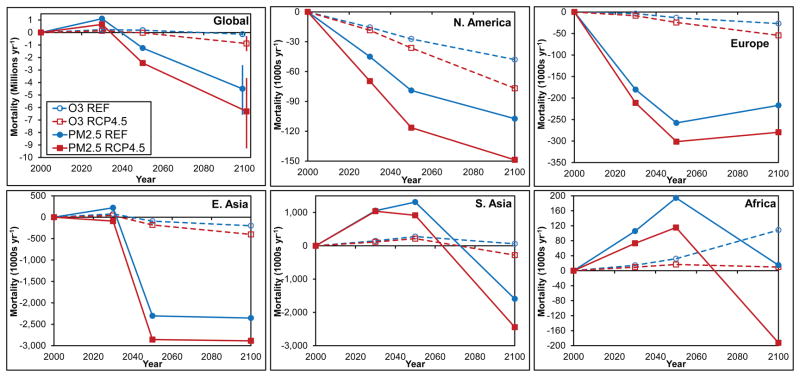
Actions to reduce greenhouse gas (GHG) emissions often reduce co-emitted air pollutants, bringing co-benefits for air quality and human health. Past studies typically evaluated near-term and local co-benefits, neglecting the long-range transport of air pollutants, long-term demographic changes, and the influence of climate change on air quality. Here we simulate the co-benefits of global GHG reductions on air quality and human health using a global atmospheric model and consistent future scenarios, via two mechanisms: a) reducing co-emitted air pollutants, and b) slowing climate change and its effect on air quality. We use new relationships between chronic mortality and exposure to fine particulate matter and ozone, global modeling methods, and new future scenarios. Relative to a reference scenario, global GHG mitigation avoids 0.5±0.2, 1.3±0.5, and 2.2±0.8 million premature deaths in 2030, 2050, and 2100. Global average marginal co-benefits of avoided mortality are $50-380 (ton CO), which exceed previous estimates, exceed marginal abatement costs in 2030 and 2050, and are within the low range of costs in 2100. East Asian co-benefits are 10-70 times the marginal cost in 2030. Air quality and health co-benefits, especially as they are mainly local and near-term, provide strong additional motivation for transitioning to a low-carbon future.
减少温室气体(GHG)排放的行动通常会减少同时排放的空气污染物,为空气质量和人类健康带来协同效益。以往的研究通常评估近期和局部的协同效益,而忽略了空气污染物的长距离传输、长期人口结构变化以及气候变化对空气质量的影响。在此,我们使用全球大气模型和一致的未来情景,通过两种机制模拟全球减少温室气体排放对空气质量和人类健康的协同效益:a)减少同时排放的空气污染物;b)减缓气候变化及其对空气质量的影响。我们采用了慢性死亡率与细颗粒物和臭氧暴露之间的新关系、全球建模方法以及新的未来情景。相对于参考情景,全球温室气体减排在2030年、2050年和2100年分别避免了0.5±0.2、13±0.5和2.2±0.8百万例过早死亡。避免死亡的全球平均边际协同效益为50 - 380美元/吨二氧化碳,超过了先前的估计,在2030年和2050年超过了边际减排成本,在2100年处于成本的较低范围。东亚地区的协同效益在2030年是边际成本的10 - 70倍。空气质量和健康协同效益,尤其是因为它们主要是局部和近期的效益,为向低碳未来转型提供了强大的额外动力。