Wijeratne D Thiwanka, Lajkosz Katherine, Brogly Susan B, Lougheed M Diane, Jiang Li, Housin Ahmad, Barber David, Johnson Ana, Doliszny Katharine M, Archer Stephen L
From the Department of Medicine (D.T.W., M.D.L., A.H., D.B., K.M.D., S.L.A.), Institute for Clinical Evaluative Sciences Queen's (D.T.W., K.L., S.B.B., M.D.L., L.J., A.J.), Department of Surgery (S.B.B.), and Department of Public Health Sciences (M.D.L., A.J.), Queen's University, Kingston, ON, Canada.
Circ Cardiovasc Qual Outcomes. 2018 Feb;11(2):e003973. doi: 10.1161/CIRCOUTCOMES.117.003973.
The World Health Organization recognizes 5 groups of pulmonary hypertension (PH), categorized by pathogenesis or comorbidity: 1-pulmonary arterial hypertension 2-left-heart disease, 3-lung disease and hypoxia 4-chronic thromboembolic disease, and 5-miscellaneous. The epidemiology of PH, apart from group 1, is largely unknown.
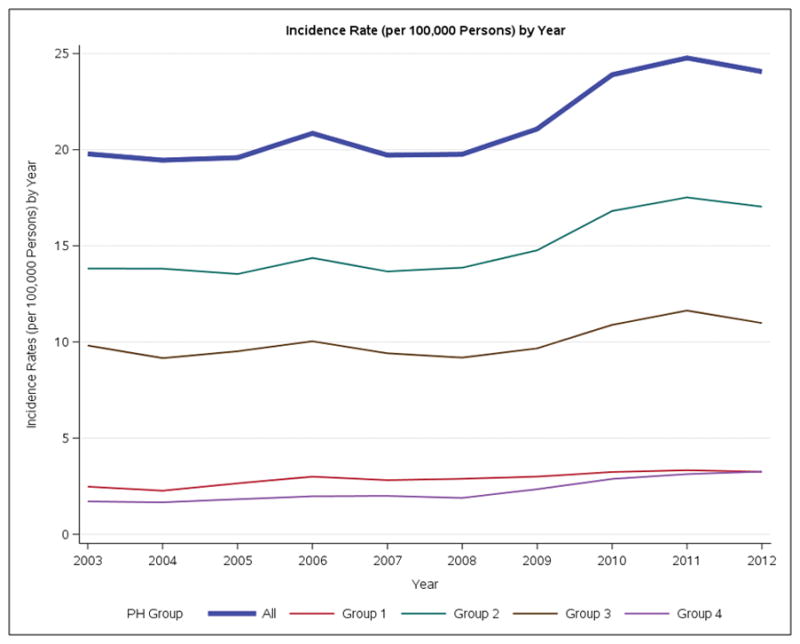
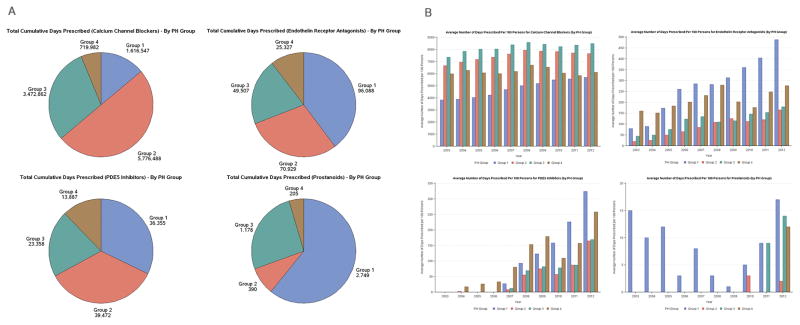
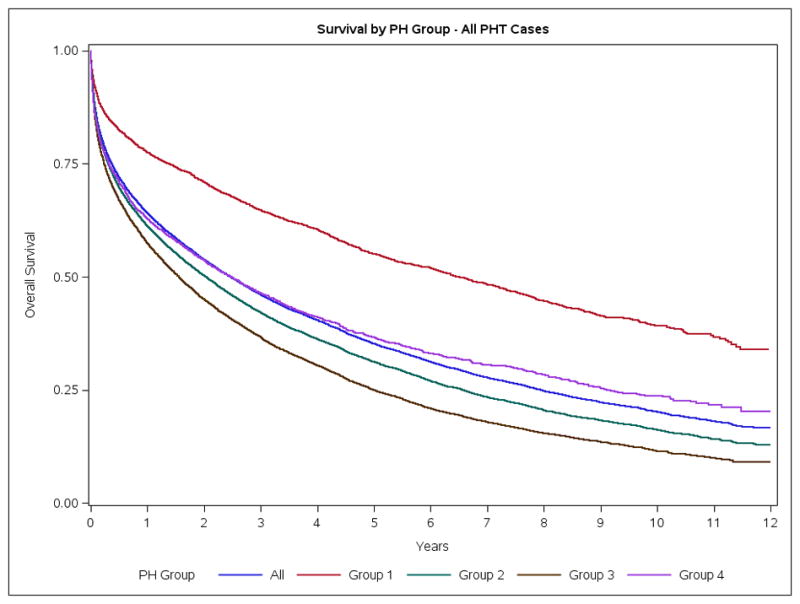
We describe incidence, prevalence, comorbidities, mortality and prescribing patterns for groups 1 to 4 PH from 1993 to 2012. Case definitions are based on hospitalizations and emergency department visits, using the Institute for Clinical Evaluative Sciences data, which comprises linked databases of universal coverage health service records for Ontario residents. This cohort included 50 529 patients with PH. The annual incidence of adult PH increased from 2003 to 2012 from 24.1 to 28.7 cases/100 000 population and the annual prevalence from 1993 to 2012 from 99.8 to 127.3 cases/100 000 population, respectively. The most common form of adult PH was group 2, alone (34.2%) or combined with group 3 PH (29.3%). A diagnosis of PH increased the 1-year standardized mortality ratio 7.2-fold. Mortality in adults with PH was 13.0%, 36.4%, and 62.4%, at 30 days, 1 year, and 5 years, respectively. Mortality was highest in groups 2 and 3 and lowest in group 1. PH was present in only 3.6% of people with left heart disease, 0.7% with lung disease, and 1.4% with thromboembolic disease, suggesting that PH is a relatively rare complication of these common diseases. Children (age<16 years) accounted for 3.6% of the cohort. In children group 1 PH was most common (65.2%), and 5-year mortality was lower (21.4%) than in adults. Group 1-specific PH therapies were increasingly prescribed over time and paradoxically were often used in patients who seemed to have group 2, PH based on diagnostic codes indicating left heart disease.
The incidence and prevalence of adult PH are increasing. Groups 2 and 3 are the most common and lethal forms of PH. This study identifies an emerging epidemic of PH that likely has substantial adverse health and economic implications.
世界卫生组织根据发病机制或合并症将肺动脉高压(PH)分为5组:1. 动脉性肺动脉高压;2. 左心疾病;3. 肺部疾病和低氧血症;4. 慢性血栓栓塞性疾病;5. 其他。除第1组外,PH的流行病学情况在很大程度上尚不明确。
我们描述了1993年至2012年第1至4组PH的发病率、患病率、合并症、死亡率及处方模式。病例定义基于住院和急诊科就诊情况,使用临床评估科学研究所的数据,该数据包含安大略省居民全面覆盖的健康服务记录的关联数据库。该队列包括50529例PH患者。2003年至2012年,成人PH的年发病率从每10万人口24.1例增至28.7例,1993年至2012年的年患病率从每10万人口99.8例增至127.3例。成人PH最常见的类型是第2组,单独存在(34.2%)或与第3组PH合并存在(29.3%)。PH诊断使1年标准化死亡比增加7.2倍。PH成人患者在30天、1年和5年时的死亡率分别为13.0%、36.4%和62.4%。第2组和第3组的死亡率最高,第1组最低。在左心疾病患者中PH仅占3.6%,肺部疾病患者中占0.7%,血栓栓塞性疾病患者中占1.4%,这表明PH是这些常见疾病相对罕见的并发症。儿童(年龄<16岁)占该队列的3.6%。在儿童中,第1组PH最常见(65.2%),5年死亡率低于成人(21.4%)。随着时间推移,第1组特异性PH治疗药物的处方量越来越多,而且矛盾的是,这些药物常常用于那些根据诊断编码提示左心疾病而看似患有第2组PH的患者。
成人PH的发病率和患病率正在上升。第2组和第3组是PH最常见和最致命的类型。本研究确定了PH正在出现的流行趋势,这可能对健康和经济产生重大不利影响。