Henz Diana, John Alexander, Merz Christian, Schöllhorn Wolfgang I
Institute of Sport Science, University of Mainz, Mainz, Germany.
Front Hum Neurosci. 2018 Jan 31;12:19. doi: 10.3389/fnhum.2018.00019. eCollection 2018.
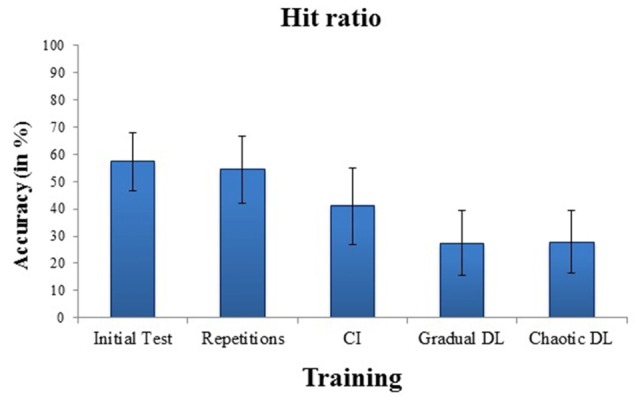
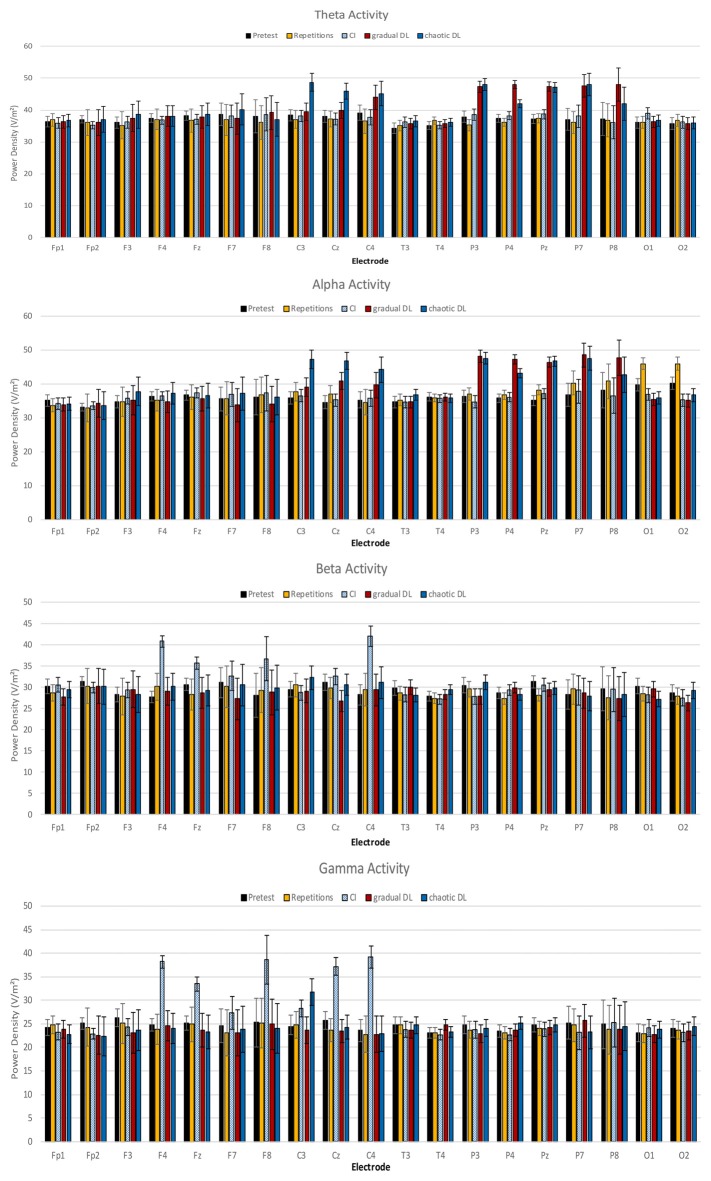
A large body of research has shown superior learning rates in variable practice compared to repetitive practice. More specifically, this has been demonstrated in the contextual interference (CI) and in the differential learning (DL) approach that are both representatives of variable practice. Behavioral studies have indicate different learning processes in CI and DL. Aim of the present study was to examine immediate post-task effects on electroencephalographic (EEG) brain activation patterns after CI and DL protocols that reveal underlying neural processes at the early stage of motor consolidation. Additionally, we tested two DL protocols (gradual DL, chaotic DL) to examine the effect of different degrees of stochastic fluctuations within the DL approach with a low degree of fluctuations in gradual DL and a high degree of fluctuations in chaotic DL. Twenty-two subjects performed badminton serves according to three variable practice protocols (CI, gradual DL, chaotic DL), and a repetitive learning protocol in a within-subjects design. Spontaneous EEG activity was measured before, and immediately after each 20-min practice session from 19 electrodes. Results showed distinguishable neural processes after CI, DL, and repetitive learning. Increases in EEG theta and alpha power were obtained in somatosensory regions (electrodes P3, P7, Pz, P4, P8) in both DL conditions compared to CI, and repetitive learning. Increases in theta and alpha activity in motor areas (electrodes C3, Cz, C4) were found after chaotic DL compared to gradual DL, and CI. Anterior areas (electrodes F3, F7, Fz, F4, F8) showed increased activity in the beta and gamma bands after CI. Alpha activity was increased in occipital areas (electrodes O1, O2) after repetitive learning. Post-task EEG brain activation patterns suggest that DL stimulates the somatosensory and motor system, and engages more regions of the cortex than repetitive learning due to a tighter stimulation of the motor and somatosensory system during DL practice. CI seems to activate specifically executively controlled processing in anterior brain areas. We discuss the obtained patterns of post-training EEG traces as evidence for different underlying neural processes in CI, DL, and repetitive learning at the early stage of motor learning.
大量研究表明,与重复练习相比,可变练习具有更高的学习效率。更具体地说,这在情境干扰(CI)和差异学习(DL)方法中得到了证明,这两种方法都是可变练习的代表。行为研究表明CI和DL中的学习过程不同。本研究的目的是检查在CI和DL协议后,任务后对脑电图(EEG)大脑激活模式的即时影响,这些协议揭示了运动巩固早期的潜在神经过程。此外,我们测试了两种DL协议(渐进式DL、混沌式DL),以研究DL方法中不同程度的随机波动的影响,渐进式DL中的波动程度较低,混沌式DL中的波动程度较高。22名受试者在受试者内设计中根据三种可变练习协议(CI、渐进式DL、混沌式DL)和重复学习协议进行羽毛球发球。在每次20分钟的练习前和练习后,立即从19个电极测量自发脑电图活动。结果显示,CI、DL和重复学习后有明显的神经过程。与CI和重复学习相比,在两种DL条件下,体感区域(电极P3、P7、Pz、P4、P8)的脑电图θ波和α波功率增加。与渐进式DL和CI相比,混沌式DL后运动区域(电极C3、Cz、C4)的θ波和α波活动增加。CI后,前部区域(电极F3、F7、Fz、F4、F8)的β波和γ波带活动增加。重复学习后,枕叶区域(电极O1、O2)的α波活动增加。任务后脑电图大脑激活模式表明,DL刺激体感和运动系统,并且由于在DL练习期间对运动和体感系统的更紧密刺激,比重复学习涉及更多的皮质区域。CI似乎特别激活前脑区域的执行控制处理。我们将获得的训练后脑电图痕迹模式作为CI、DL和运动学习早期重复学习中不同潜在神经过程的证据进行讨论。