Li Mengwei, Chen Yuhong, Chen Xiaoxiao, Zhu Wenqing, Chen Xueli, Wang Xiaolei, Fang Yuan, Kong Xiangmei, Dai Yi, Chen Junyi, Sun Xinghuai
Department of Ophthalmology and Visual Science, Eye, Ear, Nose and Throat Hospital, Shanghai Medical College of Fudan University, Shanghai, China.
Key Laboratory of Myopia, Ministry of Health (Fudan University) and Key Laboratory of Visual Impairment and Restoration of Shanghai, Shanghai, China.
PLoS One. 2018 Feb 15;13(2):e0193006. doi: 10.1371/journal.pone.0193006. eCollection 2018.
To compare various biometric parameters between fellow eyes of acute primary angle closure (glaucoma) [APAC(G)] and fellow eyes of chronic primary angle closure (glaucoma) [CPAC(G)].
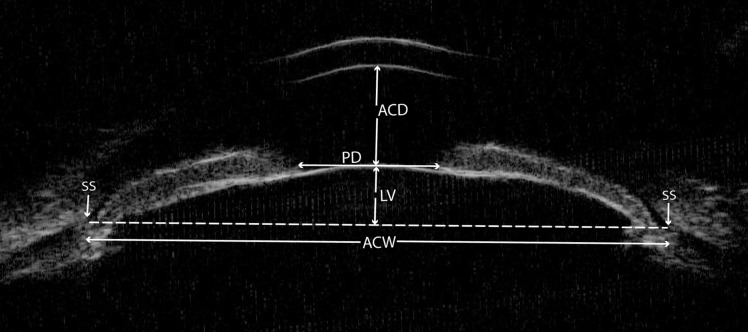
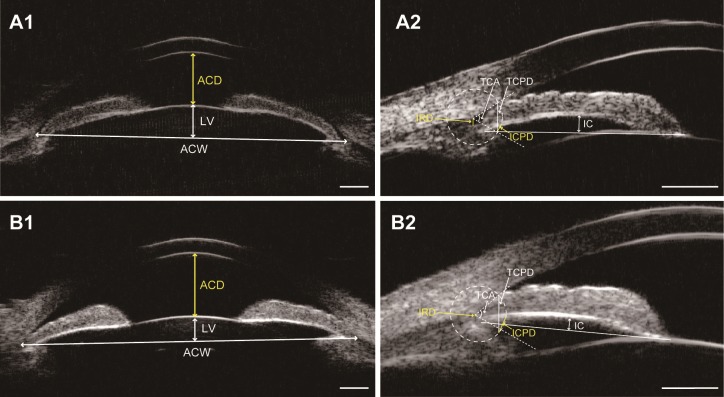
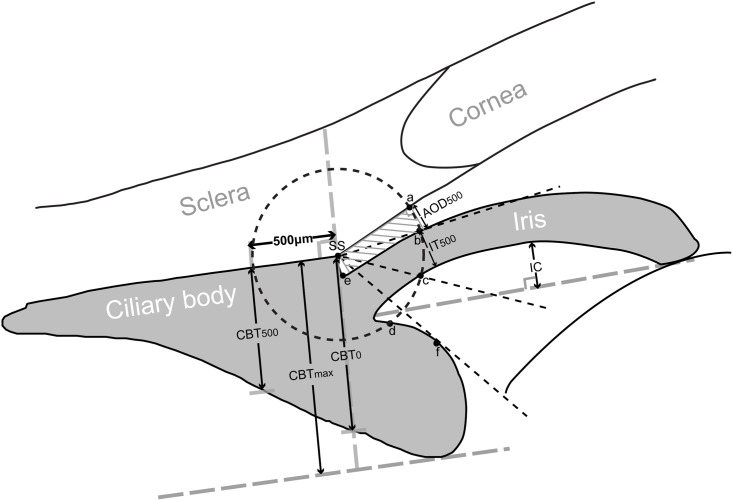
Ultrasound biomicroscopy examinations were performed on 47 patients with unilateral APAC(G) and 41 patients with asymmetric CPAC(G) before laser peripheral iridotomy and pilocarpine treatment. Anterior chamber depth and width (ACD and ACW), lens vault (LV), iris curvature (IC), iris root distance (IRD), trabecular-ciliary process distance (TCPD), iris-ciliary process distance (ICPD), trabecular-ciliary angle (TCA), and other biometric parameters were compared between fellow eyes of APAC(G) and fellow eyes of CAPC(G).
Compared with fellow eyes of CPAC(G), fellow eyes of APAC(G) had smaller ACD (P < 0.001), ACW (P = 0.007), TCPD (P = 0.016), ICPD (P = 0.008), and TCA (P = 0.006), as well as larger LV (P = 0.002), IC (P = 0.012), and IRD (P = 0.003). On multivariate logistic regression analyses, a 0.1 mm decrease in ACD (odds ratio [OR]: 0.705, 95%CI: 0.564-0.880, P = 0.002), ICPD (OR: 0.557, 95%CI: 0.335-0.925, P = 0.024), and a 0.1 mm increase in IRD (OR: 2.707, 95%CI: 1.025-7.149, P = 0.045), was significantly associated with occurrence of acute angle closures.
Fellow eyes of APAC(G) had smaller anterior segment dimensions, higher LV, more posterior iris insertion, greater IC, and more anteriorly rotated ciliary body compared with fellow eyes of CPAC(G). ACD, ICPD, and IRD were the three most important parameters that distinguish eyes predisposed to APAC(G) or CPAC(G).
比较急性原发性闭角型青光眼[APAC(G)]患眼的对侧眼与慢性原发性闭角型青光眼[CPAC(G)]患眼的对侧眼之间的各种生物测量参数。
对47例单侧APAC(G)患者和41例不对称CPAC(G)患者在进行激光周边虹膜切开术和毛果芸香碱治疗前进行超声生物显微镜检查。比较APAC(G)患眼的对侧眼与CAPC(G)患眼的对侧眼前房深度和宽度(ACD和ACW)、晶状体拱高(LV)、虹膜曲率(IC)、虹膜根部距离(IRD)、小梁-睫状体距离(TCPD)、虹膜-睫状体距离(ICPD)、小梁-睫状体角(TCA)及其他生物测量参数。
与CPAC(G)患眼的对侧眼相比,APAC(G)患眼的对侧眼ACD更小(P<0.001)、ACW更小(P = 0.007)、TCPD更小(P = 0.016)、ICPD更小(P = 0.008)、TCA更小(P = 0.006),而LV更大(P = 0.002)、IC更大(P = 0.012)、IRD更大(P = 0.003)。多因素逻辑回归分析显示,ACD每减少0.1mm(比值比[OR]:0.705,95%可信区间[CI]:0.564 - 0.880,P = 0.002)、ICPD每减少0.1mm(OR:0.557,95%CI:0.335 - 0.925,P = 0.024)以及IRD每增加0.1mm(OR:2.707,CI:1.025 - 7.149,P = 0.045)与急性房角关闭的发生显著相关。
与CPAC(G)患眼的对侧眼相比,APAC(G)患眼的对侧眼前节尺寸更小、LV更高、虹膜插入更靠后、IC更大且睫状体旋转更靠前。ACD、ICPD和IRD是区分易患APAC(G)或CPAC(G)眼的三个最重要参数。