Spackenkill High School, 112 Spackenkill Rd., Poughkeepsie, NY, 12603, USA.
Georgia Institute of Technology, School of Civil and Environmental Engineering, Atlanta, GA, 30332, USA.
BMC Ecol. 2018 Feb 15;18(1):7. doi: 10.1186/s12898-018-0163-2.
With the resurgence of tick-borne diseases such as Lyme disease and the emergence of new tick-borne pathogens such as Powassan virus, understanding what distinguishes vectors from non-vectors, and predicting undiscovered tick vectors is a crucial step towards mitigating disease risk in humans. We aimed to identify intrinsic traits that predict which Ixodes tick species are confirmed or strongly suspected to be vectors of zoonotic pathogens.
We focused on the well-studied tick genus Ixodes from which many species are known to transmit zoonotic diseases to humans. We apply generalized boosted regression to interrogate over 90 features for over 240 species of Ixodes ticks to learn what intrinsic features distinguish zoonotic vectors from non-vector species. In addition to better understanding the biological underpinnings of tick vectorial capacity, the model generates a per species probability of being a zoonotic vector on the basis of intrinsic biological similarity with known Ixodes vector species.
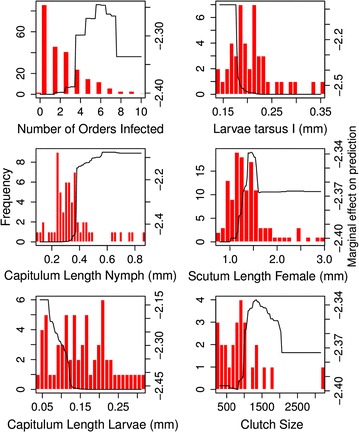
Our model predicted vector status with over 91% accuracy, and identified 14 Ixodes species with high probabilities (80%) of transmitting infections from animal hosts to humans on the basis of their traits. Distinguishing characteristics of zoonotic tick vectors of Ixodes tick species include several anatomical structures that influence host seeking behavior and blood-feeding efficiency from a greater diversity of host species compared to non-vectors.
Overall, these results suggest that zoonotic tick vectors are most likely to be those species where adult females hold a fecundity advantage by producing more eggs per clutch, which develop into larvae that feed on a greater diversity of host species compared to non-vector species. These larvae develop into nymphs whose anatomy are well suited for more efficient and longer feeding times on soft-bodied hosts compared to non-vectors, leading to larger adult females with greater fecundity. In addition to identifying novel, testable hypotheses about intrinsic features driving vectorial capacity across Ixodes tick species, our model identifies particular Ixodes species with the highest probability of carrying zoonotic diseases, offering specific targets for increased zoonotic investigation and surveillance.
随着莱姆病等蜱传疾病的死灰复燃,以及 Powassan 病毒等新的蜱传病原体的出现,了解区分媒介和非媒介的内在特征,预测未发现的蜱媒介,是减轻人类疾病风险的关键步骤。我们旨在确定哪些内在特征可预测伊蚊属的哪些蜱种被证实或强烈怀疑是人类病原体的媒介。
我们专注于研究研究充分的伊蚊属,许多已知该属的蜱种会将人类病原体传播给人类。我们应用广义增强回归分析来研究超过 240 种伊蚊属蜱种的 90 多种特征,以了解区分媒介种和非媒介种的内在特征。除了更好地了解蜱媒介能力的生物学基础外,该模型还根据与已知伊蚊媒介种的内在生物学相似性,为每个物种成为人类病原体媒介的可能性生成一个物种概率。
我们的模型预测媒介状态的准确率超过 91%,并根据其特征确定了 14 种伊蚊属蜱种具有很高的(80%)从动物宿主向人类传播感染的可能性。与非媒介种相比,伊蚊属蜱种的媒介特征包括影响宿主寻找行为和从更多宿主物种吸血效率的几个解剖结构。
总体而言,这些结果表明,伊蚊属的媒介种最有可能是那些成年雌性通过每窝产更多卵而具有繁殖优势的物种,这些卵发育成幼虫,与非媒介种相比,它们可以从更多宿主物种中取食。这些幼虫发育成若虫,其解剖结构非常适合在柔软的宿主上进行更高效和更长时间的取食,从而导致具有更大繁殖力的成年雌性。除了确定关于伊蚊属蜱种媒介能力的内在特征的新的、可检验的假说外,我们的模型还确定了具有携带人类病原体的最高概率的特定伊蚊属物种,为增加对人类病原体的调查和监测提供了具体目标。