Engström Henrik, Andersson Hagiwara Magnus, Backlund Per, Lebram Mikael, Lundberg Lars, Johannesson Mikael, Sterner Anders, Maurin Söderholm Hanna
1School of Informatics, University of Skövde, Box 408, 541 28 Skövde, Sweden.
2Centre for Prehospital Research, Faculty of Caring Science, Work Life and Social Welfare, University of Borås, 501 90 Borås, Sweden.
Adv Simul (Lond). 2016 Mar 8;1:8. doi: 10.1186/s41077-016-0009-y. eCollection 2016.
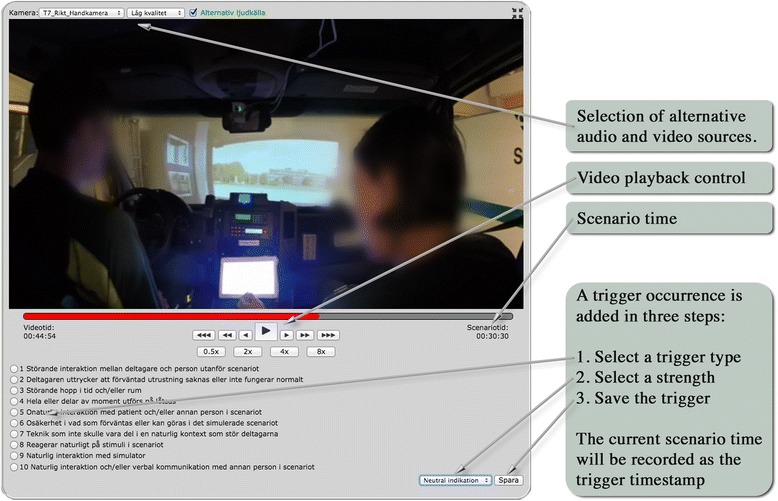
The aim of this paper is to explore how contextualization of a healthcare simulation scenarios impacts immersion, by using a novel objective instrument, the Immersion Score Rating Instrument. This instrument consists of 10 triggers that indicate reduced or enhanced immersion among participants in a simulation scenario. Triggers refer to events such as jumps in time or space (sign of reduced immersion) and natural interaction with the manikin (sign of enhanced immersion) and can be used to calculate an immersion score.
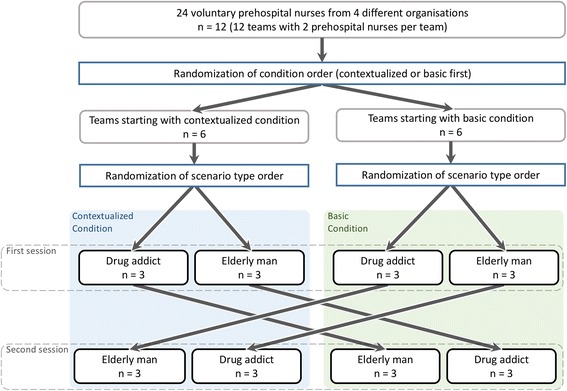
An experiment using a randomized controlled crossover design was conducted to compare immersion between two simulation training conditions for prehospital care: one basic and one contextualized. The Immersion Score Rating Instrument was used to compare the total immersion score for the whole scenario, the immersion score for individual mission phases, and to analyze differences in trigger occurrences. A paired test was used to test for significance.
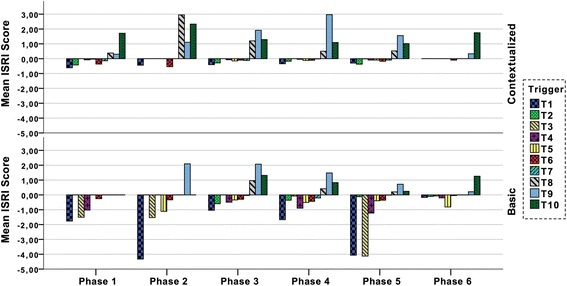
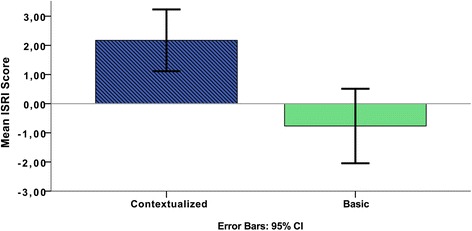
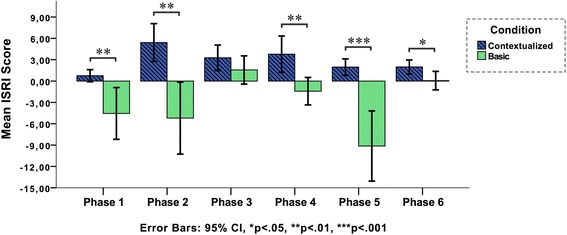
The comparison shows that the overall immersion score for the simulation was higher in the contextualized condition. The average immersion score was 2.17 (sd = 1.67) in the contextualized condition and -0.77 (sd = 2.01) in the basic condition ( < .001). The immersion score was significantly higher in the contextualized condition in five out of six mission phases. Events that might be disruptive for the simulation participants' immersion, such as interventions of the instructor and illogical jumps in time or space, are present to a higher degree in the basic scenario condition; while events that signal enhanced immersion, such as natural interaction with the manikin, are more frequently observed in the contextualized condition.
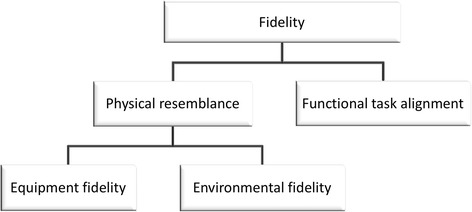
The results suggest that contextualization of simulation training with respect to increased equipment and environmental fidelity as well as functional task alignment might affect immersion positively and thus contribute to an improved training experience.
本文旨在通过使用一种新颖的客观工具——沉浸感评分工具,探讨医疗模拟场景的情境化如何影响沉浸感。该工具由10个触发因素组成,这些因素表明模拟场景中参与者的沉浸感降低或增强。触发因素包括时间或空间跳跃(沉浸感降低的迹象)以及与人体模型的自然互动(沉浸感增强的迹象)等事件,可用于计算沉浸感得分。
采用随机对照交叉设计进行实验,比较两种院前护理模拟训练条件下的沉浸感:一种是基础条件,一种是情境化条件。使用沉浸感评分工具比较整个场景的总沉浸感得分、各个任务阶段的沉浸感得分,并分析触发因素出现情况的差异。采用配对t检验进行显著性检验。
比较表明,情境化条件下模拟的总体沉浸感得分更高。情境化条件下的平均沉浸感得分为2.17(标准差=1.67),基础条件下为-0.77(标准差=2.01)(P<0.001)。在六个任务阶段中的五个阶段,情境化条件下的沉浸感得分显著更高。可能干扰模拟参与者沉浸感的事件,如教员的干预以及时间或空间上的不合逻辑跳跃,在基础场景条件下出现的程度更高;而表明沉浸感增强的事件,如与人体模型的自然互动,在情境化条件下更频繁地被观察到。
结果表明,模拟训练在增加设备和环境逼真度以及功能任务匹配方面的情境化可能会对沉浸感产生积极影响,从而有助于改善训练体验。