Ushie Boniface A, Izugbara Chimaraoke O, Mutua Michael M, Kabiru Caroline W
African Population and Health Research Center, 2nd Floor APHRC Campus, Manga Close Off Kirawa Road, P.O. Box 10787-00100, Nairobi, Kenya.
School of Public Health, University of the Witwatersrand, Johannesburg, South Africa.
BMC Womens Health. 2018 Feb 17;18(1):41. doi: 10.1186/s12905-018-0521-4.
Complications of unsafe abortion are a leading cause of maternal mortality in sub-Saharan Africa. Adolescents and young women are disproportionately represented among those at risk of these complications. Currently, we know little about the factors associated with young women's timing of abortion. This study examined the timing of abortion as well as factors influencing it among adolescents and young women aged 12-24 years who sought post-abortion care (PAC) in health facilities in Kenya.
We draw on data from a cross-sectional study on the magnitude and incidence of induced abortion in Kenya conducted in 2012. The study surveyed women presenting with a diagnosis of incomplete, inevitable, missed, complete, or septic abortion over a one-month data collection period in 328 health facilities (levels 2-6). Survey data, specifically, from adolescents and young women were analyzed to examine their characteristics, the timing of abortion, and the factors associated with the timing of abortion.
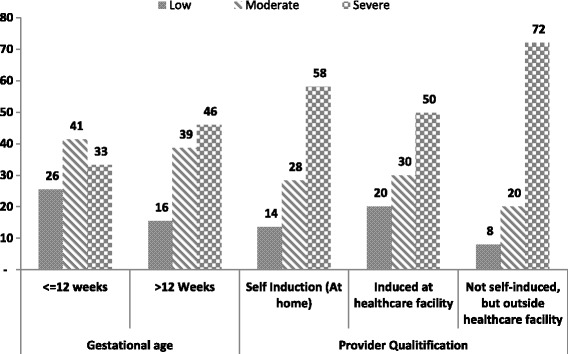
One thousand one hundred forty-five adolescents and young women presented for PAC during the data collection period. Eight percent of the women reported a previous induced abortion and 78% were not using a modern method of contraception about the time of conception. Thirty-nine percent of the index abortions occurred after 12 weeks of gestation. A greater proportion of women presenting with late abortions (more than 12 weeks gestational age) (46%) than those presenting with early abortions (33%) presented with severe complications. Controlling for socio-demographic and reproductive history, timing of abortion was significantly associated with place of residence (marginal), education, parity, clinical stage of abortion and level of severity.
Late-term abortions were substantial, and may have contributed substantially to the high proportion of women with post-abortion complications. Efforts to reduce the severity of abortion-related morbidities and mortality must target young women, particularly those living in rural and other remote areas. Interventions to reduce unintended pregnancies in this population are also urgently needed to improve early pregnancy detection and timely care seeking.
不安全堕胎的并发症是撒哈拉以南非洲孕产妇死亡的主要原因。在面临这些并发症风险的人群中,青少年和年轻女性的占比过高。目前,我们对与年轻女性堕胎时机相关的因素知之甚少。本研究调查了在肯尼亚医疗机构寻求堕胎后护理(PAC)的12至24岁青少年和年轻女性的堕胎时机及其影响因素。
我们利用了2012年在肯尼亚进行的一项关于人工流产规模和发生率的横断面研究的数据。该研究在328家医疗机构(2 - 6级)进行了为期一个月的数据收集,调查了诊断为不全流产、难免流产、稽留流产、完全流产或感染性流产的女性。具体而言,对青少年和年轻女性的调查数据进行了分析,以研究她们的特征、堕胎时机以及与堕胎时机相关的因素。
在数据收集期间,有1145名青少年和年轻女性前来寻求堕胎后护理。8%的女性报告曾有过人工流产,78%的女性在受孕时未采用现代避孕方法。39%的本次堕胎发生在妊娠12周之后。与早期堕胎(孕周小于12周)的女性相比,晚期堕胎(孕周大于12周)的女性出现严重并发症的比例更高(46%对33%)。在控制了社会人口统计学和生殖史因素后,堕胎时机与居住地(边缘因素)教育程度、产次、流产临床分期和严重程度显著相关。
晚期堕胎情况严重,可能是导致堕胎后并发症女性比例居高不下的重要原因。降低与堕胎相关的发病率和死亡率的严重程度的努力必须以年轻女性为目标,特别是那些生活在农村和其他偏远地区的女性。迫切需要采取干预措施减少该人群的意外怀孕情况,以改善早期妊娠检测和及时就医。