Guttmacher Institute, 125 Maiden Lane, New York, NY 10038.
Makerere University School of Public Health, Mulago Hill Road, Kampala, Uganda.
Contraception. 2018 Dec;98(6):510-516. doi: 10.1016/j.contraception.2018.07.135. Epub 2018 Sep 11.
To provide the first estimate of adolescents' abortion incidence in Uganda and to assess differences in the abortion experiences and morbidities of adolescent and nonadolescent postabortion care (PAC) patients.
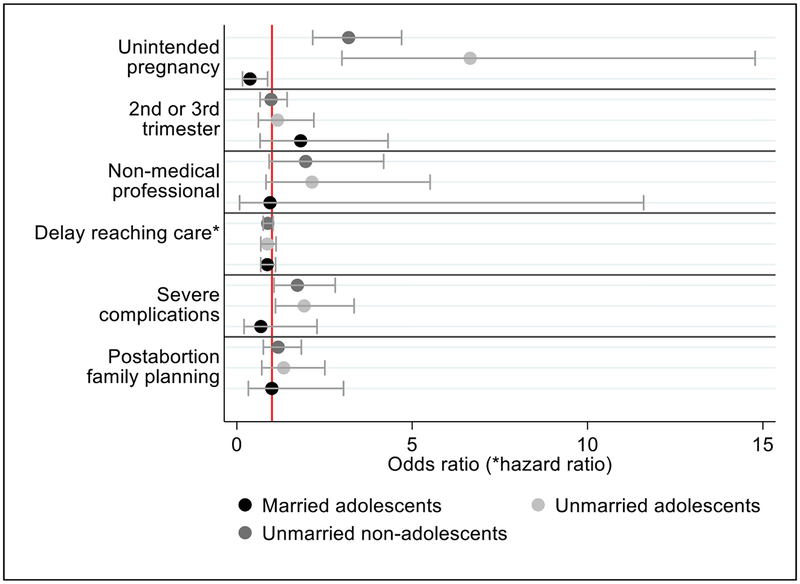
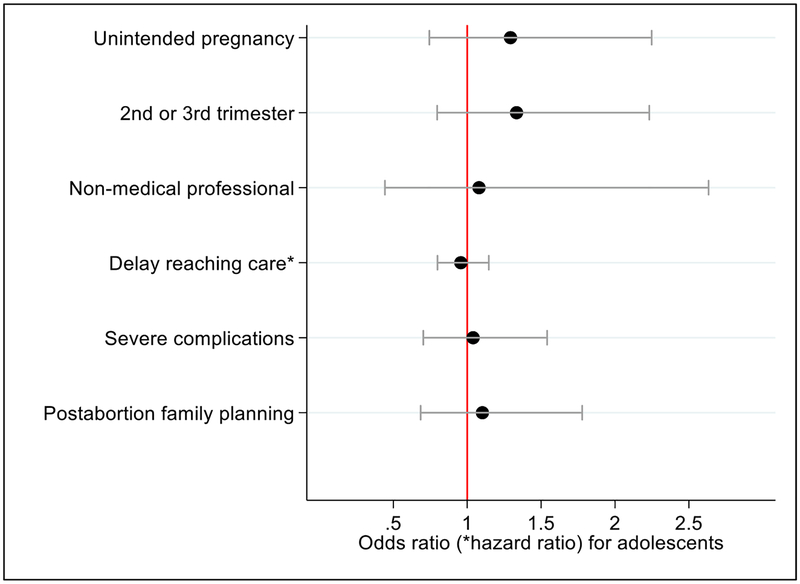
We used the age-specific Abortion Incidence Complications Method, drawing from three surveys conducted in Uganda in 2013: a nationally representative Health Facilities Survey (n=418), a Health Professionals Survey (n=147) and a Prospective Morbidity Survey of PAC patients (n=2169). Multivariable logistic and Cox proportional hazard models were used to compare adolescent and nonadolescent PAC patients on dimensions including pregnancy intention, gestational age, abortion safety, delays to care, severity of complications and receipt of postabortion family planning. We included an interaction term between adolescents and marital status to assess heterogeneity among adolescents.
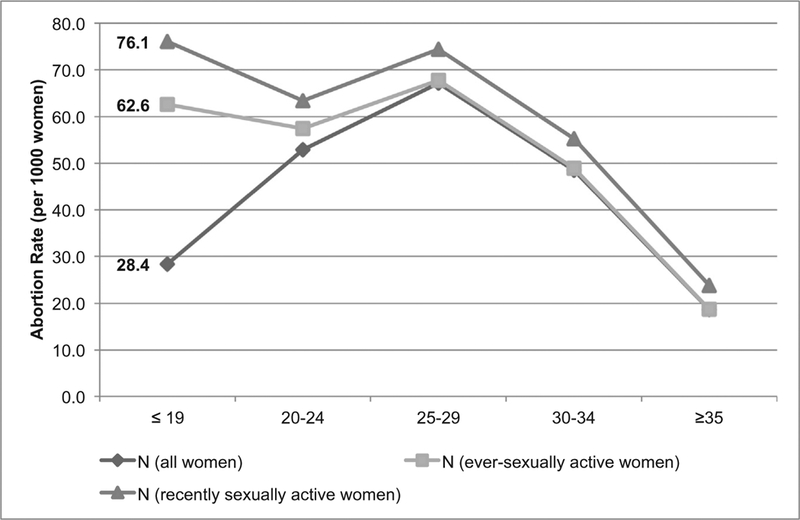
Adolescent women have the lowest abortion rate among women less than 35 years of age (28.4 abortions per 1000 women 15-19) but the highest rate among recently sexually active women (76.1 abortions per 1000 women 15-19). We do not find that adolescents face greater disadvantages in their abortion care experiences as compared to older women. However, unmarried PAC patients, both adolescent and nonadolescent, have higher odds of experiencing severe complications than nonadolescent married women.
The high abortion rate among sexually active adolescents highlights the critical need to improve adolescent family planning in Uganda. Interventions to prevent unintended pregnancy and to reduce unsafe abortion may be particularly important for unmarried adolescents. Rather than treating adolescents as a homogenous group, we need to understand how marriage and other social factors shape reproductive health outcomes.
This paper provides the first estimate of the adolescent abortion rate in Uganda. Studies of adolescent abortion and reproductive health must account for sexual activity and marital status. Further, interventions to address unintended pregnancy and unsafe abortion among unmarried women of all ages in Africa should be a priority.
提供乌干达青少年堕胎发生率的首次估计,并评估青少年和非青少年堕胎后护理(PAC)患者堕胎经历和发病情况的差异。
我们使用特定年龄的堕胎发生率并发症方法,从 2013 年在乌干达进行的三项调查中抽取数据:一项全国性的卫生机构调查(n=418)、一项卫生专业人员调查(n=147)和一项 PAC 患者前瞻性发病情况调查(n=2169)。使用多变量逻辑和 Cox 比例风险模型比较青少年和非青少年 PAC 患者在妊娠意图、妊娠龄、堕胎安全性、护理延迟、发病严重程度和堕胎后计划生育服务的获得等方面的情况。我们在青少年和婚姻状况之间加入了一个交互项,以评估青少年之间的异质性。
在 35 岁以下的女性中,青少年女性的堕胎率最低(15-19 岁女性每 1000 人中 28.4 例堕胎),但在最近有性行为的女性中,堕胎率最高(15-19 岁女性每 1000 人中 76.1 例堕胎)。我们发现,与年长女性相比,青少年在堕胎护理方面并没有面临更大的劣势。然而,未婚 PAC 患者,无论是青少年还是非青少年,与非青少年已婚女性相比,发生严重发病的几率更高。
性行为活跃的青少年堕胎率高,突显了乌干达迫切需要改善青少年计划生育服务。预防意外怀孕和减少不安全堕胎的干预措施对于未婚青少年可能尤为重要。我们不应将青少年视为同质群体,而应了解婚姻和其他社会因素如何影响生殖健康结果。
本文提供了乌干达青少年堕胎率的首次估计。研究青少年堕胎和生殖健康问题必须考虑到性行为和婚姻状况。此外,解决非洲所有年龄段未婚妇女意外怀孕和不安全堕胎问题的干预措施应成为当务之急。