Weinkauf Craig C, Concha-Moore Kirsten, Lindner Jonathan R, Marinelli Edmund R, Hadinger Kyle P, Bhattacharjee Sandipan, Berman Scott S, Goshima Kay, Leon Luis R, Matsunaga Terry O, Unger Evan
Division of Vascular and Endovascular Surgery, University of Arizona, Tucson, Ariz.
Department of Pathology, University of Arizona, Tucson, Ariz.
J Vasc Surg. 2018 Dec;68(6S):105S-113S. doi: 10.1016/j.jvs.2017.10.088. Epub 2018 Feb 13.
Molecular imaging of carotid plaque vulnerability to atheroembolic events is likely to lead to improvements in selection of patients for carotid endarterectomy (CEA). The aims of this study were to assess the relative value of endothelial inflammatory markers for this application and to develop molecular ultrasound contrast agents for their imaging.
Human CEA specimens were obtained prospectively from asymptomatic (30) and symptomatic (30) patients. Plaques were assessed by semiquantitative immunohistochemistry for vascular cell adhesion molecule 1 (VCAM-1), lectin-like oxidized low-density lipoprotein receptor 1, P-selectin, and von Willebrand factor. Established small peptide ligands to each of these targets were then synthesized and covalently conjugated to the surface of lipid-shelled microbubble ultrasound contrast agents, which were then evaluated in a flow chamber for binding kinetics to activated human aortic endothelial cells under variable shear conditions.
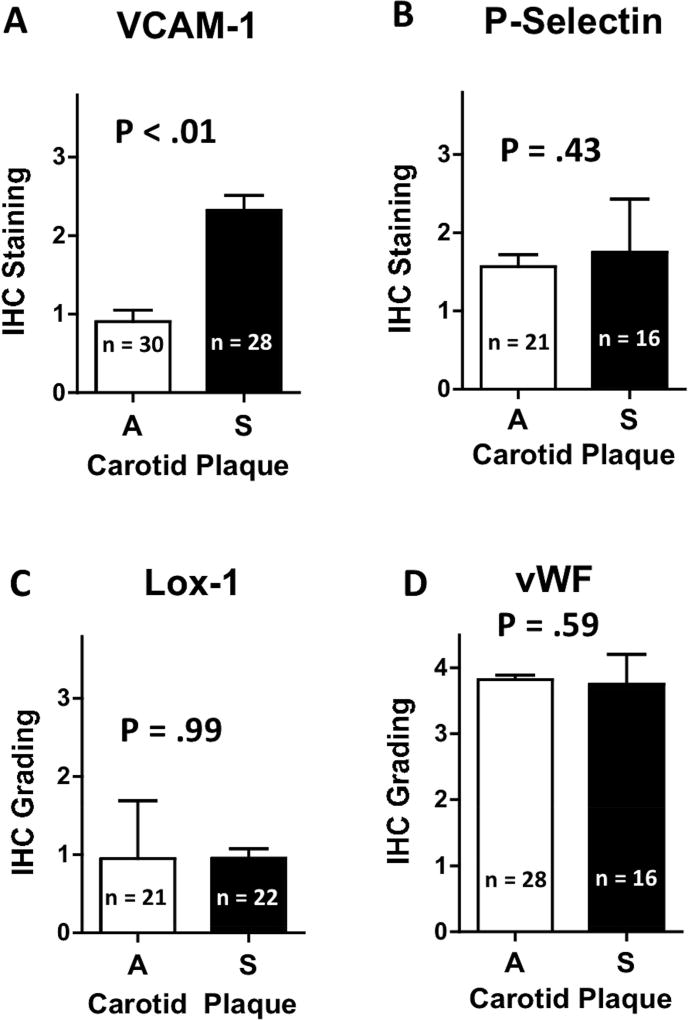
Expression of VCAM-1 on the endothelium of CEA specimens from symptomatic patients was 2.4-fold greater than that from asymptomatic patients (P < .01). Expression was not significantly different between groups for P-selectin (P = .43), von Willebrand factor (P = .59), or lectin-like oxidized low-density lipoprotein receptor 1 (P = .99). Although most plaques from asymptomatic patients displayed low VCAM-1 expression, approximately one in five expressed high VCAM-1 similar to plaques from symptomatic patients. In vitro flow chamber experiments demonstrated that VCAM-1-targeted microbubbles bind cells that express VCAM-1, even under high-shear conditions that approximate those found in human carotid arteries, whereas binding efficiency was lower for the other agents.
VCAM-1 displays significantly higher expression on high-risk (symptomatic) vs low-risk (asymptomatic) carotid plaques. Ultrasound contrast agents bearing ligands for VCAM-1 can sustain high-shear attachment and may be useful for identifying patients in whom more aggressive treatment is warranted.
对颈动脉斑块易发生动脉粥样硬化栓塞事件进行分子成像,可能会改善颈动脉内膜切除术(CEA)患者的选择。本研究的目的是评估内皮炎症标志物在此应用中的相对价值,并开发用于其成像的分子超声造影剂。
前瞻性地从无症状(30例)和有症状(30例)患者中获取人类CEA标本。通过半定量免疫组织化学评估斑块中的血管细胞黏附分子1(VCAM-1)、凝集素样氧化低密度脂蛋白受体1、P-选择素和血管性血友病因子。然后合成针对这些靶点的已确立的小肽配体,并将其共价偶联到脂质壳微泡超声造影剂表面,随后在流动腔中评估其在可变剪切条件下与活化的人主动脉内皮细胞的结合动力学。
有症状患者CEA标本内皮上VCAM-1的表达比无症状患者高2.4倍(P <.01)。P-选择素(P =.43)、血管性血友病因子(P =.59)或凝集素样氧化低密度脂蛋白受体1(P =.99)在两组之间的表达无显著差异。尽管大多数无症状患者的斑块显示低VCAM-1表达,但约五分之一的斑块表达高VCAM-1,类似于有症状患者的斑块。体外流动腔实验表明,靶向VCAM-1的微泡即使在接近人类颈动脉中发现的高剪切条件下也能与表达VCAM-1的细胞结合,而其他试剂的结合效率较低。
VCAM-1在高危(有症状)与低危(无症状)颈动脉斑块上的表达显著更高。携带VCAM-1配体的超声造影剂可维持高剪切附着,可能有助于识别需要更积极治疗的患者。