College of Animal Science, Anhui Science and Technology University, Fengyang, 233100, China, People's Republic of China.
Parasit Vectors. 2018 Feb 17;11(1):93. doi: 10.1186/s13071-018-2671-5.
Global data regarding the molecular epidemiology of Blastocystis sp. and Pentatrichomonas hominis in sheep and goats are sparse. China has one of the largest sheep and goat populations in the world. In this study we investigated the occurrence of Blastocystis sp. and P. hominis in domestic sheep and goats in China, and analyzed the genetic characterization of these two parasite species.
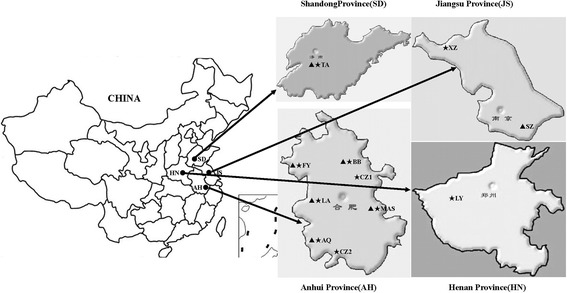
In total, we collected fresh fecal samples from 832 sheep and 781 goats located on seven and ten farms, respectively, in the central eastern region of China. The corresponding sequences obtained in this study were subject to molecular analysis for subtype and allele identification of Blastocystis sp., and species and genotype confirmation of P. hominis.
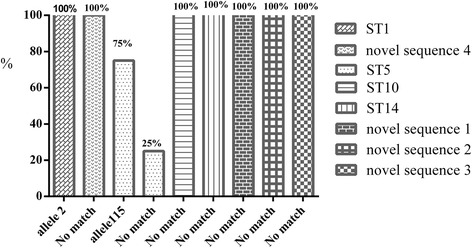
The occurrence of Blastocystis sp. was 6.0% (50/832) in sheep and 0.3% (2/781) in goats. The most predominant subtype (ST) of Blastocystis sp. in sheep was ST10 (50.0%), followed by ST14 (20%), ST5 (16%), novel sequence 1 (6%), novel sequence 4 (4%), novel sequence 2 (2%) and novel sequence 3 (2%). However, only ST1 was observed in goats. No mixed infections with different subtypes were found in this study. The 18S alleles showed allele 2 (100%) for ST1; allele 115 (75%) for ST5; and no match allele for ST5 (25%), ST10 (100%), ST14 (100%), novel sequence 1 (100%), novel sequence 2 (100%), novel sequence 3 (100%), and novel sequence 4 (100%) on the Blastocystis subtype (18S) and Sequence Typing (MLST) database. For P. hominis, two goats (0.3%) and zero sheep (0%) were identified as positive in this study. The 18S rRNA gene sequences of two P. hominis isolates from goats displayed 100% identity to type CC1, found previously in dogs, monkeys and humans.
These results provide the detailed data on the occurrence and molecular epidemiology of Blastocystis sp. and P. hominis in sheep and goats in China. They also contribute to and expand our knowledge of the Blastocystis sp. and P. hominis epidemiology around the world.
关于绵羊和山羊中肠孢子虫和 Pentatrichomonas hominis 的分子流行病学的全球数据很少。中国是世界上拥有最大绵羊和山羊种群的国家之一。在这项研究中,我们调查了中国国内绵羊和山羊中肠孢子虫和 P. hominis 的发生情况,并分析了这两种寄生虫的遗传特征。
我们共收集了来自中国中东部地区的 7 个和 10 个农场的 832 只绵羊和 781 只山羊的新鲜粪便样本。本研究中获得的相应序列进行了分子分析,以确定肠孢子虫的亚型和等位基因,以及 P. hominis 的种和基因型。
绵羊的肠孢子虫发生率为 6.0%(50/832),山羊的发生率为 0.3%(2/781)。绵羊中最主要的肠孢子虫 ST 为 ST10(50.0%),其次是 ST14(20%)、ST5(16%)、新序列 1(6%)、新序列 4(4%)、新序列 2(2%)和新序列 3(2%)。然而,仅在山羊中观察到 ST1。本研究未发现不同亚型的混合感染。18S 等位基因显示 ST1 为等位基因 2(100%);ST5 为等位基因 115(75%);ST5(25%)、ST10(100%)、ST14(100%)、新序列 1(100%)、新序列 2(100%)、新序列 3(100%)和新序列 4(100%)无匹配等位基因,在 Blastocystis 亚型(18S)和序列分型(MLST)数据库中。本研究中,两只山羊(0.3%)和零只绵羊(0%)被鉴定为阳性。从山羊中分离出的两个 P. hominis 18S rRNA 基因序列与先前在狗、猴子和人类中发现的 CC1 型完全一致。
这些结果提供了中国绵羊和山羊中肠孢子虫和 P. hominis 的发生和分子流行病学的详细数据。它们还为我们了解全球范围内的肠孢子虫和 P. hominis 流行病学做出了贡献并扩大了我们的知识。