Sánchez Angie, Munoz Marina, Gómez Natalia, Tabares Juan, Segura Laura, Salazar Ángela, Restrepo Cristian, Ruíz Miguel, Reyes Patricia, Qian Yuchen, Xiao Lihua, López Myriam C, Ramírez Juan D
Facultad de Medicina, Departamento de Salud Pública, Universidad Nacional de ColombiaBogotá, Colombia; Grupo de Investigaciones Microbiológicas-UR, Programa de Biología, Facultad de Ciencias Naturales y Matemáticas, Universidad del RosarioBogotá, Colombia.
Grupo de Investigaciones Microbiológicas-UR, Programa de Biología, Facultad de Ciencias Naturales y Matemáticas, Universidad del Rosario Bogotá, Colombia.
Front Microbiol. 2017 Feb 21;8:248. doi: 10.3389/fmicb.2017.00248. eCollection 2017.
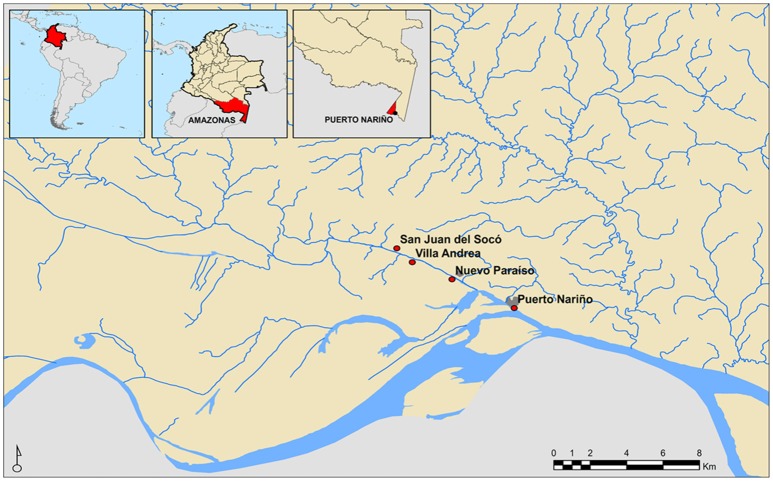
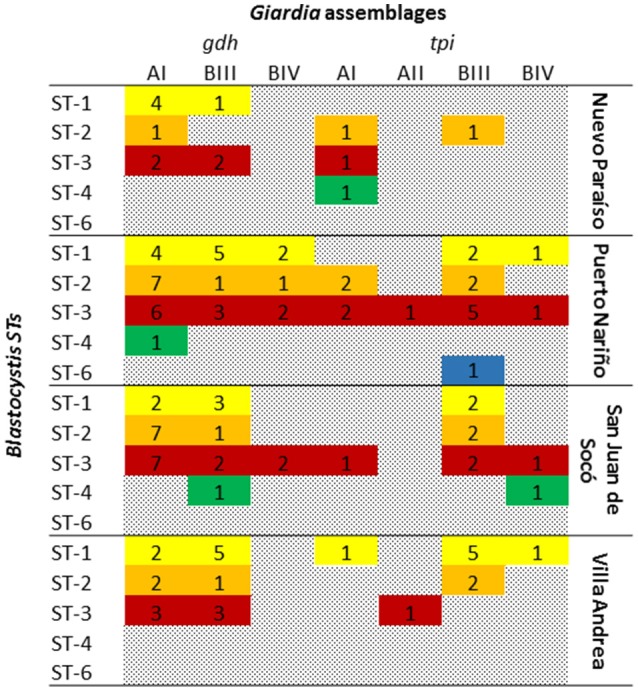
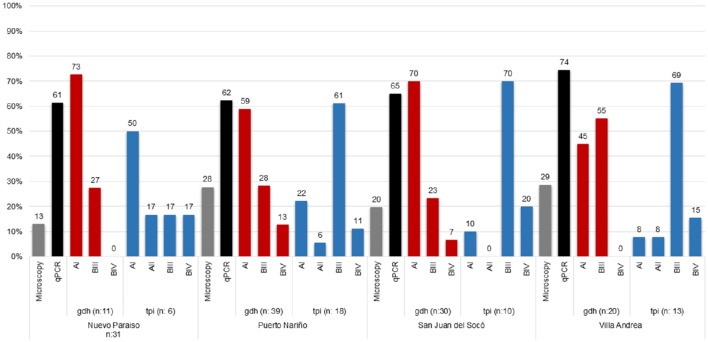
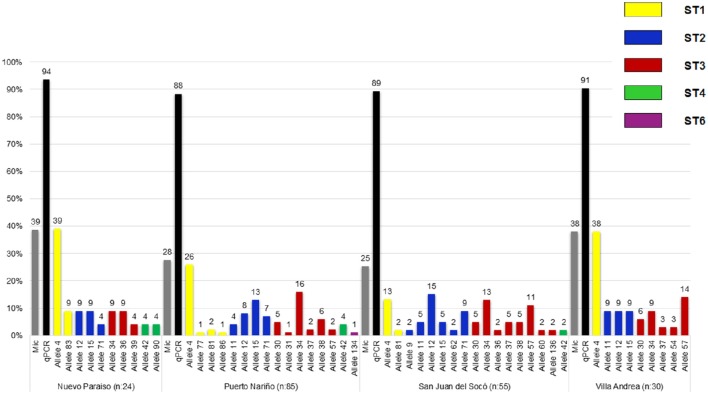
The incidence and prevalence of intestinal parasites in children is most likely due to lack of natural or acquired resistance and differences in behavior and habits closely related to environmental and socioeconomic determinants. The most important protozoa that parasitize humans are , and . These parasites present wide intraspecific genetic diversity and subsequently classified into assemblages and subtypes. The Amazon basin is the largest in the world and is the fifth freshwater reserve on the planet. Contradictorily, people living in these areas (Indigenous populations) have poor quality of life, which favors the infection of diseases of fecal-oral transmission. The aim of this work was to unravel the molecular epidemiology of and across four communities (Puerto Nariño, San Juan del Soco, Villa Andrea and Nuevo Paraíso). We obtained 284 fecal samples from children under 15 years old that were analyzed by direct microscopy (261 samples) and Real Time PCR (qPCR) (284 samples). The positive samples for these protozoa were further characterized by several molecular markers to depict assemblages and subtypes. We observed a frequency of infection by microscopy of 23.7% (62 samples) and by qPCR of 64.8% (184 samples); for by microscopy of 35.2% (92 samples) and by qPCR of 88.7% (252 samples) and for only 1.9% (5 samples) were positive by microscopy and qPCR 1.8% (5 samples). Regarding the assemblages, using the glutamate dehydrogenase ( marker we observed AI, BIII and BIV assemblages and when using triose phosphate isomerase () we observed assemblages AI, AII, BIII and BIV. In contrast, STs detected were 1, 2, 3, 4, and 6. Lastly, the species (with the subtypes IdA19 and IaA12R8) and (with the subtype IIcA5G3c) were identified. We observed a high profile of zoonotic transmission regarding the assemblages and STs/alleles. Also, we highlight the elevated frequency of infection by these two protozoans suggesting an active transmission in the area. Our findings reinforces the need to deploy better epidemiological surveillance systems for enteric pathogens in the area.
儿童肠道寄生虫的发病率和流行率很可能是由于缺乏天然或后天抵抗力,以及与环境和社会经济决定因素密切相关的行为和习惯差异。寄生于人类的最重要原生动物有 、 和 。这些寄生虫存在广泛的种内遗传多样性,随后被分为不同的类群和亚型。亚马逊流域是世界上最大的流域,也是地球上第五大淡水储备区。矛盾的是,生活在这些地区的人群(原住民)生活质量较差,这有利于粪-口传播疾病的感染。这项工作的目的是揭示 和 在四个社区(纳里尼奥港、圣胡安德索科、安德里亚别墅和新帕拉伊索)的分子流行病学。我们从15岁以下儿童中获取了284份粪便样本,通过直接显微镜检查(261份样本)和实时荧光定量聚合酶链反应(qPCR)(284份样本)进行分析。这些原生动物的阳性样本通过几种分子标记进一步表征,以描述类群和亚型。我们观察到,通过显微镜检查 的感染率为23.7%(62份样本),通过qPCR为64.8%(184份样本);通过显微镜检查 的感染率为35.2%(92份样本),通过qPCR为88.7%(252份样本),而对于 ,通过显微镜检查只有1.9%(5份样本)呈阳性,通过qPCR为1.8%(5份样本)。关于 的类群,使用谷氨酸脱氢酶( )标记时,我们观察到AI、BIII和BIV类群,而使用磷酸丙糖异构酶( )时,我们观察到AI、AII、BIII和BIV类群。相比之下,检测到的 亚型有1、2、3、4和6。最后,鉴定出了 物种(亚型为IdA19和IaA12R8)和 物种(亚型为IIcA5G3c)。我们观察到关于 类群和 亚型/等位基因存在高度的人畜共患病传播情况。此外,我们强调这两种原生动物的高感染频率,表明该地区存在活跃的传播。我们的研究结果强化了在该地区部署更好的肠道病原体流行病学监测系统的必要性。