Bio-Imaging Lab, University of Antwerp, Universiteitsplein 1, 2610 Wilrijk, Antwerp, Belgium.
Bio-Imaging Lab, University of Antwerp, Universiteitsplein 1, 2610 Wilrijk, Antwerp, Belgium.
Neuroimage. 2018 Oct 15;180(Pt B):463-484. doi: 10.1016/j.neuroimage.2018.01.075. Epub 2018 Feb 15.
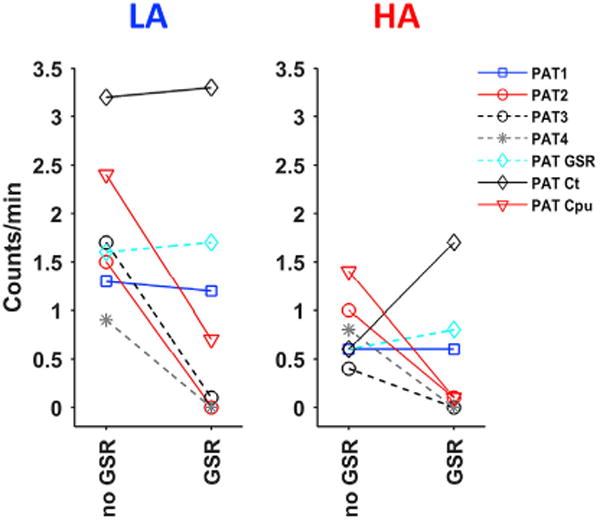
Time-resolved 'dynamic' over whole-period 'static' analysis of low frequency (LF) blood-oxygen level dependent (BOLD) fluctuations provides many additional insights into the macroscale organization and dynamics of neural activity. Although there has been considerable advancement in the development of mouse resting state fMRI (rsfMRI), very little remains known about its dynamic repertoire. Here, we report for the first time the detection of a set of recurring spatiotemporal Quasi-Periodic Patterns (QPPs) in mice, which show spatial similarity with known resting state networks. Furthermore, we establish a close relationship between several of these patterns and the global signal. We acquired high temporal rsfMRI scans under conditions of low (LA) and high (HA) medetomidine-isoflurane anesthesia. We then employed the algorithm developed by Majeed et al. (2011), previously applied in rats and humans, which detects and averages recurring spatiotemporal patterns in the LF BOLD signal. One type of observed patterns in mice was highly similar to those originally observed in rats, displaying propagation from lateral to medial cortical regions, which suggestively pertain to a mouse Task-Positive like network (TPN) and Default Mode like network (DMN). Other QPPs showed more widespread or striatal involvement and were no longer detected after global signal regression (GSR). This was further supported by diminished detection of subcortical dynamics after GSR, with cortical dynamics predominating. Observed QPPs were both qualitatively and quantitatively determined to be consistent across both anesthesia conditions, with GSR producing the same outcome. Under LA, QPPs were consistently detected at both group and single subject level. Under HA, consistency and pattern occurrence rate decreased, whilst cortical contribution to the patterns diminished. These findings confirm the robustness of QPPs across species and demonstrate a new approach to study mouse LF BOLD spatiotemporal dynamics and mechanisms underlying functional connectivity. The observed impact of GSR on QPPs might help better comprehend its controversial role in conventional resting state studies. Finally, consistent detection of QPPs at single subject level under LA promises a step forward towards more reliable mouse rsfMRI and further confirms the importance of selecting an optimal anesthesia regime.
对低频(LF)血氧水平依赖(BOLD)波动进行全周期“静态”分析和时间分辨“动态”分析,可以深入了解神经活动的宏观组织和动态。尽管在开发小鼠静息状态 fMRI(rsfMRI)方面已经取得了相当大的进展,但对于其动态范围却知之甚少。在这里,我们首次报告在小鼠中检测到一组重复出现的准周期模式(QPP),这些模式与已知的静息状态网络具有空间相似性。此外,我们还建立了这些模式中的几个与全局信号之间的密切关系。我们在低(LA)和高(HA)美托咪定-异氟烷麻醉条件下采集高时间分辨率 rsfMRI 扫描。然后,我们使用 Majeed 等人(2011)开发的算法,该算法以前在大鼠和人类中应用过,用于检测和平均 LF BOLD 信号中的重复时空模式。在小鼠中观察到的一种模式与在大鼠中观察到的模式非常相似,显示从外侧到内侧皮质区域的传播,这表明与小鼠任务正性网络(TPN)和默认模式网络(DMN)有关。其他 QPP 表现出更广泛的或纹状体的参与,并且在全局信号回归(GSR)后不再被检测到。GSR 后皮质下动力学的检测减少进一步支持了这一点,皮质动力学占主导地位。观察到的 QPP 在两种麻醉条件下均从定性和定量上确定是一致的,GSR 产生相同的结果。在 LA 下,在组和单个受试者水平上均一致地检测到 QPP。在 HA 下,一致性和模式出现率降低,而模式对皮质的贡献减少。这些发现证实了 QPP 在不同物种中的稳健性,并展示了一种新的方法来研究小鼠 LF BOLD 时空动力学和功能连接的机制。观察到的 GSR 对 QPP 的影响可能有助于更好地理解其在传统静息状态研究中的有争议作用。最后,在 LA 下在单个受试者水平上一致地检测到 QPP,这是朝着更可靠的小鼠 rsfMRI 迈出的一步,并进一步证实了选择最佳麻醉方案的重要性。