Programa de Pós-Graduação em Epidemiologia, Universidade Federal do Rio Grande do Sul, Porto Alegre, Brazil.
Instituto de Salud Pública, Facultad de Medicina, Pontificia Universidad Católica del Ecuador, Av. 12 de octubre 1076 y Roca, Quito, Ecuador.
BMC Public Health. 2018 Feb 20;18(1):269. doi: 10.1186/s12889-018-5163-9.
In 2011-2012, an outbreak of measles occurred in Ecuador. This study sought to ascertain which population characteristics were associated.
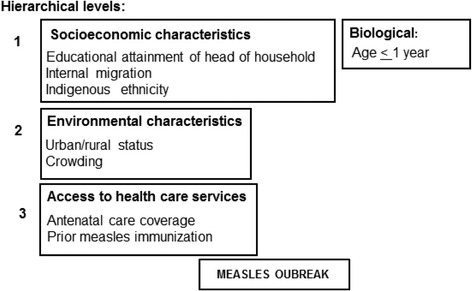
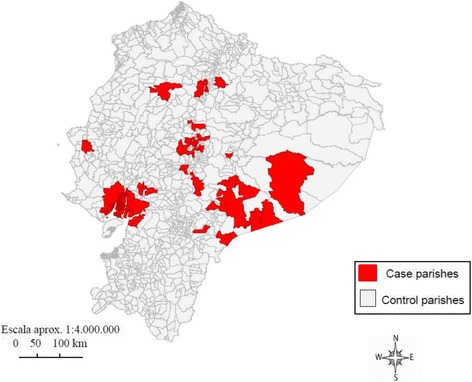
Case-control study of aggregate data. The unit of analysis was the parish (smallest geographic division). The national communicable disease surveillance database was used to identify 52 case parishes (with at least one confirmed case of measles) and 972 control parishes (no cases of measles). A hierarchical model was used to determine the association of measles with population characteristics and access to health care.
Case parishes were mostly urban and had a higher proportion of children under 1 year of age, heads of household with higher educational attainment, larger indigenous population, lower rates of measles immunization, and lower rates of antenatal care visit attendance. On multivariate analysis, associations were found with educational attainment of head of household ≥8 years (OR: 0.29; 95%CI 0.15-0.57) and ≥1.4% indigenous population (OR: 3.29; 95%CI 1.63-6.68). Antenatal care visit attendance had a protective effect against measles (OR: 0.98; 95%CI 0.97-0.99). Measles vaccination was protective of the outbreak (OR: 0.97; 95%CI 0.95-0.98). The magnitude of these associations was modest, but represents the effect of single protective factors, capable of acting at the population level regardless of socioeconomic, biological, and environmental confounding factors.
In Ecuador, the parishes with the highest percentage of indigenous populations and those with the lowest vaccination coverage were the most vulnerable during the measles outbreak.
2011-2012 年,厄瓜多尔发生麻疹疫情。本研究旨在确定与疫情相关的人群特征。
采用整群病例对照研究。分析单位为教区(最小的地理分区)。利用国家传染病监测数据库,确定了 52 个麻疹病例教区(至少有一例确诊麻疹病例)和 972 个对照教区(无麻疹病例)。采用分层模型确定麻疹与人口特征和获得医疗保健之间的关联。
麻疹病例教区主要为城市,1 岁以下儿童比例较高,家庭户主受教育程度较高,土著人口比例较高,麻疹免疫率较低,产前保健就诊率较低。多变量分析发现,家庭户主受教育程度≥8 年(比值比:0.29;95%置信区间:0.15-0.57)和土著人口比例≥1.4%(比值比:3.29;95%置信区间:1.63-6.68)与麻疹相关。产前保健就诊对麻疹有保护作用(比值比:0.98;95%置信区间:0.97-0.99)。麻疹疫苗接种对疫情有保护作用(比值比:0.97;95%置信区间:0.95-0.98)。这些关联的程度不大,但代表了单个保护因素的作用,能够在人群层面发挥作用,而不受社会经济、生物和环境混杂因素的影响。
在厄瓜多尔,土著人口比例最高和疫苗接种率最低的教区在麻疹疫情期间最为脆弱。