Microbial Ecology, Nutrition and Health Research Unit, Institute of Agrochemistry and Food Technology, National Research Council (IATA-CSIC), C/Catedrático Agustín Escardino, 7. 46980, Paterna, Valencia, Spain.
Gut Health Group, The Rowett Institute, University of Aberdeen, Aberdeen, UK.
Microbiome. 2018 Feb 20;6(1):36. doi: 10.1186/s40168-018-0415-6.
To investigate whether alterations in the developing intestinal microbiota and immune markers precede celiac disease (CD) onset in infants at familial risk of developing the disease.
A nested case-control study was carried out as part of a larger prospective cohort study, which included healthy full-term newborns (> 200) with at least one first relative with biopsy-verified CD. The present study includes cases of CD (n = 10) and the best-matched controls (n = 10) who did not develop the disease after 5-year follow-up. Fecal microbiota, assessed by high-throughput 16S rRNA gene amplicon sequencing, and immune parameters were profiled at 4 and 6 months of age and related to CD onset.
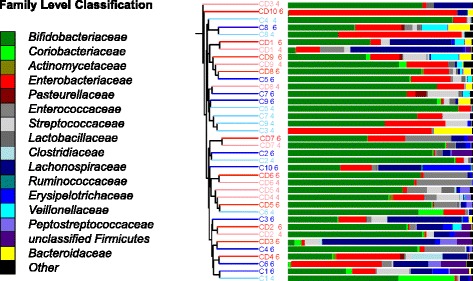
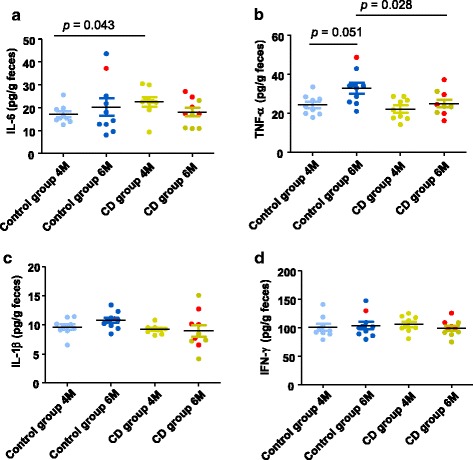
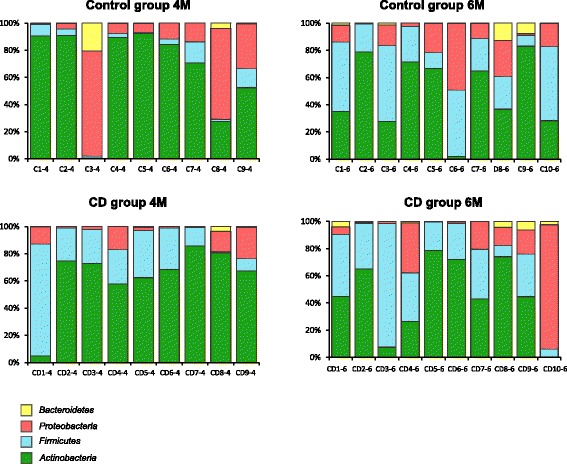
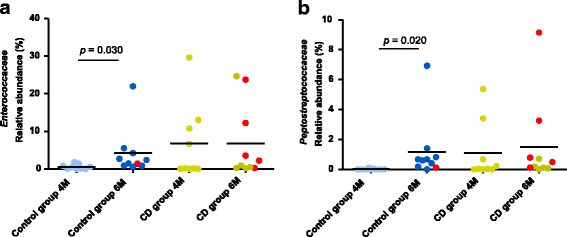
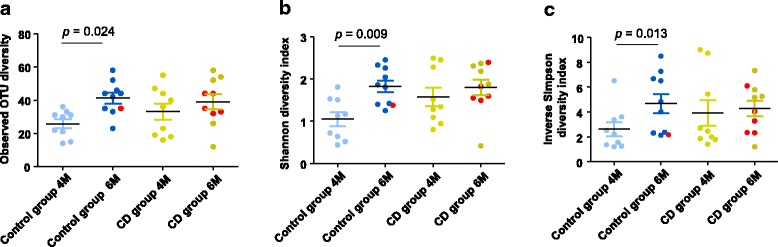
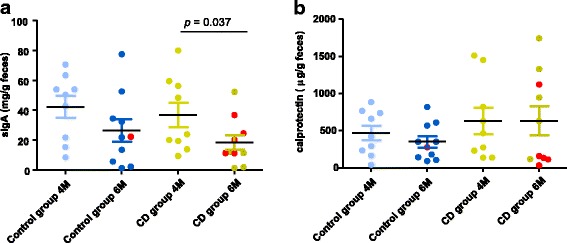
The microbiota of infants who remained healthy showed an increase in bacterial diversity over time, characterized by increases in Firmicutes families, but not those who developed CD. Infants who subsequently developed CD showed a significant reduction in sIgA levels over time, while those who remained healthy showed increases in TNF-α correlated to Bifidobacterium spp. An increased relative abundance of Bifidobacterium longum was associated with control children while increased proportions of Bifidobacterium breve and Enterococcus spp. were associated with CD development.
The findings suggest that alterations in the early trajectory of gut microbiota in infants at CD risk could influence the immune maturation process and predispose to CD, although larger population studies are warranted to confirm this hypothesis.
为了研究在具有发生乳糜泻(CD)风险的婴儿中,肠道微生物群和免疫标志物的变化是否先于 CD 发病。
作为一项更大的前瞻性队列研究的一部分,进行了一项嵌套病例对照研究,该研究纳入了 10 例 CD 病例(n=10)和经过 5 年随访后未发生疾病的最佳匹配对照(n=10)。这些病例和对照均为具有活检证实的 CD 的至少一位一级亲属的健康足月新生儿(>200 例)。本研究在 4 个月和 6 个月大时评估了粪便微生物群,采用高通量 16S rRNA 基因扩增子测序进行评估,并与 CD 发病相关。
保持健康的婴儿的微生物群随着时间的推移显示出细菌多样性的增加,其特征是厚壁菌门家族的增加,但 CD 患者的微生物群没有增加。随后发生 CD 的婴儿的 sIgA 水平随时间显著降低,而保持健康的婴儿的 TNF-α水平则随着双歧杆菌属的增加而增加。长双歧杆菌的相对丰度增加与对照组儿童有关,而短双歧杆菌和肠球菌属的比例增加则与 CD 发病有关。
这些发现表明,CD 风险婴儿肠道微生物群早期轨迹的改变可能会影响免疫成熟过程并易患 CD,但需要更大的人群研究来证实这一假设。