Subbiah Vivek, Kurzrock Razelle
Department of Investigational Cancer Therapeutics, Division of Cancer Medicine, Unit 0455, The University of Texas MD Anderson Cancer Center, 1515 Holcombe Boulevard, Houston, TX 77030, USA.
Division of Hematology & Oncology, Center for Personalized Therapy & Clinical Trials Office, UC San Diego - Moores Cancer Center, 3855 Health Sciences Drive, MC #0658, La Jolla, CA 92093-0658, USA.
Trends Cancer. 2018 Feb;4(2):101-109. doi: 10.1016/j.trecan.2017.12.004. Epub 2018 Jan 12.
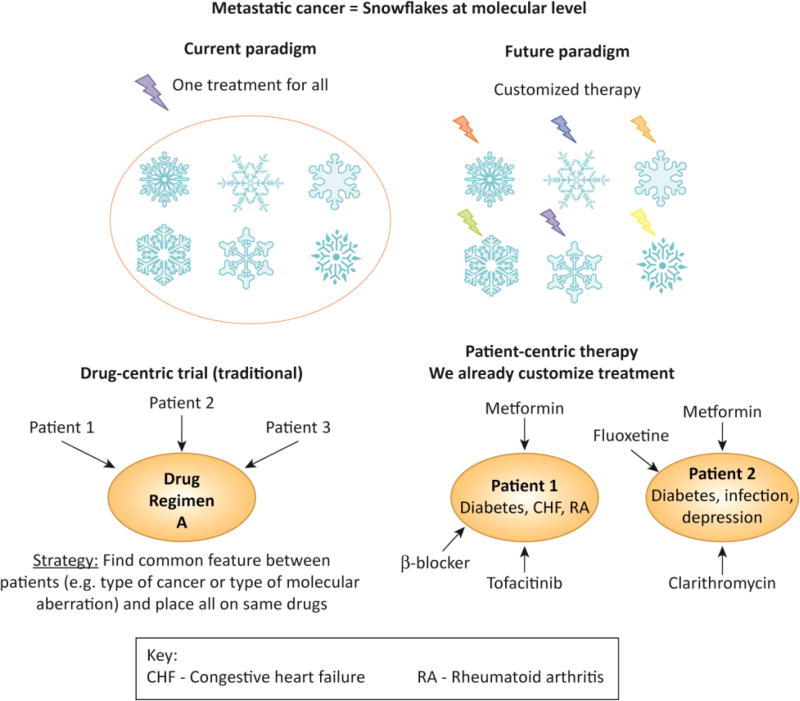
The pace of genomic and immunological breakthroughs in oncology is accelerating, making it likely that large randomized trials will increasingly become outdated before their completion. Traditional clinical research/practice paradigms must adapt to the reality unveiled by genomics, especially the need for customized drug combinations, rather than one-size-fits-all monotherapy. The raison-d'être of precision oncology is to offer 'the right drug for the right patient at the right time', a process enabled by transformative tissue and blood-based genomic technologies. Genomically targeted therapies are most suitable in early disease, when molecular heterogeneity is less pronounced, while immunotherapy is most effective against tumors with unstable genomes. Next-generation cancer research/practice models will need to overcome the tyranny of tradition and emphasize an innovative, precise and personalized patient-centric approach.
肿瘤学领域基因组学和免疫学突破的步伐正在加快,这使得大型随机试验在完成之前越来越有可能过时。传统的临床研究/实践模式必须适应基因组学揭示的现实,特别是对定制药物组合的需求,而不是一刀切的单一疗法。精准肿瘤学的存在意义在于“在正确的时间为正确的患者提供正确的药物”,这一过程由变革性的基于组织和血液的基因组技术实现。基因组靶向疗法最适合早期疾病,此时分子异质性不太明显,而免疫疗法对基因组不稳定的肿瘤最有效。下一代癌症研究/实践模式需要克服传统的束缚,强调创新、精准和以患者为中心的个性化方法。