Hernández-Camacho Juan D, Bernier Michel, López-Lluch Guillermo, Navas Plácido
Centro Andaluz de Biología del Desarrollo and CIBERER, Instituto de Salud Carlos III, Universidad Pablo de Olavide-CSIC-JA, Sevilla, Spain.
Translational Gerontology Branch, National Institute on Aging, National Institutes of Health, Baltimore, MD, United States.
Front Physiol. 2018 Feb 5;9:44. doi: 10.3389/fphys.2018.00044. eCollection 2018.
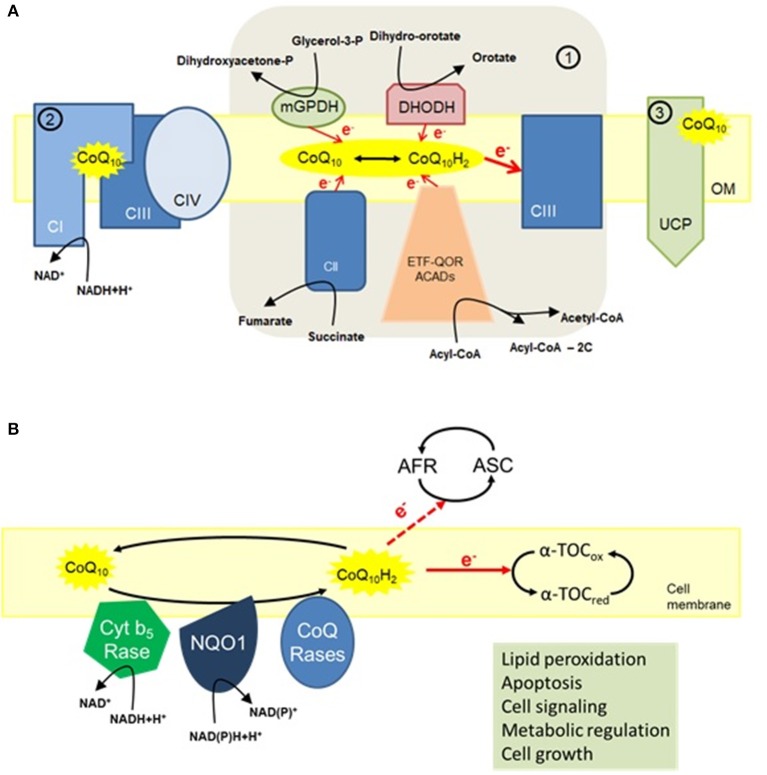
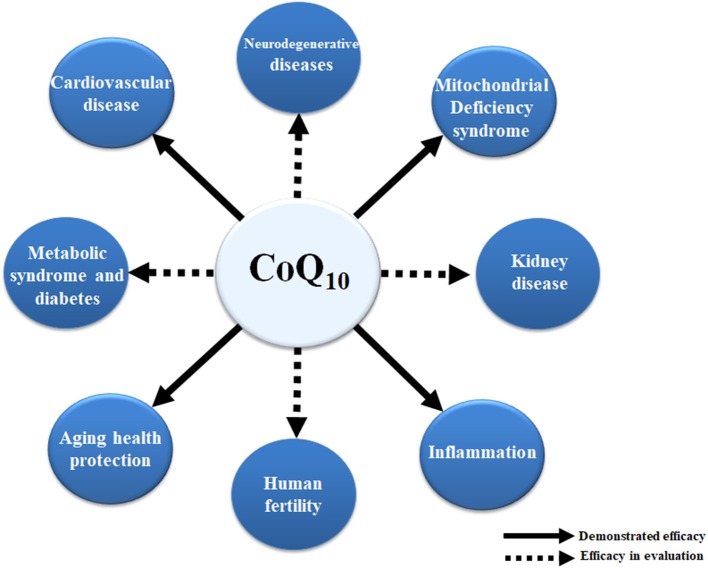
Coenzyme Q (CoQ) is an essential component of the mitochondrial electron transport chain and an antioxidant in plasma membranes and lipoproteins. It is endogenously produced in all cells by a highly regulated pathway that involves a mitochondrial multiprotein complex. Defects in either the structural and/or regulatory components of CoQ complex or in non-CoQ biosynthetic mitochondrial proteins can result in a decrease in CoQ concentration and/or an increase in oxidative stress. Besides CoQ deficiency syndrome and aging, there are chronic diseases in which lower levels of CoQ are detected in tissues and organs providing the hypothesis that CoQ supplementation could alleviate aging symptoms and/or retard the onset of these diseases. Here, we review the current knowledge of CoQ biosynthesis and primary CoQ deficiency syndrome, and have collected published results from clinical trials based on CoQ supplementation. There is evidence that supplementation positively affects mitochondrial deficiency syndrome and the symptoms of aging based mainly on improvements in bioenergetics. Cardiovascular disease and inflammation are alleviated by the antioxidant effect of CoQ. There is a need for further studies and clinical trials involving a greater number of participants undergoing longer treatments in order to assess the benefits of CoQ treatment in metabolic syndrome and diabetes, neurodegenerative disorders, kidney diseases, and human fertility.
辅酶Q(CoQ)是线粒体电子传递链的重要组成部分,也是质膜和脂蛋白中的一种抗氧化剂。它在所有细胞中通过一条高度调控的途径内源性产生,该途径涉及一种线粒体多蛋白复合物。辅酶Q复合物的结构和/或调节成分或非辅酶Q生物合成的线粒体蛋白存在缺陷,都可能导致辅酶Q浓度降低和/或氧化应激增加。除了辅酶Q缺乏综合征和衰老外,在一些慢性疾病的组织和器官中也检测到较低水平的辅酶Q,这为补充辅酶Q可以缓解衰老症状和/或延缓这些疾病的发生提供了假设。在此,我们综述了目前关于辅酶Q生物合成和原发性辅酶Q缺乏综合征的知识,并收集了基于补充辅酶Q的临床试验已发表结果。有证据表明,补充辅酶Q主要通过改善生物能量学对线粒体缺乏综合征和衰老症状产生积极影响。辅酶Q的抗氧化作用可缓解心血管疾病和炎症。为了评估补充辅酶Q在代谢综合征和糖尿病、神经退行性疾病、肾脏疾病以及人类生育方面的益处,需要开展更多涉及更多参与者、更长治疗时间的进一步研究和临床试验。