Agudelo-Botero Marcela, Giraldo-Rodríguez Liliana, Murillo-González Juana Catalina, Mino-León Dolores, Cruz-Arenas Esteban
Centro de Investigación en Políticas, Población y Salud, Facultad de Medicina, Universidad Nacional Autónoma de México, Mexico City, Mexico.
Departamento de Epidemiología Demográfica y Determinantes Sociales, Instituto Nacional de Geriatría, Mexico City, Mexico.
PLoS One. 2018 Feb 20;13(2):e0192926. doi: 10.1371/journal.pone.0192926. eCollection 2018.
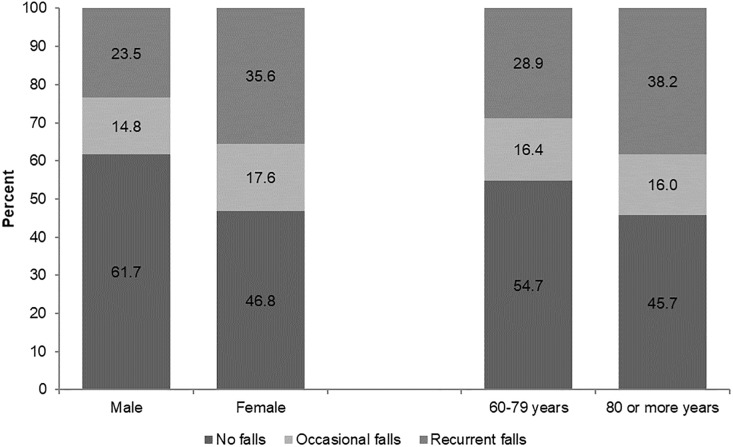
Falls are a frequent event among older adults that can cause wounds, disability, psychological disorders, and premature death. Although the large number of existing studies on the issue, few have been conducted in middle- and low-income countries. The objective of the present study is to identify the sociodemographic, medical, and functional performance factors associated with occasional and recurrent falls in Mexican older adults dwelling in community. Cross-sectional analysis of 9 598 adults ≥60 years old who participated in the fourth round (2015) of the Mexican Health and Aging Study. Bivariate tests were performed to evaluate the differences between covariates by distinct fall groups (no falls, occasional falls, and recurrent falls). Multiple logistic regressions with unadjusted and adjusted models were estimated. Approximately 46% of older adults had had at least one fall during the previous two years (one fall 16% and recurrent falls 30%). Occasional falls were only associated with being a woman; in addition to the sex, recurrent falls were strongly associated with advanced age, rural residence, bad and very bad self-perception of health status, activity-limiting pain, urinary incontinence, depression, arthritis, limitations in basic activities of daily living, and limitations in advanced activities of daily living. Falls, primarily recurrent falls, deserve to be addressed through multifactorial strategies that include different areas of intervention.
跌倒在老年人中是常见事件,可导致受伤、残疾、心理障碍和过早死亡。尽管针对该问题已有大量研究,但在中低收入国家开展的研究较少。本研究的目的是确定墨西哥社区居住的老年人中与偶尔跌倒和反复跌倒相关的社会人口学、医学和功能表现因素。对参与墨西哥健康与老龄化研究第四轮(2015年)的9598名60岁及以上成年人进行横断面分析。进行双变量检验以评估不同跌倒组(无跌倒者、偶尔跌倒者和反复跌倒者)协变量之间的差异。估计了未调整模型和调整模型的多重逻辑回归。约46%的老年人在过去两年中至少跌倒过一次(单次跌倒16%,反复跌倒30%)。偶尔跌倒仅与女性相关;除性别外,反复跌倒还与高龄、农村居住、对健康状况的不良和非常差的自我认知、活动受限疼痛、尿失禁、抑郁、关节炎、日常生活基本活动受限以及日常生活高级活动受限密切相关。跌倒,尤其是反复跌倒,值得通过包括不同干预领域的多因素策略来解决。