School of Physical Therapy-Dallas, Texas Woman's University, Dallas, TX, USA.
School of Occupational Therapy-Dallas, Texas Woman's University, Dallas, TX, USA.
BMC Geriatr. 2021 Sep 25;21(1):510. doi: 10.1186/s12877-021-02464-8.
Dual-task gait performance declines as humans age, leading to increased fall risk among older adults. It is unclear whether different secondary cognitive tasks mediate age-related decline in dual-task gait. This study aimed to examine how type and difficulty level of the secondary cognitive tasks differentially affect dual-task gait in older adults.
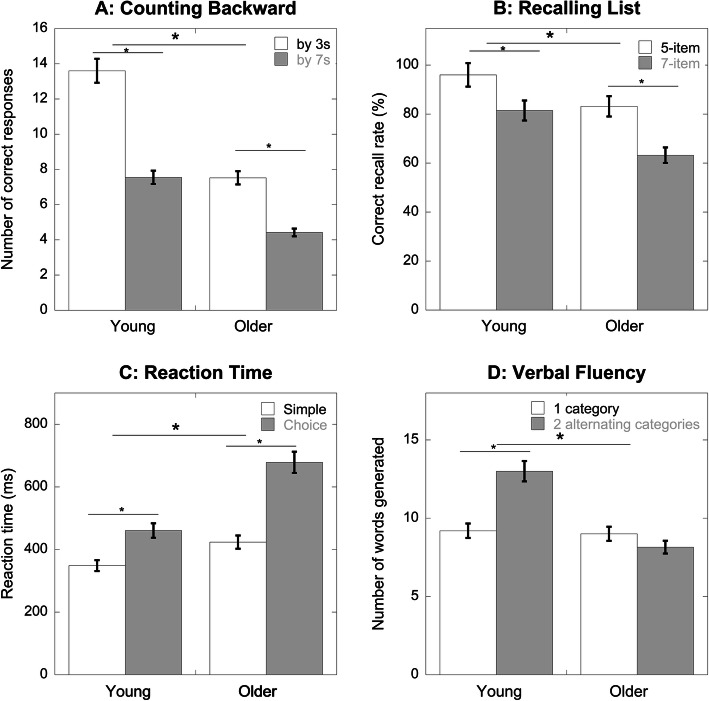
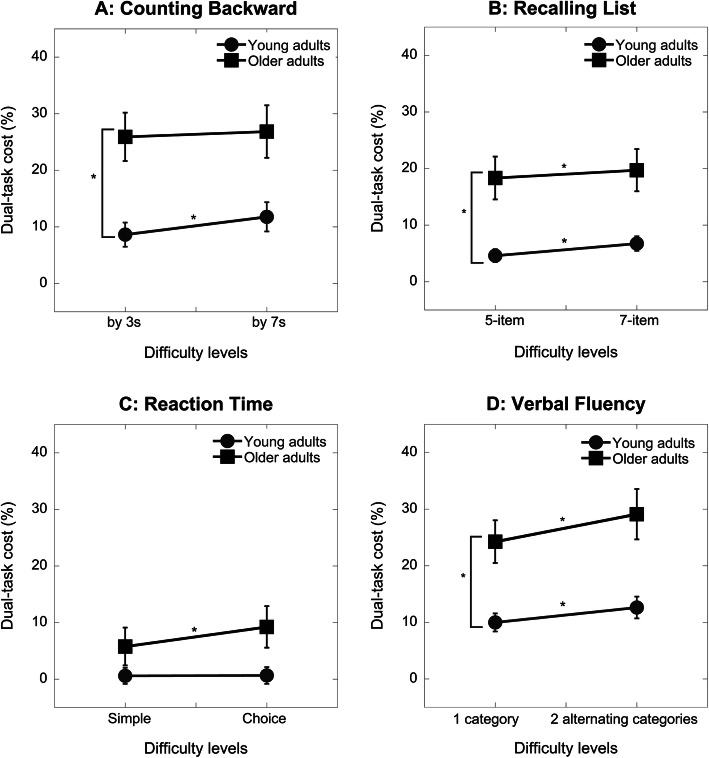
Twenty young and twenty older adults participated in this single-session study. We employed four different types of secondary tasks and each consisted of two difficulty levels, yielding eight different dual-task conditions. The dual-task conditions included walking and 1) counting backward by 3 s or by 7 s; 2) remembering a 5-item or 7-item lists; 3) responding to a simple or choice reaction time tasks; 4) generating words from single or alternated categories. Gait speed and cognitive task performance under single- and dual-task conditions were used to compute dual-task cost (DTC, %) with a greater DTC indicating a worse performance.
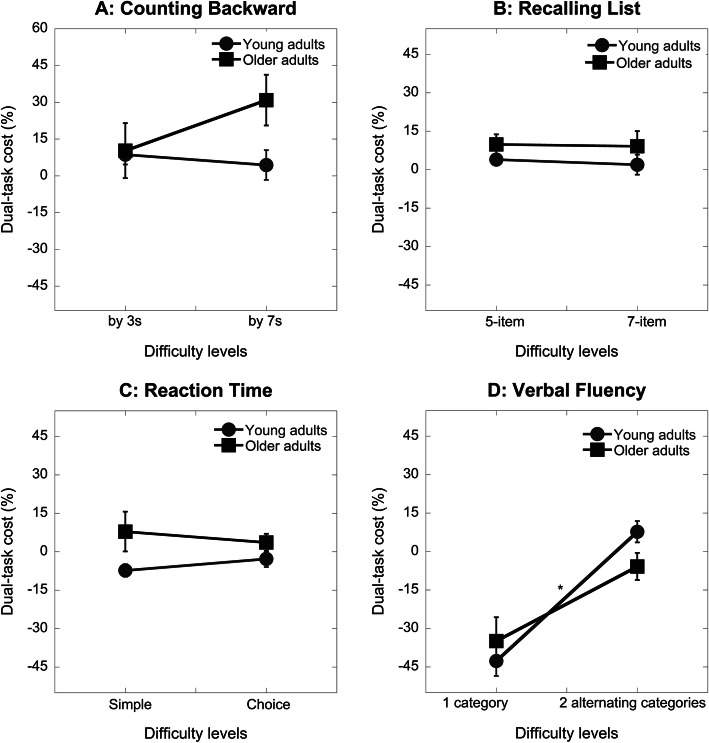
A significant three-way interaction was found for the gait speed DTC (p = .04). Increased difficulty in the reaction time task significantly increased gait speed DTC for older adults (p = .01) but not for young adults (p = .90). In contrast, increased difficulty level in the counting backward task significantly increased gait speed DTC for young adults (p = .03) but not for older adults (p = .85). Both groups responded similarly to the increased task difficulty in the other two tasks.
Older adults demonstrated a different response to dual-task challenges than young adults. Aging might have different impacts on various cognitive domains and result in distinctive dual-task gait interference patterns.
随着人类年龄的增长,双任务步态表现会下降,导致老年人跌倒风险增加。目前尚不清楚不同的次要认知任务是否会影响双任务步态的年龄相关性下降。本研究旨在探讨不同类型和难度级别的次要认知任务如何对老年人的双任务步态产生不同的影响。
20 名年轻和 20 名老年参与者参加了这项单次研究。我们采用了四种不同类型的次要任务,每个任务都有两个难度级别,共产生了八种不同的双任务条件。双任务条件包括行走和 1)以 3 秒或 7 秒为间隔进行倒数计数;2)记住 5 项或 7 项列表;3)对简单或选择反应时间任务做出反应;4)从单一或交替类别生成单词。在单任务和双任务条件下的步态速度和认知任务表现用于计算双任务成本(DTC,%),DTC 越高表示表现越差。
步态速度 DTC 存在显著的三向交互作用(p=0.04)。反应时任务难度增加显著增加了老年人的步态速度 DTC(p=0.01),但对年轻人没有影响(p=0.90)。相反,倒数计数任务难度增加显著增加了年轻人的步态速度 DTC(p=0.03),但对老年人没有影响(p=0.85)。两组在其他两项任务中对任务难度增加的反应相似。
老年人对双任务挑战的反应与年轻人不同。衰老可能对不同的认知领域产生不同的影响,导致不同的双任务步态干扰模式。