Spruit Iris M, Wilderjans Tom F, van Steenbergen Henk
Cognitive Psychology Unit, Institute of Psychology, Leiden University, Wassenaarseweg, 52 2333 AK, Leiden, The Netherlands.
Research Group of Methodology and Statistics, Institute of Psychology, Leiden University, Leiden, The Netherlands.
Cogn Affect Behav Neurosci. 2018 Apr;18(2):375-388. doi: 10.3758/s13415-018-0576-6.
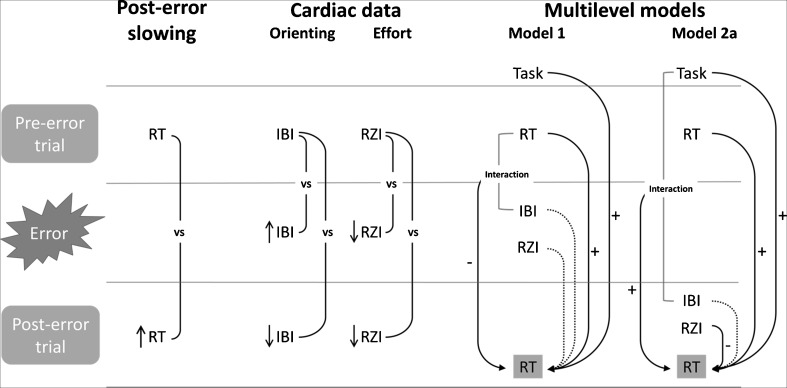
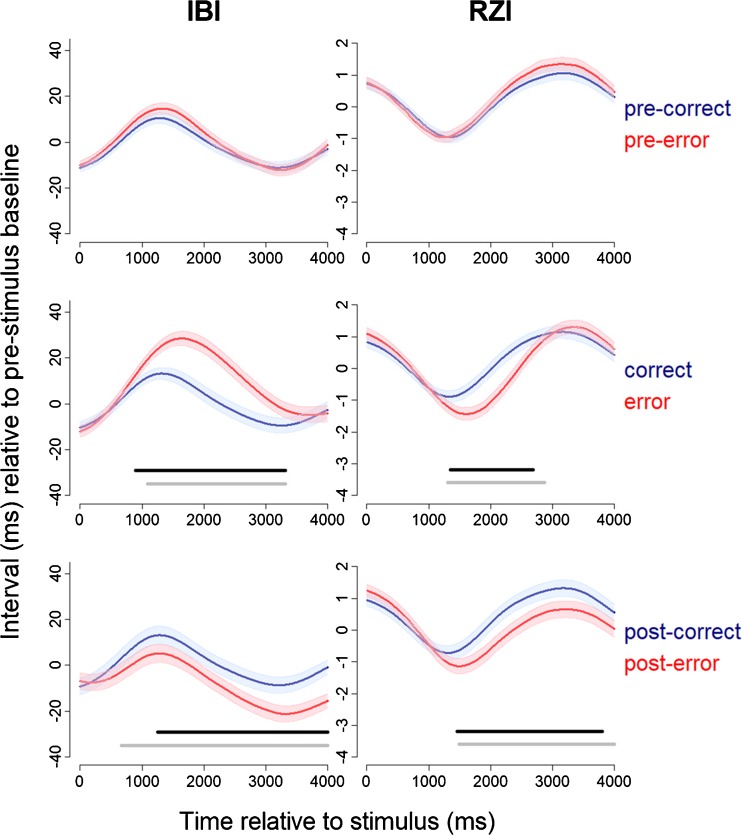
Posterror slowing (PES) is the observation that people respond slower on trials subsequent to error commissions than on trials subsequent to correct responses. Different accounts have been proposed to explain PES. On the one hand, it has been suggested that PES arises from an adaptive increase in cognitive control following error commission, thereby making people more cautious after making an error. On the other hand, PES has been attributed to an orienting response, indicating that attention is shifted toward the error. In the present study we tested these accounts by investigating the effects of error commission in both flanker and switch tasks on two task-evoked cardiac measures: the interbeat interval-that is, the interval between two consecutive R peaks-and the RZ interval-that is, the interval between the R peak and the Z point-as measured using electro- and impedance cardiography, respectively. These measures allowed us to measure cardiac deceleration (autonomic orienting) and cardiac effort mobilization, respectively. Our results revealed a shorter RZ interval during posterror trials, indicating increased effort mobilization following errors. In addition, we replicated earlier studies that have shown cardiac slowing during error trials. However, multilevel analyses showed that only the posterror decrease in RZ interval predicted posterror reaction times, whereas there was no positive relationship between error-related cardiac deceleration and posterror reaction times. Our results suggest that PES is related to increased cardiac effort, supporting a cognitive-control account of PES.
错误后减缓(PES)是指人们在犯错后的试验中比在正确反应后的试验中反应更慢的现象。人们提出了不同的解释来阐释PES。一方面,有人认为PES源于犯错后认知控制的适应性增强,从而使人们在犯错后更加谨慎。另一方面,PES被归因于一种定向反应,表明注意力转向了错误。在本研究中,我们通过在侧翼任务和切换任务中探究犯错对两种任务诱发的心脏指标的影响来检验这些解释:心跳间期,即两个连续R波峰之间的间期,以及RZ间期,即R波峰与Z点之间的间期,分别通过心电图和阻抗心动图进行测量。这些指标使我们能够分别测量心脏减速(自主定向)和心脏努力动员。我们的结果显示,在错误后的试验中RZ间期更短,表明错误后努力动员增加。此外,我们重复了早期研究,这些研究表明在错误试验期间心脏会减速。然而,多层次分析表明,只有错误后RZ间期的缩短能预测错误后的反应时间,而与错误相关的心脏减速和错误后的反应时间之间没有正相关关系。我们的结果表明,PES与心脏努力增加有关,支持了对PES的认知控制解释。