Kulkarni Upasana, Herrmenau Christoph, Win Stephanie J, Bauer Michael, Kamradt Thomas
Institute of Immunology, Jena University Hospital, Jena, Germany.
Department of Anesthesiology and Intensive Care Medicine, Jena University Hospital, Jena, Germany.
PLoS One. 2018 Feb 21;13(2):e0192304. doi: 10.1371/journal.pone.0192304. eCollection 2018.
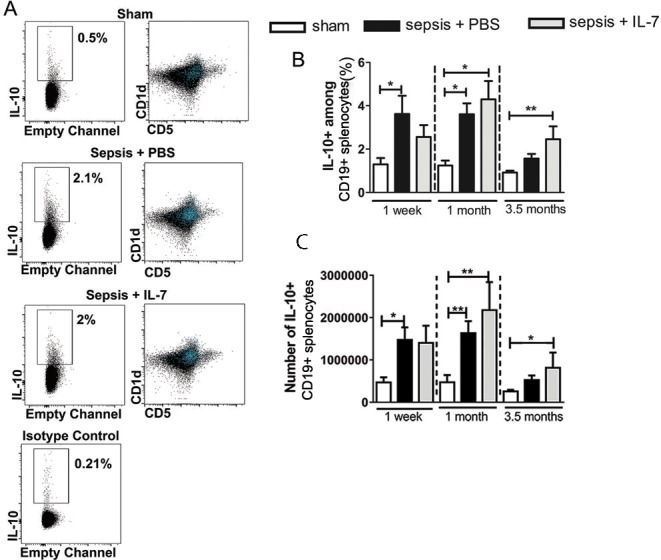
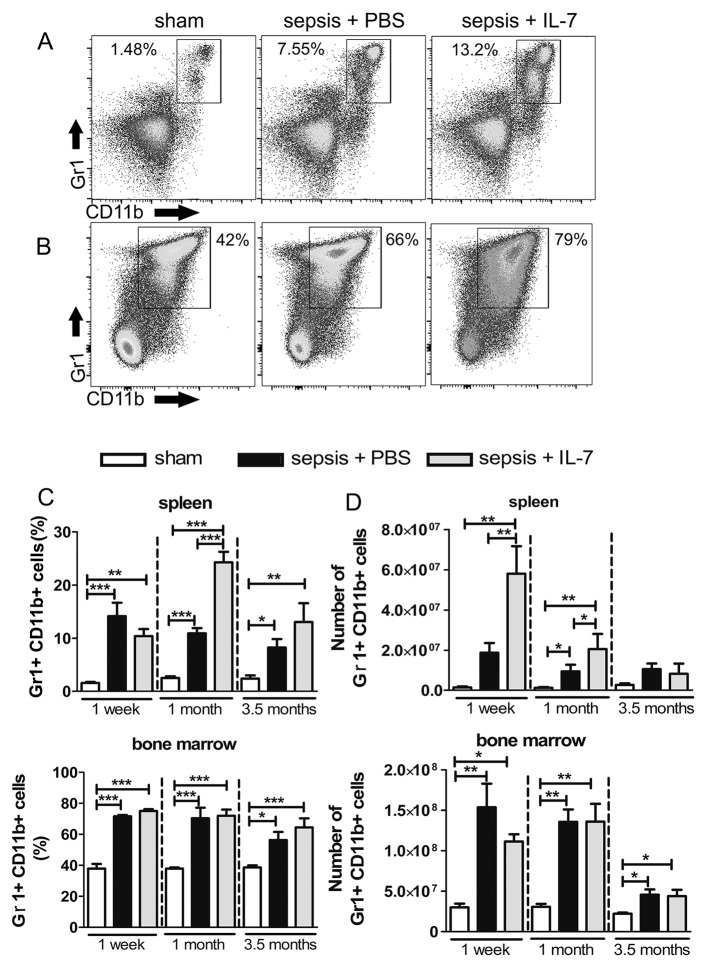
Immunological dysregulation in sepsis is associated with often lethal secondary infections. Loss of effector cells and an expansion of immunoregulatory cell populations both contribute to sepsis-induced immunosuppression. The extent and duration of this immunosuppression are unknown. Interleukin 7 (IL-7) is important for the maintenance of lymphocytes and can accelerate the reconstitution of effector lymphocytes in sepsis. How IL-7 influences immunosuppressive cell populations is unknown. We have used the mouse model of peritoneal contamination and infection (PCI) to investigate the expansion of immunoregulatory cells as long-term sequelae of sepsis with or without IL-7 treatment. We analysed the frequencies and numbers of regulatory T cells (Tregs), double negative T cells, IL-10 producing B cells and myeloid-derived suppressor cells (MDSCs) for 3.5 months after sepsis induction. Sepsis induced an increase in IL-10+ B cells, which was enhanced and prolonged by IL-7 treatment. An increased frequency of MDSCs in the spleen was still detectable 3.5 months after sepsis induction and this was more pronounced in IL-7-treated mice. MDSCs from septic mice were more potent at suppressing T cell proliferation than MDSCs from control mice. Our data reveal that sepsis induces a long lasting increase in IL-10+ B cells and MDSCs. Late-onset IL-7 treatment augments this increase, which should be relevant for clinical interventions.
脓毒症中的免疫失调与往往致命的继发性感染相关。效应细胞的丧失和免疫调节细胞群体的扩增均促成脓毒症诱导的免疫抑制。这种免疫抑制的程度和持续时间尚不清楚。白细胞介素7(IL-7)对淋巴细胞的维持很重要,并且可以加速脓毒症中效应淋巴细胞的重建。IL-7如何影响免疫抑制细胞群体尚不清楚。我们使用腹膜污染和感染(PCI)小鼠模型来研究免疫调节细胞作为脓毒症长期后遗症在有或没有IL-7治疗情况下的扩增情况。我们在脓毒症诱导后3.5个月分析了调节性T细胞(Tregs)、双阴性T细胞、产生IL-10的B细胞和髓源性抑制细胞(MDSCs)的频率和数量。脓毒症诱导IL-10+B细胞增加,IL-7治疗使其增强并延长。脓毒症诱导后3.5个月仍可检测到脾脏中MDSCs频率增加,在IL-7治疗的小鼠中更明显。来自脓毒症小鼠的MDSCs比来自对照小鼠的MDSCs在抑制T细胞增殖方面更有效。我们的数据显示,脓毒症诱导IL-10+B细胞和MDSCs长期增加。迟发性IL-7治疗增强了这种增加,这对临床干预应该具有相关性。