Li Dong-Bin, Liu Jing-Li, Wang Wei, Luo Xiu-Mei, Zhou Xia, Li Jin-Pin, Cao Xiao-Li, Long Xiao-Hong, Chen Jia-Gui, Qin Chao
Department of Neurology, The First Affiliated Hospital, Guangxi Medical University, Nanning, China.
Public Health School of Guangxi Medical University, Nanning, China.
Front Aging Neurosci. 2018 Feb 6;10:24. doi: 10.3389/fnagi.2018.00024. eCollection 2018.
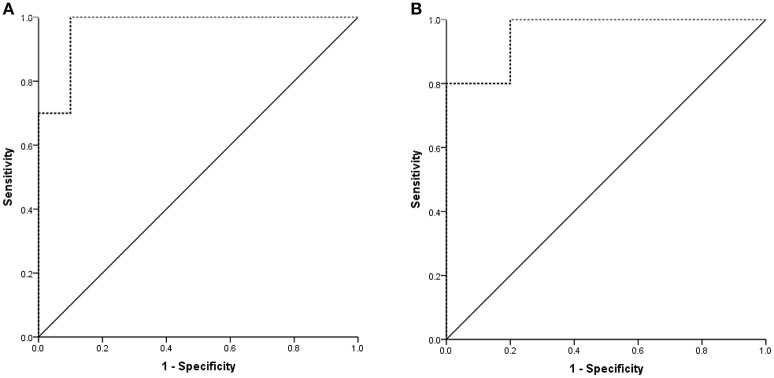
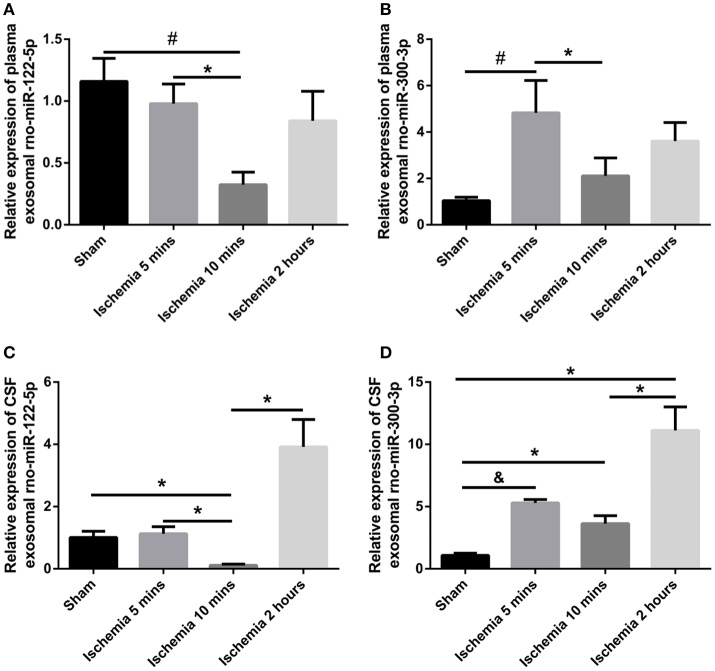
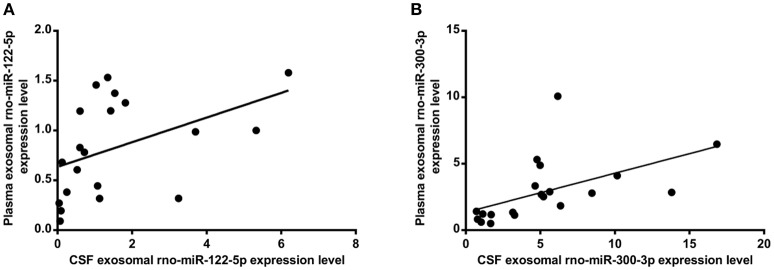
Differentiation of transient ischaemic attack (TIA) from ischaemic stroke within the thrombolysis time window is difficult. Although TIA may be diagnosed within this window, the latest imaging technologies are complex and costly. Serum markers, which are non-invasive, rapid and economic, are used for diagnosis and prognosis of various diseases. Exosome-derived miRNA markers for TIA are unknown. We examined focal brain ischaemia produced by occlusion of the middle cerebral artery (MCAo) for 5 min, 10 min, and 2 h in rats. Exosomal miRNAs with consistent trends in cerebrospinal fluid (CSF) and plasma were identified by deep sequencing and quantitative real-time polymerase chain reaction (qRT-PCR). The areas under the curve (AUC) of the receiver operating characteristic (ROC) curve were used to evaluate the diagnostic accuracy of these miRNAs for TIA in rats. Rno-miR-122-5p and rno-miR-300-3p were selected. Plasma exosomal rno-miR-122-5p was significantly downregulated in 10 min ischaemic rats compared with control and 5 min plasma. Plasma exosomal rno-miR-300-3p was significantly upregulated in 5 min ischaemic rats compared with control, 10 min and 2 h rats. Plasma and CSF levels of these miRNAs were correlated. ROC analysis showed high AUC values for rno-miR-122-5p (0.960) and rno-miR-300-3p (0.970) in the 10 and 5 min rats, respectively, compared with controls. Plasma exosomal rno-miR-122-5p and rno-miR-300-3p may be blood-based TIA biomarkers.
在溶栓时间窗内区分短暂性脑缺血发作(TIA)和缺血性卒中很困难。尽管在此时间窗内可能诊断出TIA,但最新的成像技术复杂且昂贵。血清标志物具有非侵入性、快速且经济的特点,被用于各种疾病的诊断和预后评估。目前尚不清楚用于TIA的外泌体衍生miRNA标志物。我们在大鼠中检查了大脑中动脉闭塞(MCAo)5分钟、10分钟和2小时所产生的局灶性脑缺血。通过深度测序和定量实时聚合酶链反应(qRT-PCR)鉴定了脑脊液(CSF)和血浆中具有一致趋势的外泌体miRNA。采用受试者操作特征(ROC)曲线的曲线下面积(AUC)来评估这些miRNA对大鼠TIA的诊断准确性。选择了Rno-miR-122-5p和rno-miR-300-3p。与对照组和5分钟血浆相比,10分钟缺血大鼠的血浆外泌体rno-miR-122-5p显著下调。与对照组、10分钟和2小时大鼠相比,5分钟缺血大鼠的血浆外泌体rno-miR-300-3p显著上调。这些miRNA的血浆和CSF水平具有相关性。ROC分析显示,与对照组相比,在10分钟和5分钟的大鼠中,rno-miR-122-5p(0.960)和rno-miR-300-3p(0.970)的AUC值较高。血浆外泌体rno-miR-122-5p和rno-miR-300-3p可能是基于血液的TIA生物标志物。