Liu Qianfeng, Fang Jiasong, Li Jiangtao, Zhang Li, Xie Bin-Bin, Chen Xiu-Lan, Zhang Yu-Zhong
State Key Laboratory of Marine Geology, Tongji University, Shanghai, China.
Hadal Science and Technology Research Center, Shanghai Ocean University, Shanghai, China.
Front Microbiol. 2018 Feb 6;9:135. doi: 10.3389/fmicb.2018.00135. eCollection 2018.
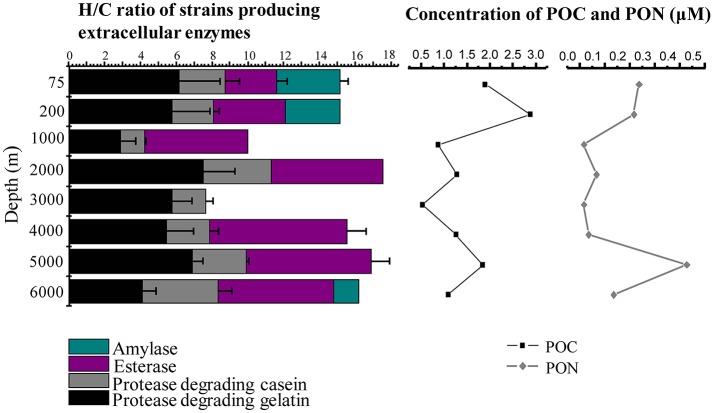
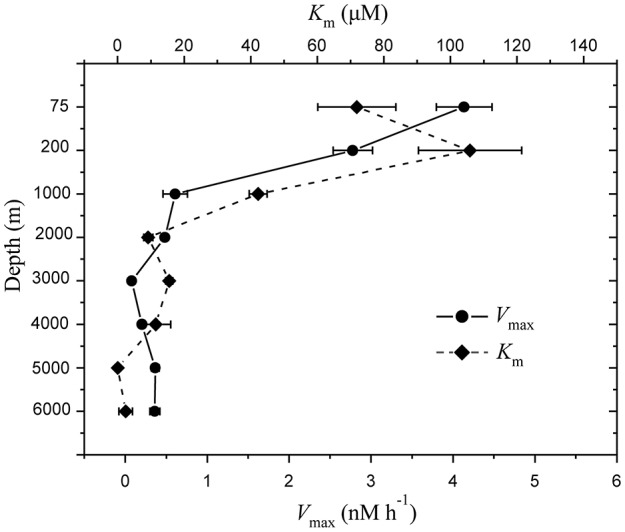
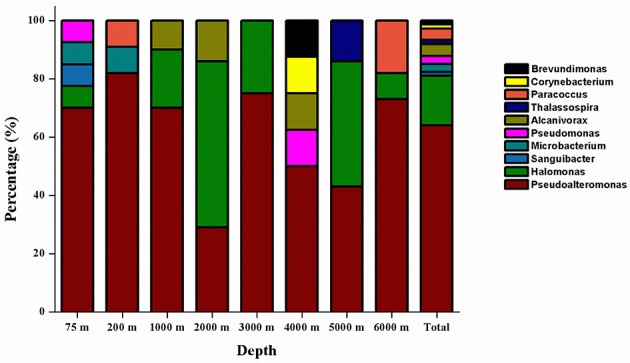
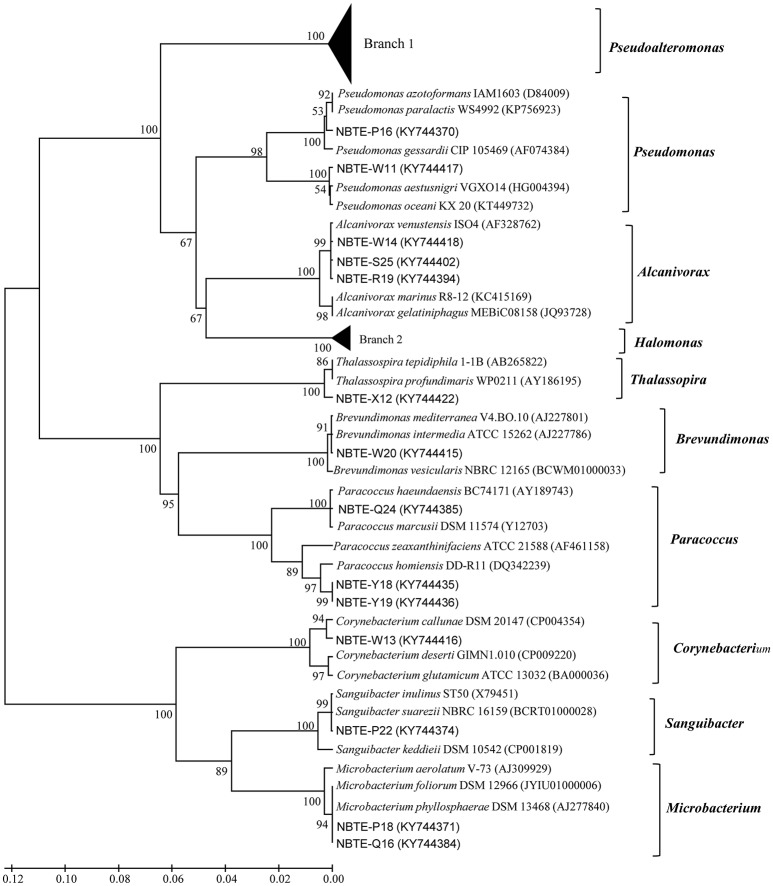
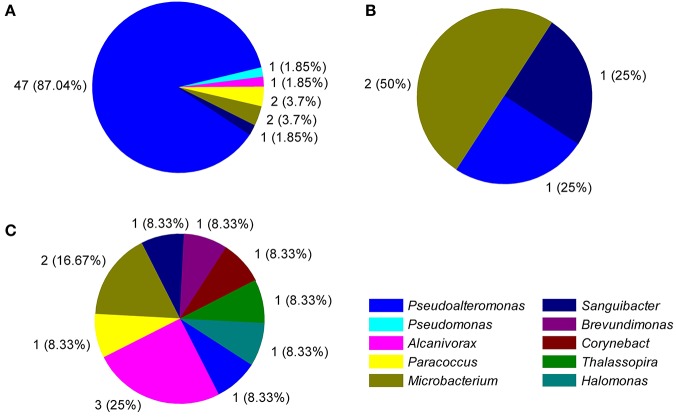
Marine microorganisms and their extracellular enzymes (ECEs) play an important role in the remineralization of organic material by hydrolyzing high-molecular-weight substrates to sizes sufficiently small to be transported through cell membrane, yet the diversity of the enzyme-producing bacteria and the types of ECEs involved in the degradation process are largely unknown. In this work, we investigated the diversity of cultivable bacteria and their ECEs and the potential activities of aminopeptidase in the water column at eight different depths of the New Britain Trench. There was a great diversity of cultivable bacteria and ECEs, and depth appears an important driver of the diversity. The 16S rRNA sequence analysis revealed that the cultivable bacteria were affiliated mostly with the phyla Proteobacteria and Actinobacteria, and the predominant genera were (62.7%) and (17.3%). Moreover, 70.7% of the isolates were found to produce hydrolytic zone on casein and gelatin plates, in which was the predominant group, exhibiting relatively high protease production. Inhibitor analysis showed that the extracellular proteases from the isolated bacteria were serine proteases in the surface water and metalloproteases in the deep water. Meanwhile, the and of aminopeptidase exhibited a maximum in the surface water and low values in the deep bathy- and abyssopelagic water, indicating lower rates of hydrolysis and higher substrate affinity in the deeper waters. These results shed new insights into the diversity of the cultivable bacteria and bacterial ECEs and their likely biogeochemical functions in the trench environment.
海洋微生物及其胞外酶(ECEs)在有机物质的再矿化过程中发挥着重要作用,它们通过将高分子量底物水解为足够小的尺寸以便通过细胞膜运输,然而,参与降解过程的产酶细菌的多样性以及ECEs的类型在很大程度上尚不清楚。在这项研究中,我们调查了新不列颠海沟八个不同深度水柱中可培养细菌及其ECEs的多样性以及氨肽酶的潜在活性。可培养细菌和ECEs具有高度多样性,深度似乎是多样性的一个重要驱动因素。16S rRNA序列分析表明,可培养细菌大多隶属于变形菌门和放线菌门,主要属为(62.7%)和(17.3%)。此外,70.7%的分离株在酪蛋白和明胶平板上产生水解圈,其中是主要群体,表现出相对较高的蛋白酶产量。抑制剂分析表明,分离细菌的胞外蛋白酶在表层水中是丝氨酸蛋白酶,在深层水中是金属蛋白酶。同时,氨肽酶的和在表层水中达到最大值,在深海和深渊层水中值较低,表明在较深水域中水解速率较低且底物亲和力较高。这些结果为可培养细菌和细菌ECEs的多样性及其在海沟环境中可能的生物地球化学功能提供了新的见解。