Peterson Brent M, Johnson Cynthia, Case Kaylene R, Shackelford Daniel Y K, Brown Jessica M, Lalonde Trent L, Hayward Reid
1Department of Kinesiology and Health Science, Biola University, 13800 Biola Ave., La Mirada, CA 90639 USA.
3School of Sport and Exercise Science, University of Northern Colorado Cancer Rehabilitation Institute, University of Northern Colorado, 501 W. 20th St., Greeley, CO 80639 USA.
Pilot Feasibility Stud. 2018 Feb 17;4:50. doi: 10.1186/s40814-018-0242-3. eCollection 2018.
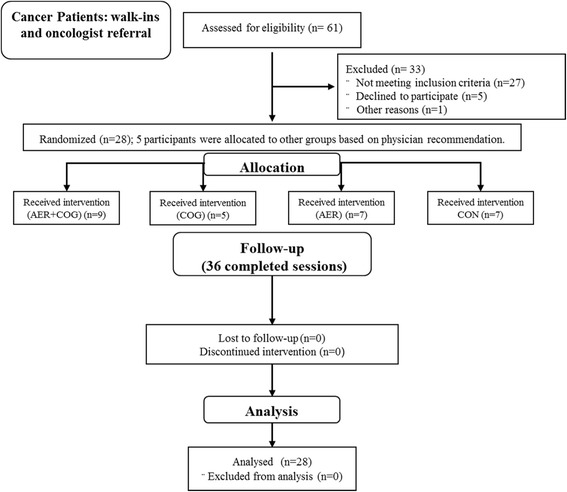
Cancer-related cognitive impairment (CRCI) may negatively affect upwards of 75% of cancer patients. Exercise and cognitive training, independently, may increase functional capacity and aspects of cognitive function. Yet, combined training protocols have not been evaluated in cancer survivor populations. Therefore, the aim of this study was to explore the feasibility of a quasi-randomized, controlled, exploratory, repeated-measures aerobic and cognitive training intervention on cognitive function in participants undergoing treatment for cancer ( = 28).
Pre- and post-physical and cognitive assessments were administered. A 36-session (approximately 12 weeks) computer-based cognitive (COG), aerobic (AER), cognitive and aerobic (AER + COG), and flexibility (CON) training intervention was completed. Dependent measures tests and pre- to post percentages were then calculated to address within-group changes for each dependent variable.
Within-group measures revealed that the AER logical memory scores (pre- to post mean difference [2.3], 95.0% CI [0.9, 3.7], percentage change [32.7%]), delayed recall scores (pre- to post mean difference [2.1], 95.0% CI [0.3, 3.9], percentage change [27.2%]), block design scores (pre- to post mean difference [1.7], 95.0% CI [0.2, 3.2], percentage change [19.0%]), and letter-number sequencing scores (pre- to post mean difference [1.0], 95.0% CI [0.2, 1.8], percentage change [12.3%]) all increased. Aspects of verbal fluidity scores increased in the CON group. However, all cognitive scores (AER + COG and COG groups) failed to increase.
Aerobic training for CRCI may positively impact cognitive function. Individually, these methods may appropriately address CRCI, but combined training of this nature may be too demanding for patients undergoing treatment for cancer. However, larger randomized trials are needed to substantiate this protocol in large-scale cancer rehabilitation centers.
癌症相关认知障碍(CRCI)可能会对超过75%的癌症患者产生负面影响。运动和认知训练各自都可能提高功能能力和认知功能的某些方面。然而,联合训练方案尚未在癌症幸存者群体中进行评估。因此,本研究的目的是探讨一种准随机、对照、探索性、重复测量的有氧和认知训练干预对接受癌症治疗的参与者(n = 28)认知功能的可行性。
进行了身体和认知的前后评估。完成了一个为期36节(约12周)的基于计算机的认知(COG)、有氧(AER)、认知和有氧(AER+COG)以及灵活性(CON)训练干预。然后计算相关测量指标测试以及前后百分比,以分析每个因变量的组内变化。
组内测量结果显示,AER组的逻辑记忆分数(前后平均差异[2.3],95.0%可信区间[0.9, 3.7],百分比变化[32.7%])、延迟回忆分数(前后平均差异[2.1],95.0%可信区间[0.3, 3.9],百分比变化[27.2%])、积木设计分数(前后平均差异[1.7],95.0%可信区间[0.2, 3.2],百分比变化[19.0%])以及字母数字排序分数(前后平均差异[1.0],95.0%可信区间[0.2, 1.8],百分比变化[12.3%])均有所增加。CON组的言语流畅性分数的某些方面有所增加。然而,所有认知分数(AER+COG组和COG组)均未增加。
针对CRCI的有氧训练可能对认知功能产生积极影响。单独来看,这些方法可能适用于应对CRCI,但这种联合训练对接受癌症治疗的患者来说可能要求过高。然而,需要更大规模的随机试验在大型癌症康复中心证实该方案。