Mary MacKillop Institute for Health Research, Australian Catholic University, Melbourne, Victoria, Australia.
Department of Health Research Methods, Evidence and Impact, McMaster University, Hamilton, Ontario, Canada.
BMC Cancer. 2021 Nov 5;21(1):1179. doi: 10.1186/s12885-021-08701-y.
The primary objective of this systematic review was to update our previous review on randomized controlled trials (RCTs) of exercise in cancers other than breast or prostate, evaluating: 1) the application of principles of exercise training within the exercise prescription; 2) reporting of the exercise prescription components (i.e., frequency, intensity, time, and type (FITT)); and 3) reporting of participant adherence to FITT. A secondary objective was to examine whether reporting of these interventions had improved over time.
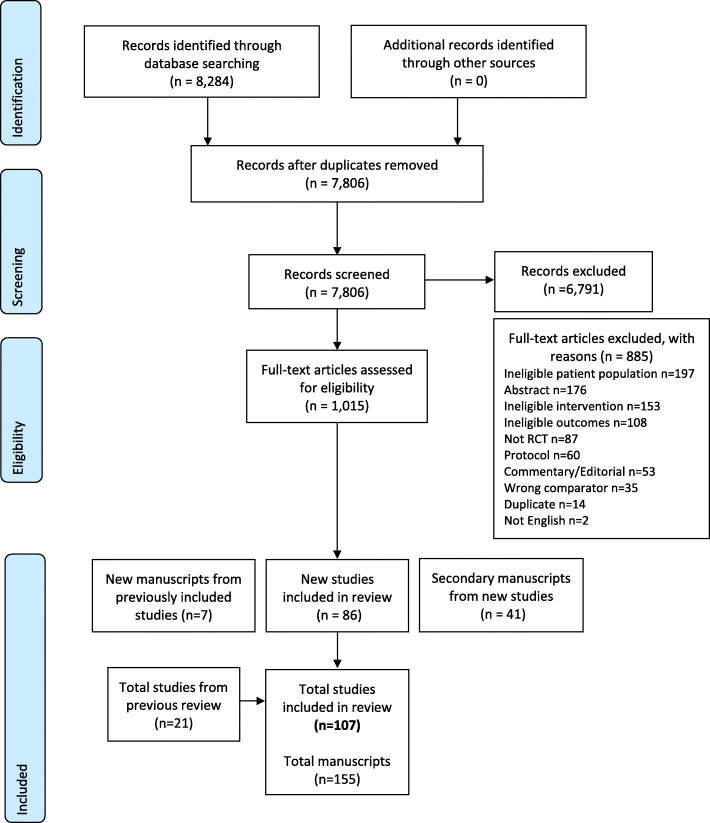
MEDLINE, EMBASE, CINAHL and SPORTDiscus databases were searched from 2012 to 2020. Eligible studies were RCTs of at least 4 weeks of aerobic and/or resistance exercise that reported on physiological outcomes relating to exercise (e.g., aerobic capacity, muscular strength) in people with cancer other than breast or prostate.
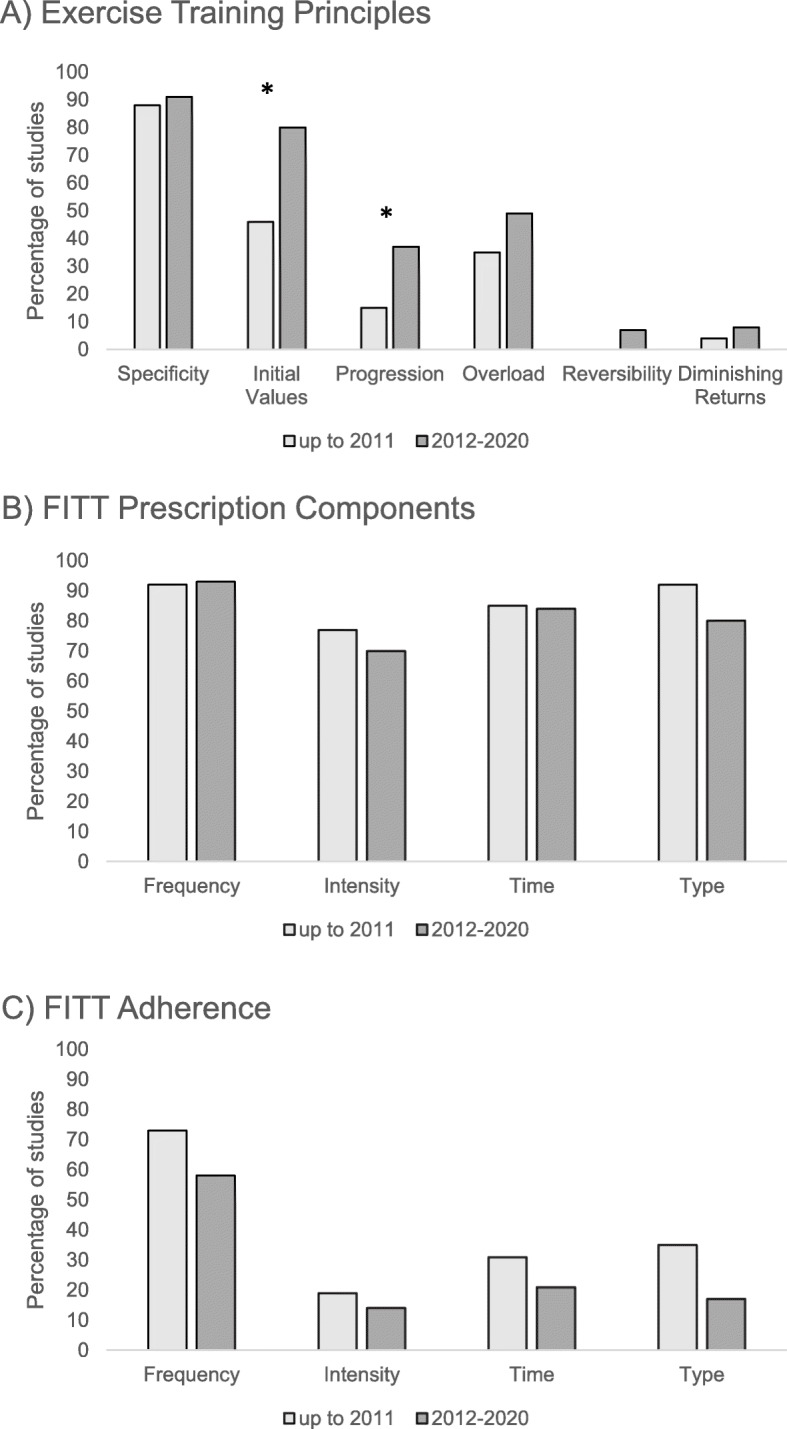
Eighty-six new studies were identified in the updated search, for a total of 107 studies included in this review. The principle of specificity was applied by 91%, progression by 32%, overload by 46%, initial values by 72%, reversibility by 7% and diminishing returns by 5%. A significant increase in the percentage of studies that appropriately reported initial values (46 to 80%, p < 0.001) and progression (15 to 37%, p = 0.039) was found for studies published after 2011 compared to older studies. All four FITT prescription components were fully reported in the methods in 58% of all studies, which was higher than the proportion that fully reported adherence to the FITT prescription components in the results (7% of studies). Reporting of the FITT exercise prescription components and FITT adherence did not improve in studies published after 2011 compared to older studies.
Full reporting of exercise prescription and adherence still needs improvement within exercise oncology RCTs. Some aspects of exercise intervention reporting have improved since 2011, including the reporting of the principles of progression and initial values. Enhancing the reporting of exercise prescriptions, particularly FITT adherence, may provide better context for interpreting study results and improve research to practice translation.
本系统评价的主要目的是更新我们之前关于除乳腺癌和前列腺癌以外的癌症的随机对照试验(RCT)的综述,评估:1)在运动处方中应用运动训练原则;2)报告运动处方成分(即频率、强度、时间和类型(FITT));3)报告参与者对 FITT 的依从性。次要目的是检查这些干预措施的报告是否随时间有所改善。
从 2012 年到 2020 年,我们在 MEDLINE、EMBASE、CINAHL 和 SPORTDiscus 数据库中进行了搜索。纳入的研究为至少 4 周的有氧运动和/或抗阻运动的 RCT,报告了除乳腺癌和前列腺癌以外的癌症患者与运动相关的生理结果(如有氧能力、肌肉力量)。
在更新的搜索中发现了 86 项新研究,共有 107 项研究纳入本综述。特异性原则的应用率为 91%,进展率为 32%,超负荷率为 46%,初始值报告率为 72%,可逆性为 7%,收益递减为 5%。与较旧的研究相比,发现 2011 年后发表的研究中,适当报告初始值(46%至 80%,p<0.001)和进展(15%至 37%,p=0.039)的研究比例显著增加。所有四项 FITT 处方成分在 58%的研究中都在方法中得到了充分报告,高于在结果中充分报告 FITT 处方成分依从性的研究比例(7%的研究)。与较旧的研究相比,2011 年后发表的研究中,FITT 运动处方成分和 FITT 依从性的报告并没有改善。
在运动肿瘤学 RCT 中,运动处方和依从性的全面报告仍需改进。自 2011 年以来,运动干预报告的某些方面有所改善,包括进展和初始值原则的报告。增强运动处方的报告,特别是 FITT 依从性,可以为解释研究结果提供更好的背景,并促进研究向实践的转化。