The Institute for Drug Research, The School of Pharmacy, The Faculty of Medicine , The Hebrew University , Jerusalem 9112001 , Israel.
Faculty of Engineering and The Institute of Nanotechnology and Advanced Materials , Bar-Ilan University , Ramat Gan 5290002 , Israel.
Nano Lett. 2018 Mar 14;18(3):1582-1591. doi: 10.1021/acs.nanolett.7b03813. Epub 2018 Feb 22.
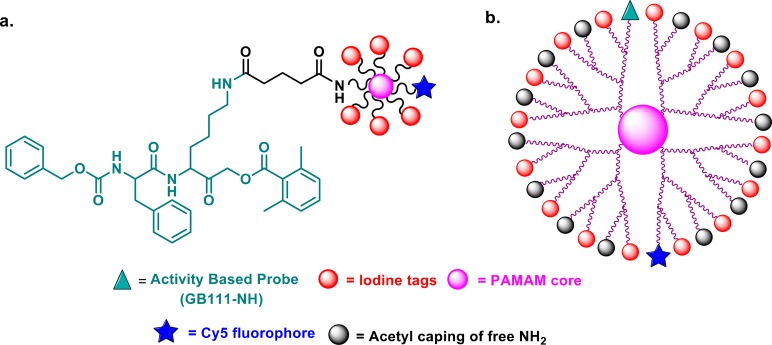
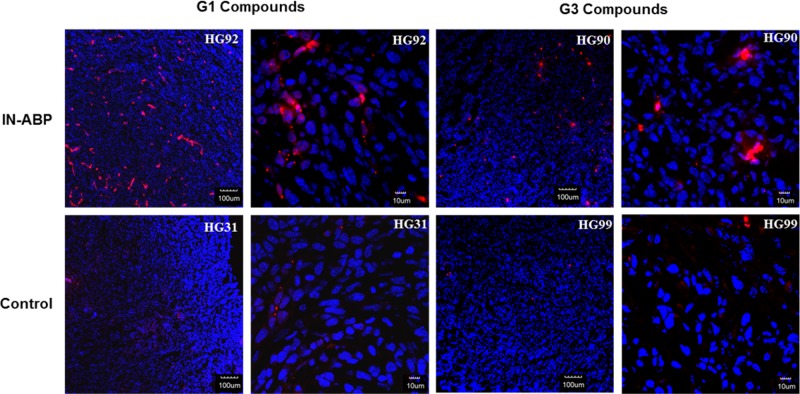
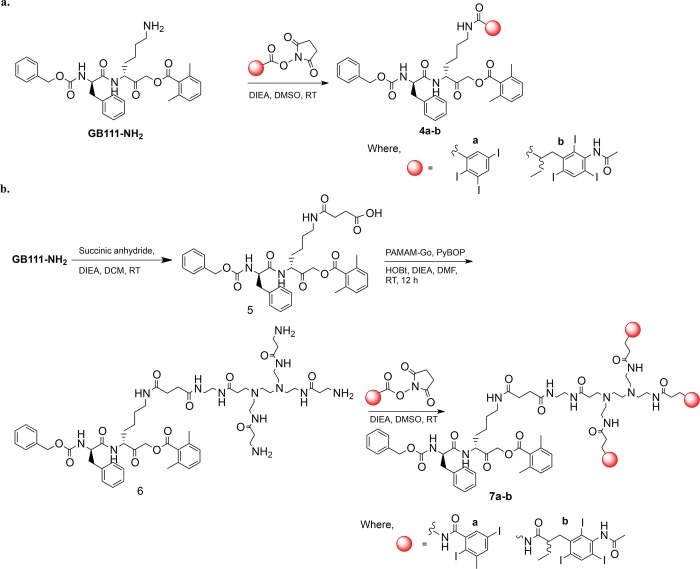
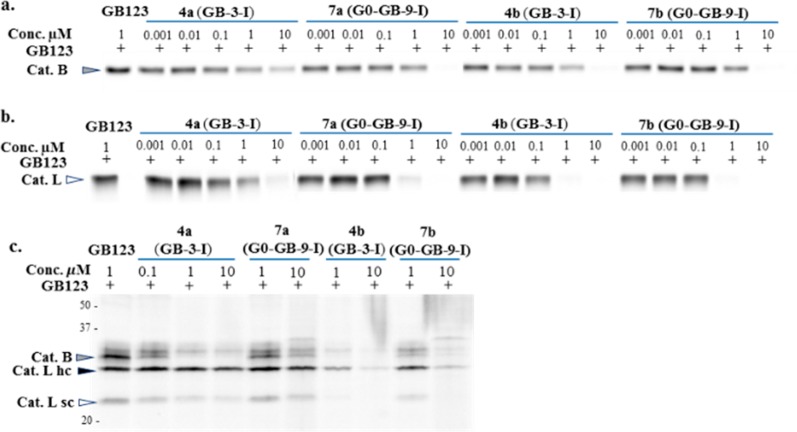
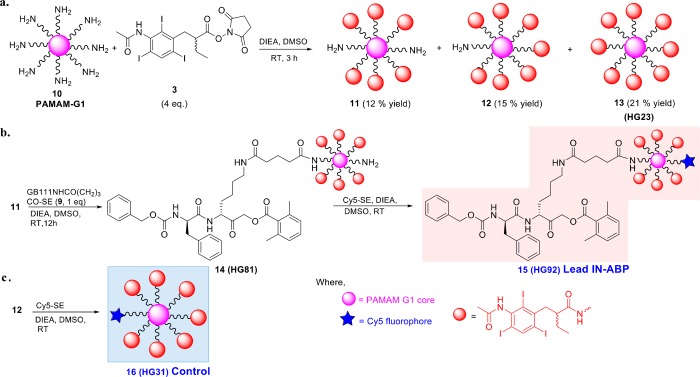
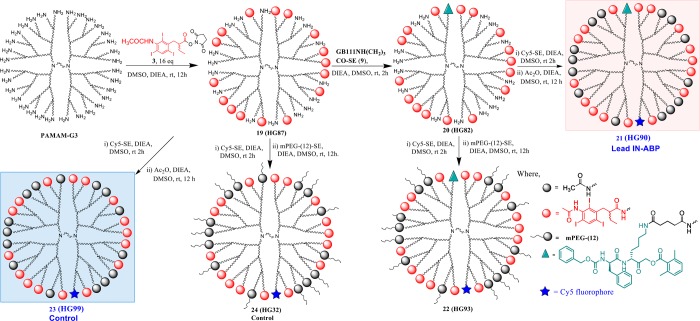
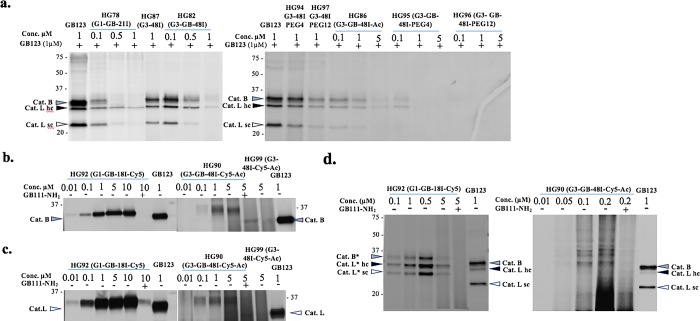
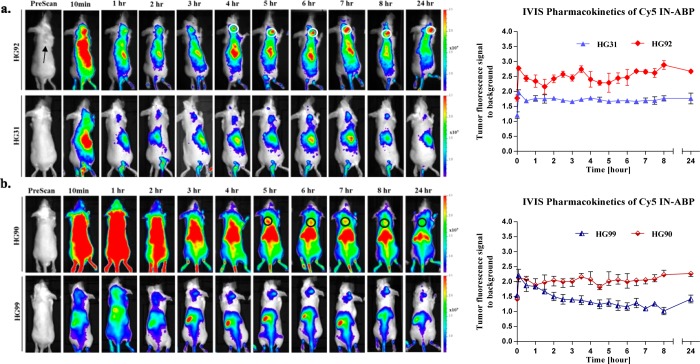
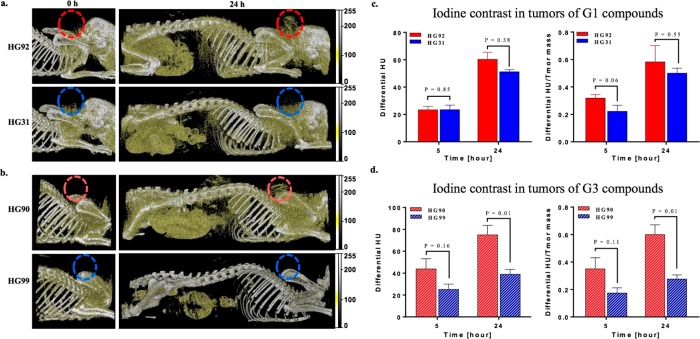
X-ray computed tomography (CT) is a robust, precise, fast, and reliable imaging method that enables excellent spatial resolution and quantification of contrast agents throughout the body. However, CT is largely inadequate for molecular imaging applications due mainly to its low contrast sensitivity that forces the use of large concentrations of contrast agents for detection. To overcome this limitation, we generated a new class of iodinated nanoscale activity-based probes (IN-ABPs) that sufficiently accumulates at the target site by covalently binding cysteine cathepsins that are exceptionally highly expressed in cancer. The IN-ABPs are comprised of a short targeting peptide selective to specific cathepsins, an electrophilic moiety that allows activity-dependent covalent binding, and tags containing dendrimers with up to 48 iodine atoms. IN-ABPs selectively bind and inhibit activity of recombinant and intracellular cathepsin B, L, and S. We compared the in vivo kinetics, biodistribution, and tumor accumulation of IN-ABPs bearing 18 and 48 iodine atoms each, and their control counterparts lacking the targeting moiety. Here we show that although both IN-ABPs bind specifically to cathepsins within the tumor and produce detectable CT contrast, the 48-iodine bearing IN-ABP was found to be optimal with signals over 2.1-fold higher than its nontargeted counterpart. In conclusion, this study shows the synthetic feasibility and potential utility of IN-ABPs as potent contrast agents that enable molecular imaging of tumors using CT.
X 射线计算机断层扫描(CT)是一种强大、精确、快速且可靠的成像方法,能够实现出色的空间分辨率和对全身对比剂的定量。然而,由于其对比度灵敏度低,迫使使用大量浓度的对比剂进行检测,因此 CT 在很大程度上不适合用于分子成像应用。为了克服这一限制,我们生成了一类新型碘纳米级活性探针(IN-ABPs),通过与在癌症中异常高表达的半胱氨酸组织蛋白酶共价结合,足以在靶部位积累。IN-ABPs 由短靶向肽组成,对特定的组织蛋白酶具有选择性,具有亲电部分,允许基于活性的共价结合,以及带有多达 48 个碘原子的树状聚合物标签。IN-ABPs 选择性地结合并抑制重组和细胞内组织蛋白酶 B、L 和 S 的活性。我们比较了每个 IN-ABP 带有 18 个和 48 个碘原子的体内动力学、生物分布和肿瘤积累情况,以及缺乏靶向部分的对照物。在这里,我们表明,尽管两种 IN-ABP 都特异性地与肿瘤内的组织蛋白酶结合,并产生可检测的 CT 对比,但带有 48 个碘原子的 IN-ABP 被发现是最佳的,其信号比非靶向物高 2.1 倍以上。总之,这项研究表明了 IN-ABPs 作为强大的对比剂的合成可行性和潜在用途,可使用 CT 进行肿瘤的分子成像。