Mosquitos Vetores: Endossimbiontes e Interação Patógeno-Vetor, Instituto de Pesquisas René Rachou, Fiocruz, Belo Horizonte, MG, Brazil.
Laboratório de Biologia Molecular de Insetos, Instituto Oswaldo Cruz, Fiocruz, Rio de Janeiro, RJ, Brazil.
Parasit Vectors. 2018 Feb 22;11(1):109. doi: 10.1186/s13071-018-2695-x.
Mosquito-borne diseases are rapidly spreading to vast territories, putting at risk most of the world's population. A key player in this scenario is Aedes aegypti, a hematophagous species which hosts and transmits viruses causing dengue and other serious illnesses. Since vector control strategies relying only on insecticides have proven unsustainable, an alternative method involving the release of Wolbachia-harboring individuals has emerged. Its successful implementation vastly depends on how fit the released individuals are in the natural habitat, being able to mate with wild populations and to spread Wolbachia to subsequent generations. In mosquitoes, an important aspect of reproductive fitness is the acoustic communication between males and females, which translates to interactions between harmonic frequencies in close proximity flight. This study aimed to characterize the flight tone produced by individuals harboring Wolbachia, also evaluating their ability to establish stable acoustic interactions.
Wild-type (WT) and Wolbachia-harboring specimens (wMelBr) were thorax-tethered to blunt copper wires and placed at close proximity to sensitive microphones. Wing-beat frequencies (WBFs) were characterized at fundamental and harmonic levels, for both single individuals and couples. Harmonic interactions in homogeneous and heterogeneous couples of WT and wMelBr variants were identified, categorized and quantified accordingly.
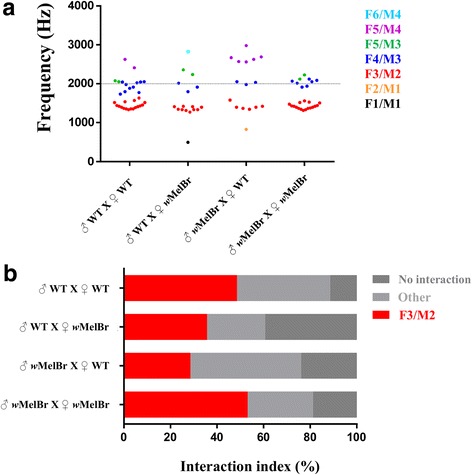
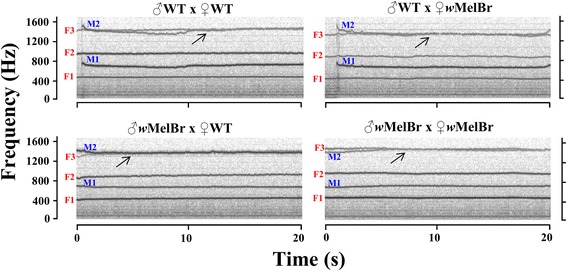
In tethered 'solo' flights, individuals harboring Wolbachia developed WBFs, differing slightly, in a sex-dependent way, from those of the WT strain. To test the ability to form harmonic 'duets', tethered couples of wMelBr and WT individuals were shuffled in different sex pairs and had their flight tones analyzed. All couple types, with WT and/or wMelBr individuals, were able to interact acoustically in the frequency range of 1300-1500 Hz, which translates to the convergence between male's second harmonic and female's third. No significant differences were found in the proportions of interacting couples between the pair types. Surprisingly, spectrograms also revealed the convergence between alternative harmonic frequencies, inside and outside the species putative hearing threshold.
Wolbachia infection leads to small sex-dependent changes on the flight tones of Ae. aegypti, but it does not seem to prevent the stereotyped harmonic interaction between males and females. Therefore, when released in the natural habitat to breed with native individuals, Wolbachia-harboring individuals shall be fit enough to meet the criteria of acoustically-related mating behavior and promote bacteria dispersion effectively.
蚊媒疾病正在迅速蔓延到大片领土,使世界上大多数人口面临风险。在这种情况下,埃及伊蚊是一个关键角色,它是一种吸血物种,携带并传播导致登革热和其他严重疾病的病毒。由于仅依靠杀虫剂的病媒控制策略已被证明是不可持续的,因此出现了一种涉及释放携带沃尔巴克氏体的个体的替代方法。其成功实施在很大程度上取决于释放的个体在自然栖息地中的适应性,即能够与野生种群交配并将沃尔巴克氏体传播给后代。在蚊子中,生殖适应性的一个重要方面是雄性和雌性之间的声学通讯,这转化为近距离飞行中谐波频率之间的相互作用。本研究旨在表征携带沃尔巴克氏体的个体产生的飞行音,并评估它们建立稳定声学相互作用的能力。
将野生型(WT)和携带沃尔巴克氏体的标本(wMelBr)胸部系在钝铜线上,并将其放置在靠近灵敏麦克风的地方。在单个个体和个体对的基础和谐波水平上,对翼拍频率(WBF)进行了特征描述。确定、分类和量化了同质和异质 WT 和 wMelBr 变体个体对之间的谐波相互作用。
在系绳的“独奏”飞行中,携带沃尔巴克氏体的个体产生的 WBF 略有不同,在性别上存在依赖关系,与 WT 菌株不同。为了测试形成谐波“二重奏”的能力,将携带 wMelBr 和 WT 个体的系绳个体对混合在不同的性别对中,并对它们的飞行音进行了分析。所有的个体对类型,无论是 WT 还是 wMelBr 个体,都能够在 1300-1500 Hz 的频率范围内进行声学相互作用,这转化为雄性的第二谐波和雌性的第三谐波的收敛。在个体对类型之间,相互作用的个体对的比例没有发现显著差异。令人惊讶的是,声谱图还揭示了种内和种外替代谐波频率之间的收敛。
沃尔巴克氏体感染导致埃及伊蚊的飞行音出现小的性别依赖变化,但它似乎不会阻止雄性和雌性之间刻板的谐波相互作用。因此,当在自然栖息地中释放以与本地个体交配并有效传播细菌时,携带沃尔巴克氏体的个体应该足够适应,以满足与声学相关的交配行为的标准,并有效地促进细菌的传播。