Mostafa Ashraf A, Al-Askar Abdulaziz A, Almaary Khalid S, Dawoud Turki M, Sholkamy Essam N, Bakri Marwah M
Botany and Microbiology Dept., College of Science, King Saud University, P.O. 2455, Riyadh 11451, Saudi Arabia.
National Institute of Oceanography and Fisheries, Al-Kanater Fish Research Station, Egypt.
Saudi J Biol Sci. 2018 Feb;25(2):361-366. doi: 10.1016/j.sjbs.2017.02.004. Epub 2017 Feb 24.
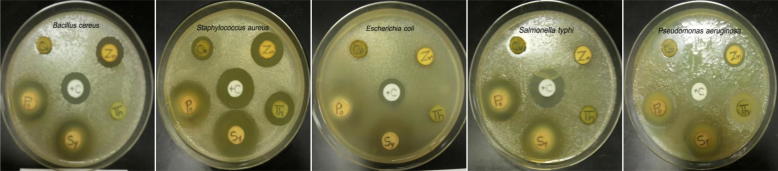
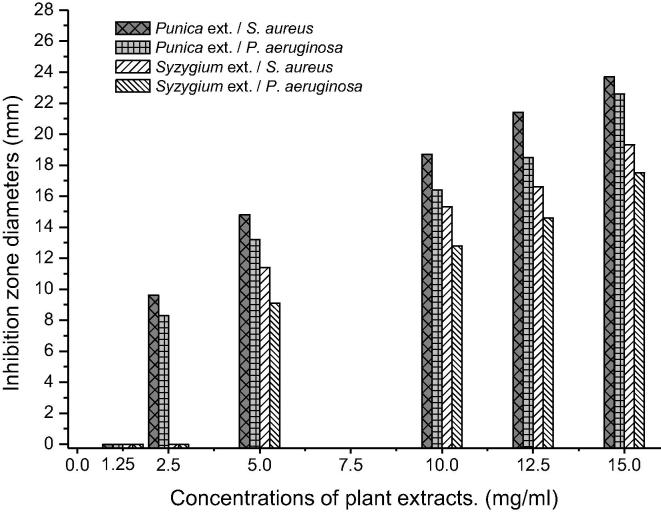
Prevention of food spoilage and food poisoning pathogens is usually achieved by use of chemical preservatives which have negative impacts including: human health hazards of the chemical applications, chemical residues in food & feed chains and acquisition of microbial resistance to the used chemicals. Because of such concerns, the necessity to find a potentially effective, healthy safer and natural alternative preservatives is increased. Within these texts, Plant extracts have been used to control food poisoning diseases and preserve foodstuff. Antimicrobial activity of five plant extracts were investigated against , , , and using agar disc diffusion technique. Ethanolic extracts of , and were potentially effective with variable efficiency against the tested bacterial strains at concentration of 10 mg/ml while extract of was only effective against respectively. and ethanolic extracts were the most effective plant extracts and showed bacteriostatic and bactericidal activities against the highly susceptible strains of food borne pathogenic bacteria ( and ) with MIC's ranged from 2.5 to 5.0 mg/ml and MBC of 5.0 and 10 mg/ml except . which was less sensitive and its MBC reached to 12.5 mg/ml of respectively. These plant extracts which proved to be potentially effective can be used as natural alternative preventives to control food poisoning diseases and preserve food stuff avoiding healthy hazards of chemically antimicrobial agent applications.
预防食品腐败和食物中毒病原体通常通过使用化学防腐剂来实现,而化学防腐剂具有负面影响,包括:化学物质应用对人体健康的危害、食品和饲料链中的化学残留以及微生物对所用化学物质产生抗性。由于这些问题,寻找一种潜在有效、健康安全且天然的替代防腐剂的必要性日益增加。在这些文献中,植物提取物已被用于控制食物中毒疾病和保存食品。采用琼脂平板扩散技术研究了五种植物提取物对[此处细菌名称缺失]、[此处细菌名称缺失]、[此处细菌名称缺失]、[此处细菌名称缺失]和[此处细菌名称缺失]的抗菌活性。[此处植物名称缺失]、[此处植物名称缺失]和[此处植物名称缺失]的乙醇提取物在浓度为10毫克/毫升时对测试的细菌菌株具有不同程度的潜在有效性,而[此处植物名称缺失]的提取物仅分别对[此处细菌名称缺失]有效。[此处植物名称缺失]和[此处植物名称缺失]的乙醇提取物是最有效的植物提取物,对食源性病原体的高度敏感菌株([此处细菌名称缺失]和[此处细菌名称缺失])表现出抑菌和杀菌活性,其最低抑菌浓度(MIC)范围为2.5至5.0毫克/毫升,最低杀菌浓度(MBC)分别为5.0和10毫克/毫升,但[此处细菌名称缺失]除外,其敏感性较低,其对[此处细菌名称缺失]的MBC达到12.5毫克/毫升。这些被证明具有潜在有效性的植物提取物可用作天然替代防腐剂,以控制食物中毒疾病和保存食品,避免化学抗菌剂应用带来的健康危害。