Institute of Cognitive Sciences and Technologies, National Research Council, Rome, Italy.
City, University of London, London, UK; Wellcome Trust Centre for Neuroimaging, UCL, London, UK.
Trends Cogn Sci. 2018 Apr;22(4):294-306. doi: 10.1016/j.tics.2018.01.009. Epub 2018 Feb 20.
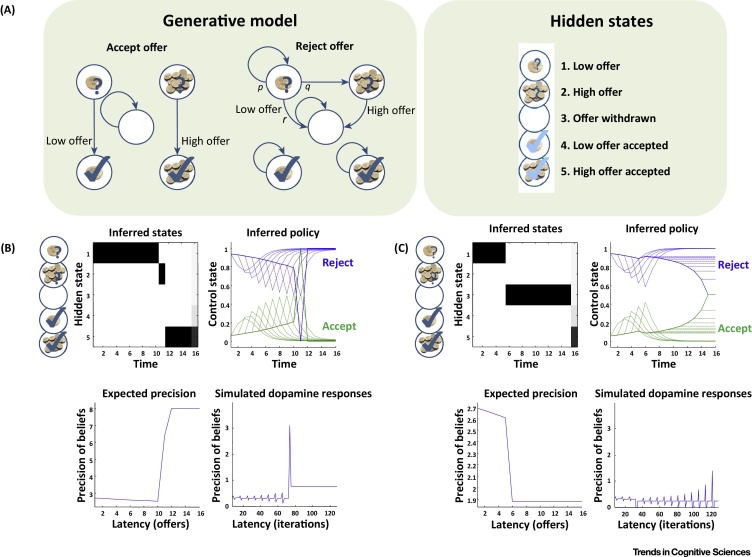
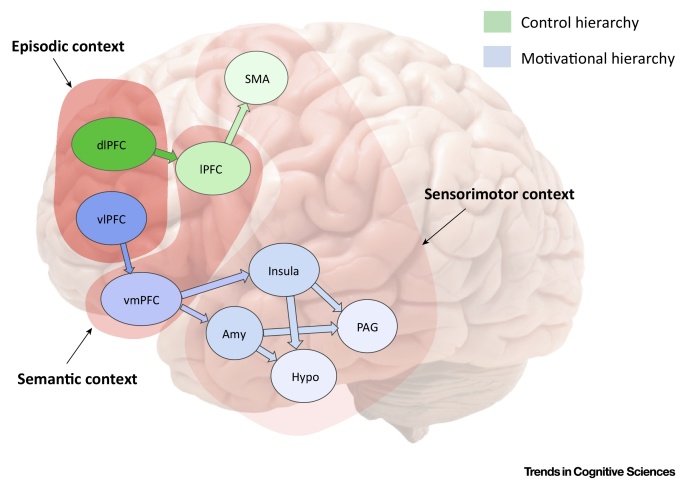
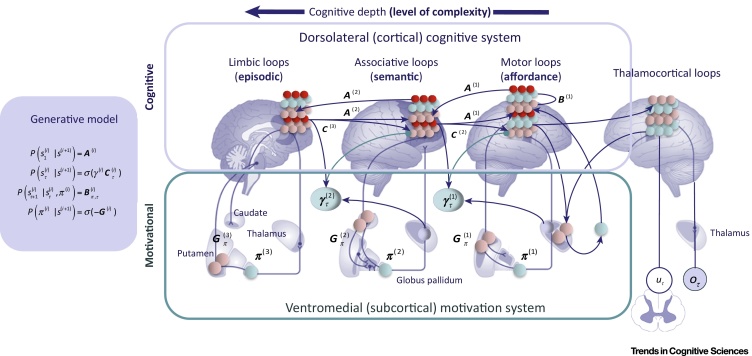
Motivated control refers to the coordination of behaviour to achieve affectively valenced outcomes or goals. The study of motivated control traditionally assumes a distinction between control and motivational processes, which map to distinct (dorsolateral versus ventromedial) brain systems. However, the respective roles and interactions between these processes remain controversial. We offer a novel perspective that casts control and motivational processes as complementary aspects - goal propagation and prioritization, respectively - of active inference and hierarchical goal processing under deep generative models. We propose that the control hierarchy propagates prior preferences or goals, but their precision is informed by the motivational context, inferred at different levels of the motivational hierarchy. The ensuing integration of control and motivational processes underwrites action and policy selection and, ultimately, motivated behaviour, by enabling deep inference to prioritize goals in a context-sensitive way.
动机控制是指协调行为以实现情感价值的结果或目标。动机控制的研究传统上假定控制和动机过程之间存在区别,这些过程映射到不同的(背外侧与腹内侧)大脑系统。然而,这些过程的各自作用和相互作用仍然存在争议。我们提供了一个新的视角,将控制和动机过程视为主动推断和深层生成模型下的层级目标处理的互补方面——分别是目标传播和优先级排序。我们提出,控制层次结构传播先前的偏好或目标,但它们的精度由动机环境决定,在动机层次结构的不同层次上推断出来。控制和动机过程的后续整合通过使深度推断能够以上下文敏感的方式优先考虑目标,从而为行动和策略选择,最终为动机行为提供支持。