Institute of Immunology, Biomedical Sciences Research Center (BSRC), 'Alexander Fleming', Vari, Greece.
Faculty of Medicine, University of Crete, Heraklion, Greece.
Ann Rheum Dis. 2018 Jun;77(6):926-934. doi: 10.1136/annrheumdis-2017-212597. Epub 2018 Feb 23.
Patients with rheumatoid arthritis and spondyloarthritisshow higher mortality rates, mainly caused by cardiac comorbidities. The TghuTNF (Tg197) arthritis model develops tumour necrosis factor (TNF)-driven and mesenchymalsynovial fibroblast (SF)-dependent polyarthritis. Here, we investigate whether this model develops, similarly to human patients, comorbid heart pathology and explore cellular and molecular mechanisms linking arthritis to cardiac comorbidities.
Histopathological analysis and echocardiographic evaluation of cardiac function were performed in the Tg197 model. Valve interstitial cells (VICs) were targeted by mice carrying the transgene. Tg197 and Tg197 mutant mice were used to explore the role of mesenchymal TNF signalling in the development of heart valve disease. Pathogenic VICs and SFs were further analysed by comparative RNA-sequencing analysis.
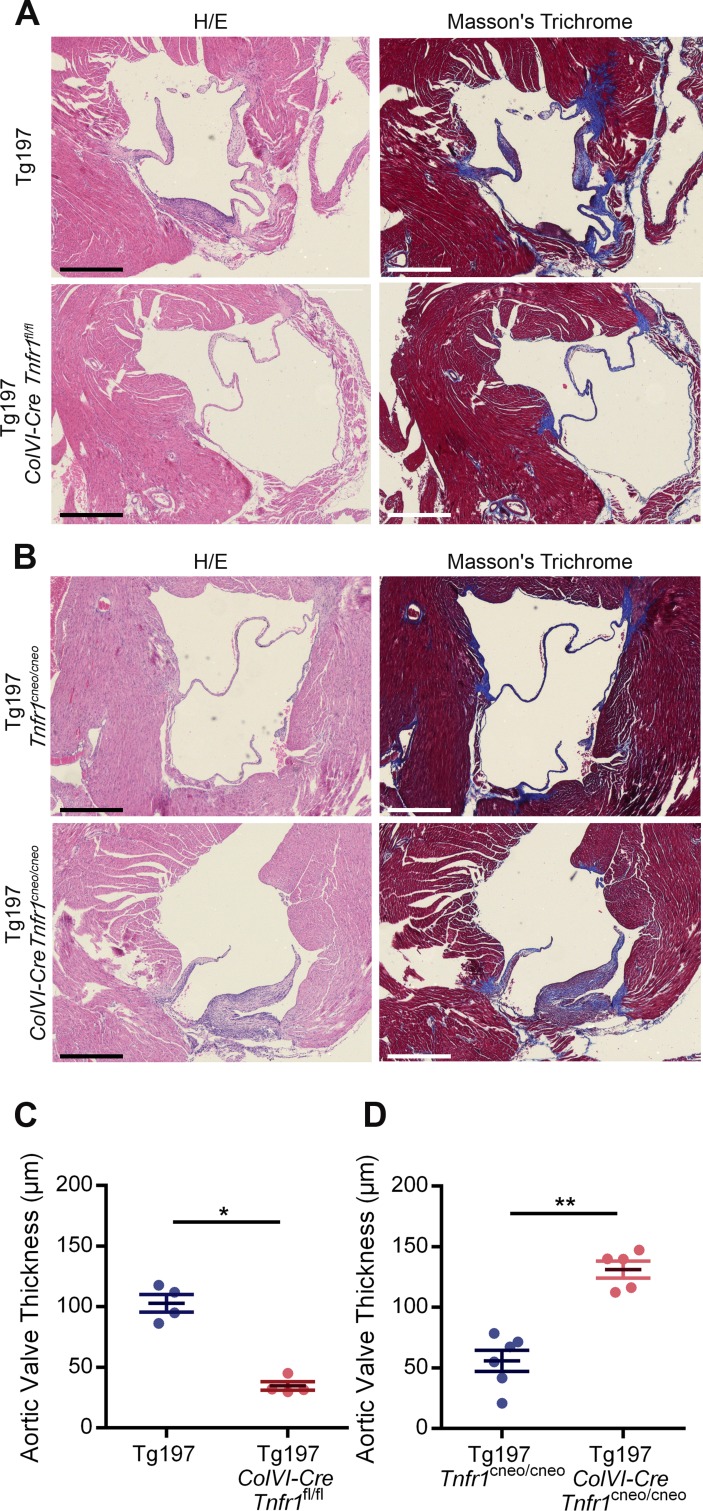
Tg197 mice develop left-sided heart valve disease, characterised by valvular fibrosis with minimal signs of inflammation. Thickened valve areas consist almost entirely of hyperproliferative -expressing mesenchymal VICs. Development of pathology results in valve stenosis and left ventricular dysfunction, accompanied by arrhythmic episodes and, occasionally, valvular regurgitation. TNF dependency of the pathology was indicated by disease modulation following pharmacological inhibition or mesenchymal-specific genetic ablation or activation of TNF/TNFR1 signalling. Tg197-derived VICs exhibited an activated phenotype o, reminiscent of the activated pathogenic phenotype of Tg197-derived SFs. Significant functional similarities between SFs and VICs were revealed by RNA-seq analysis, demonstrating common cellular mechanisms underlying TNF-mediated arthritides and cardiac comorbidities.
Comorbidheart valve disease and chronic polyarthritis are efficiently modelled in the Tg197 arthritis model and share common TNF/TNFR1-mediated, mesenchymal cell-specific aetiopathogenic mechanisms.
类风湿关节炎和脊柱关节炎患者的死亡率较高,主要是由心脏合并症引起的。Tg197TNF(Tg197)关节炎模型发展为肿瘤坏死因子(TNF)驱动和间充质滑膜成纤维细胞(SF)依赖性多关节炎。在这里,我们研究了这种模型是否会像人类患者一样发展出合并的心脏病理学,并探讨了将关节炎与心脏合并症联系起来的细胞和分子机制。
在 Tg197 模型中进行心脏功能的组织病理学分析和超声心动图评估。携带转基因的小鼠靶向瓣膜间质细胞(VIC)。使用 Tg197 和 Tg197 突变小鼠来探索间充质 TNF 信号在心脏瓣膜疾病发展中的作用。进一步通过比较 RNA 测序分析来分析致病的 VIC 和 SF。
Tg197 小鼠发生左侧心脏瓣膜疾病,其特征为瓣膜纤维化,炎症迹象很少。增厚的瓣膜区域几乎完全由过度增殖的表达间充质的 VIC 组成。病理学的发展导致瓣膜狭窄和左心室功能障碍,伴有心律失常发作,偶尔伴有瓣膜反流。病理学的 TNF 依赖性通过药理学抑制或间充质特异性基因敲除或 TNF/TNFR1 信号的激活来调节。Tg197 衍生的 VIC 表现出激活的表型,类似于 Tg197 衍生的 SF 的激活的致病表型。SF 和 VIC 之间的显著功能相似性通过 RNA-seq 分析揭示,证明了 TNF 介导的关节炎和心脏合并症的共同细胞机制。
Tg197 关节炎模型有效地模拟了合并的心脏瓣膜疾病和慢性多关节炎,并共享 TNF/TNFR1 介导的、间充质细胞特异性的共同发病机制。