Xiong Guoping, He Pingge, Lyu Zhipeng, Chen Tengfei, Huang Boyun, Chen Lei, Fisher Timothy S
Birck Nanotechnology Center, Purdue University, West Lafayette, IN, 47907, USA.
School of Mechanical Engineering, Purdue University, West Lafayette, IN, 47907, USA.
Nat Commun. 2018 Feb 23;9(1):790. doi: 10.1038/s41467-018-03112-3.
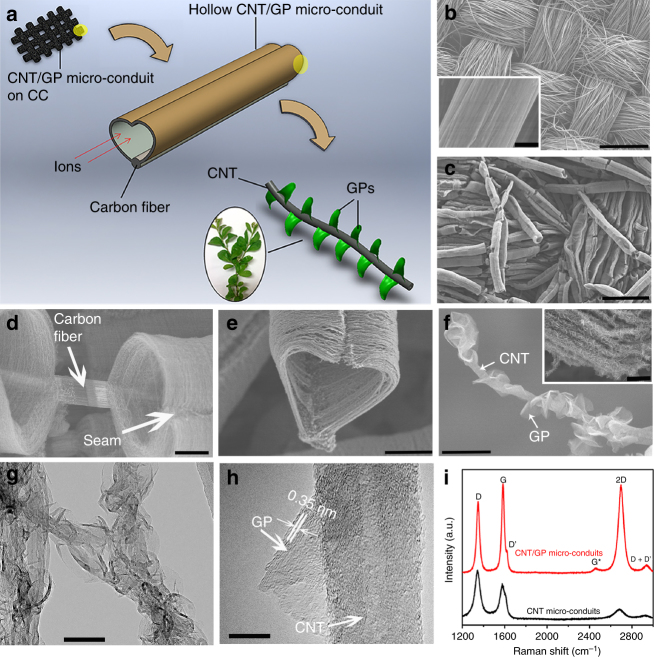
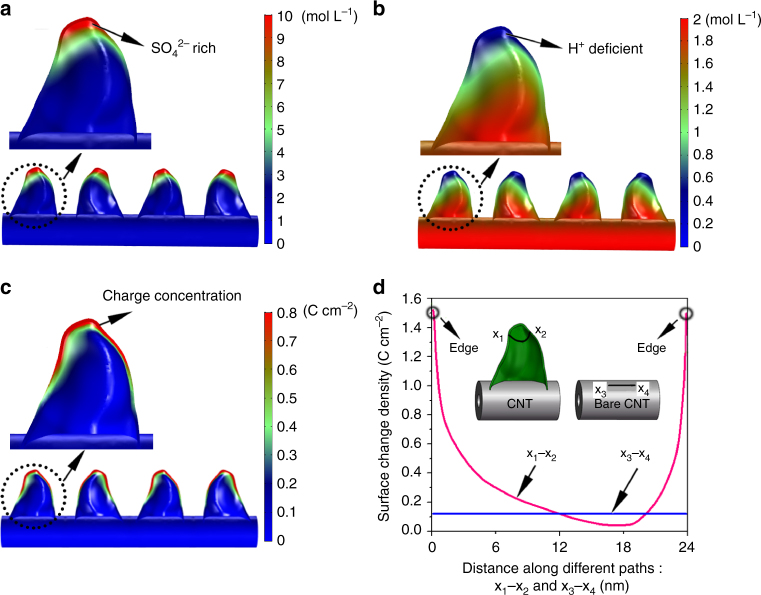
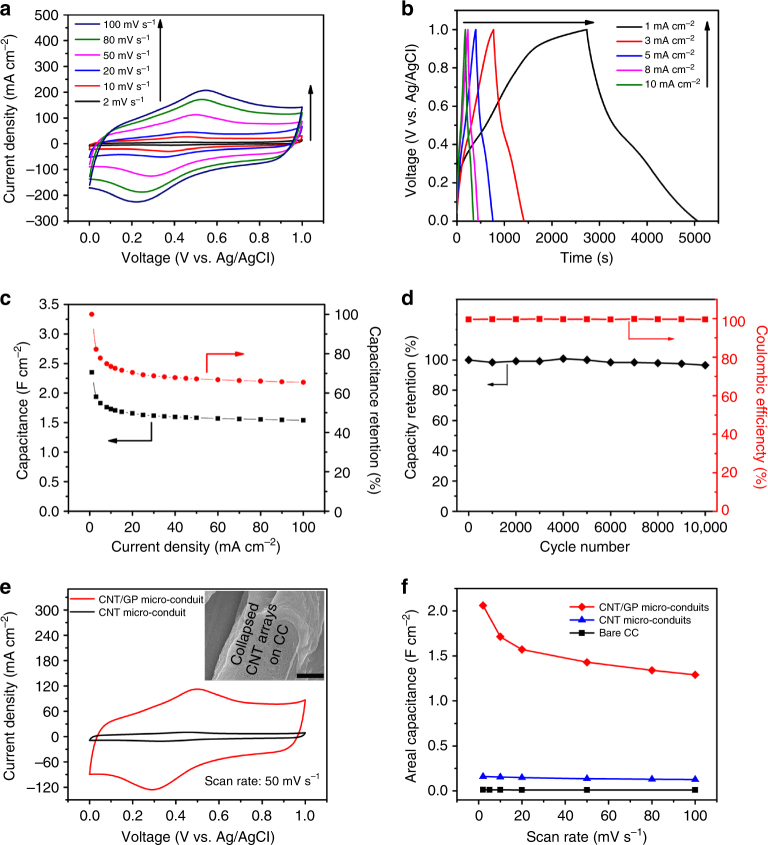
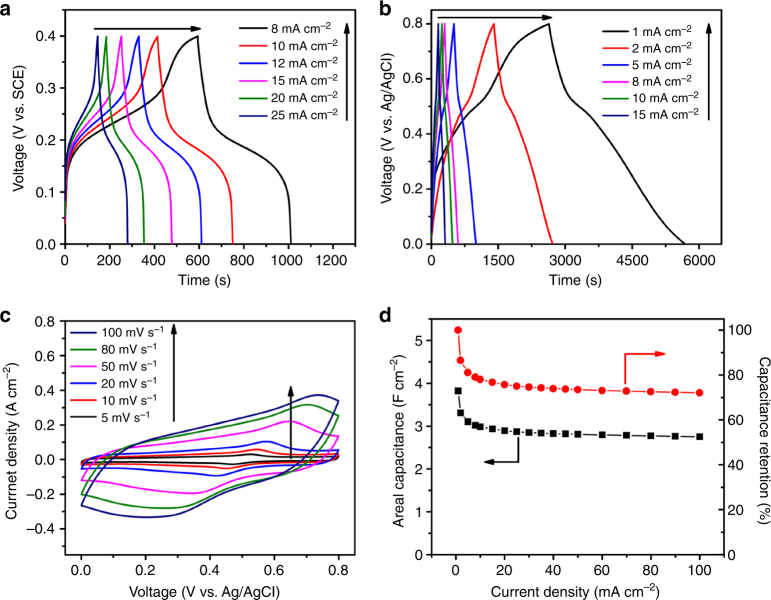
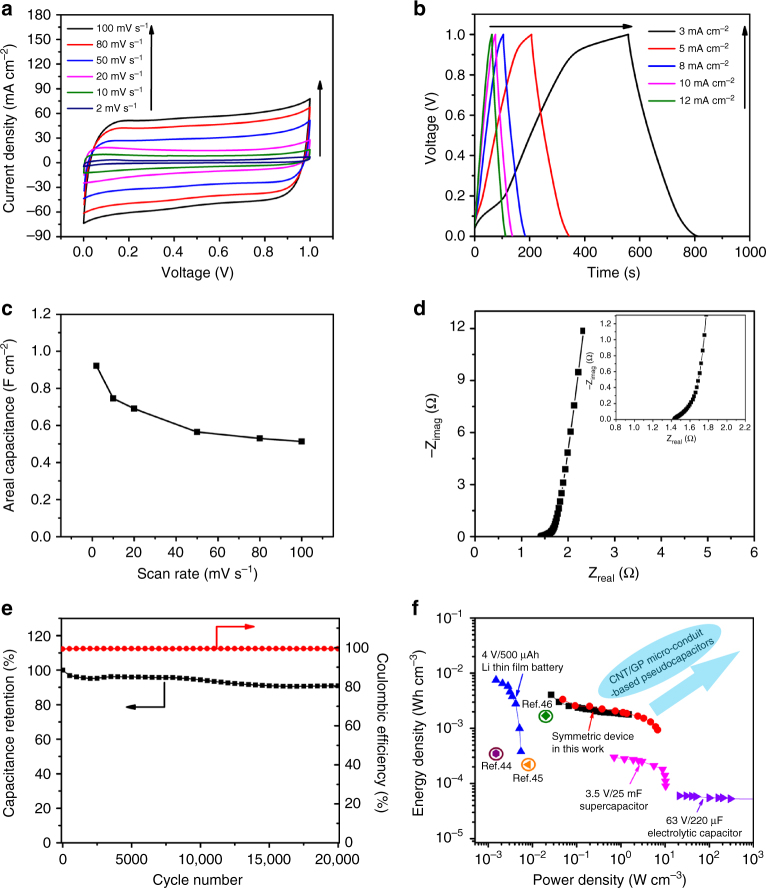
Designing electrodes in a highly ordered structure simultaneously with appropriate orientation, outstanding mechanical robustness, and high electrical conductivity to achieve excellent electrochemical performance remains a daunting challenge. Inspired by the phenomenon in nature that leaves significantly increase exposed tree surface area to absorb carbon dioxide (like ions) from the environments (like electrolyte) for photosynthesis, we report a design of micro-conduits in a bioinspired leaves-on-branchlet structure consisting of carbon nanotube arrays serving as branchlets and graphene petals as leaves for such electrodes. The hierarchical all-carbon micro-conduit electrodes with hollow channels exhibit high areal capacitance of 2.35 F cm (~500 F g based on active material mass), high rate capability and outstanding cyclic stability (capacitance retention of ~95% over 10,000 cycles). Furthermore, Nernst-Planck-Poisson calculations elucidate the underlying mechanism of charge transfer and storage governed by sharp graphene petal edges, and thus provides insights into their outstanding electrochemical performance.
设计具有高度有序结构的电极,同时具备合适的取向、出色的机械稳健性和高导电性,以实现优异的电化学性能,仍然是一项艰巨的挑战。受自然界中树叶显著增加树木表面积以从环境(如电解质)中吸收二氧化碳(如离子)进行光合作用这一现象的启发,我们报道了一种受生物启发的小枝上叶片结构中的微导管设计,该结构由作为小枝的碳纳米管阵列和作为叶片的石墨烯花瓣组成,用于此类电极。具有中空通道的分级全碳微导管电极表现出2.35 F/cm²的高面积电容(基于活性材料质量约为500 F/g)、高倍率性能和出色的循环稳定性(在10000次循环中电容保持率约为95%)。此外,能斯特 - 普朗克 - 泊松计算阐明了由尖锐的石墨烯花瓣边缘控制的电荷转移和存储的潜在机制,从而为它们出色的电化学性能提供了见解。