Centre d'Etudes Biologiques de Chizé, UMR 7372, CNRS/Université de La Rochelle, Villiers-en-Bois, France.
J Anim Ecol. 2018 Jul;87(4):945-955. doi: 10.1111/1365-2656.12817. Epub 2018 Mar 30.
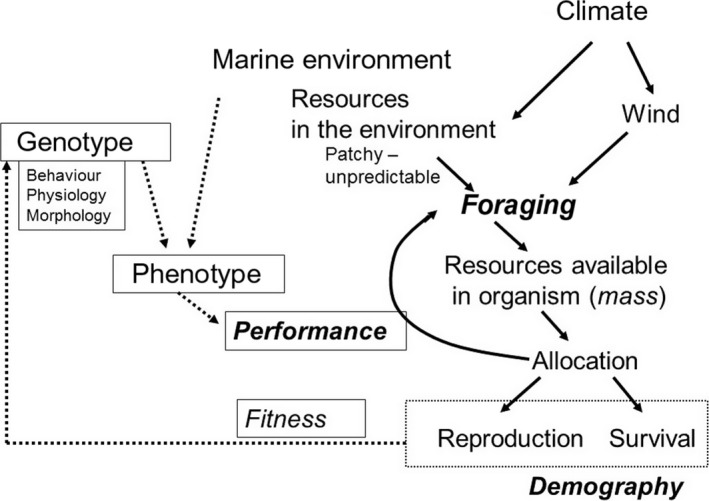
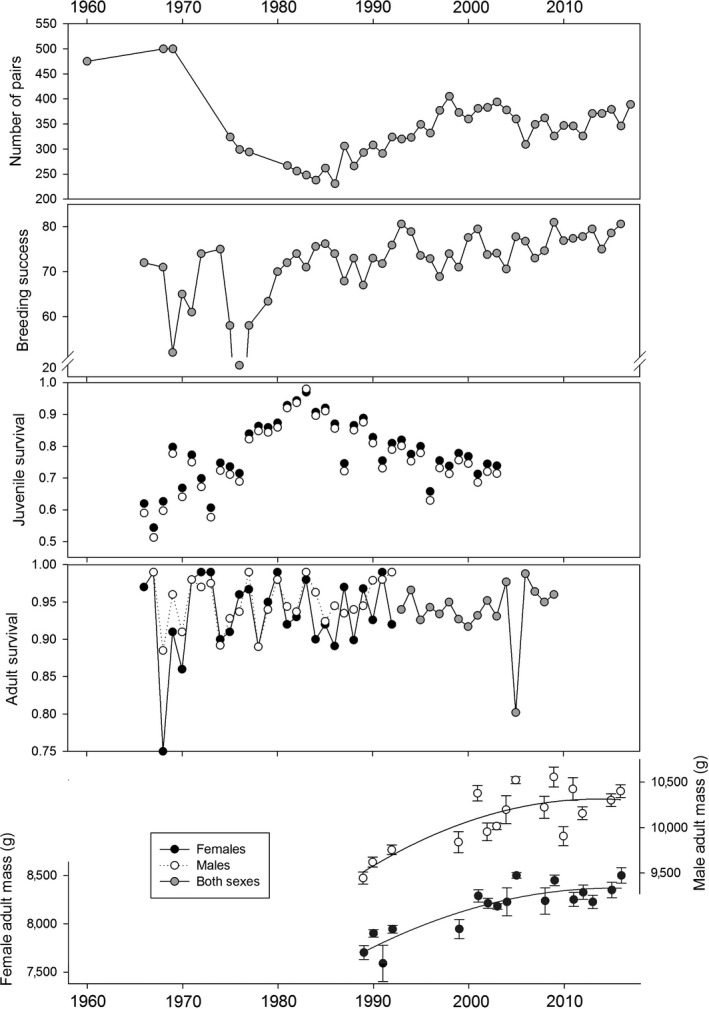
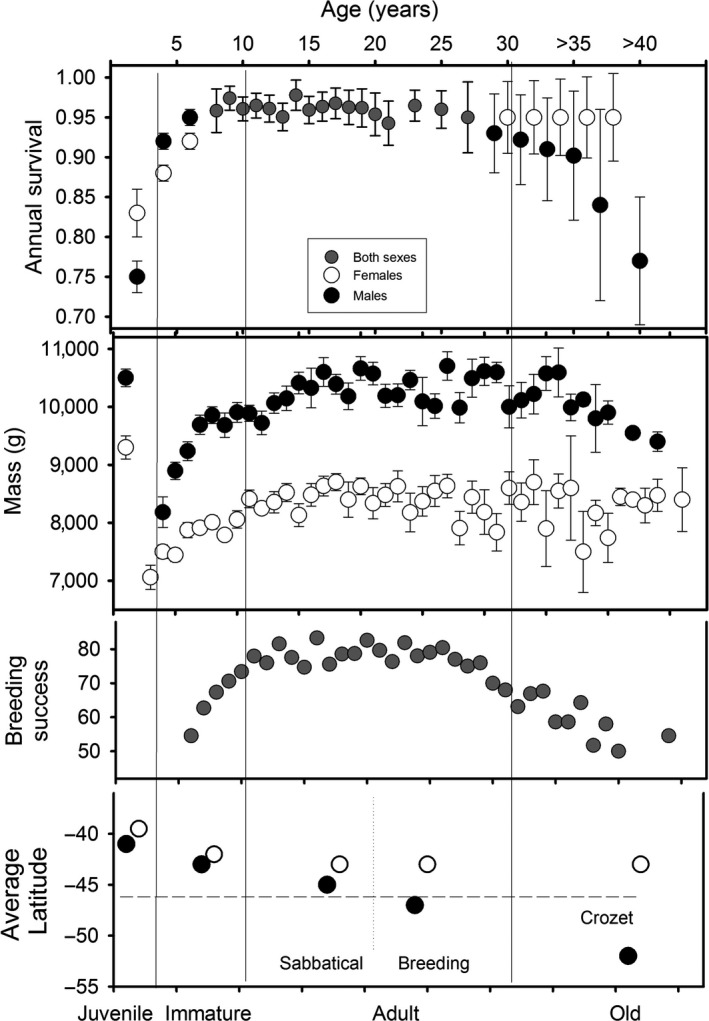
Population dynamics and foraging ecology are two fields of the population ecology that are generally studied separately. Yet, foraging determines allocation processes and therefore demography. Studies on wandering albatrosses Diomedea exulans over the past 50 years have contributed to better understand the links between population dynamics and foraging ecology. This article reviews how these two facets of population ecology have been combined to better understand ecological processes, but also have contributed fundamentally for the conservation of this long-lived threatened species. Wandering albatross research has combined a 50-year long-term study of marked individuals with two decades of tracking studies that have been initiated on this species, favoured by its large size and tameness. At all stages of their life history, the body mass of individuals plays a central role in allocation processes, in particular in influencing adult and juvenile survival, decisions to recruit into the population or to invest into provisioning the offspring or into maintenance. Strong age-related variations in demographic parameters are observed and are linked to age-related differences in foraging distribution and efficiency. Marked sex-specific differences in foraging distribution, foraging efficiency and changes in mass over lifetime are directly related to the strong sex-specific investment in breeding and survival trajectories of the two sexes, with body mass playing a pivotal role especially in males. Long-term study has allowed determining the sex-specific and age-specific demographic causes of population decline, and the tracking studies have been able to derive where and how these impacts occur, in particular the role of long-line fisheries.
种群动态和觅食生态学是种群生态学中两个通常分开研究的领域。然而,觅食决定了分配过程,从而影响了种群动态。在过去的 50 年里,对漂泊信天翁(Diomedea exulans)的研究有助于更好地理解种群动态和觅食生态学之间的联系。本文回顾了这两个种群生态学方面是如何结合起来的,以便更好地了解生态过程,但也为保护这种长寿受威胁物种做出了根本贡献。漂泊信天翁的研究将 50 年对标记个体的长期研究与 20 年来对该物种的追踪研究相结合,这得益于其体型较大和温顺的特点。在其生命史的所有阶段,个体的体重在分配过程中起着核心作用,特别是在影响成年和幼年个体的生存、决定是否加入种群、投资于喂养后代或维持自身等方面。观察到与年龄相关的人口参数的强烈变化,这些变化与与年龄相关的觅食分布和效率差异有关。在觅食分布、觅食效率和一生中体重变化方面存在明显的性别特异性差异,这与两性在繁殖和生存轨迹方面的强烈性别特异性投资直接相关,体重在男性中尤其起着关键作用。长期研究确定了种群衰退的性别和年龄特异性人口原因,而追踪研究能够确定这些影响发生的地点和方式,特别是长线渔业的作用。