Waskiw-Ford Marcus, Wu Anne, Mainra Amar, Marchand Noah, Alhuzaim Abdullatif, Bourbeau Jean, Smith Benjamin M, Jensen Dennis
Clinical Exercise and Respiratory Physiology Laboratory, Department of Kinesiology and Physical Education, McGill University, Montréal, QC, Canada.
Department of Medicine, Respiratory Division, McGill University, Montréal, QC, Canada.
Front Physiol. 2018 Feb 12;9:86. doi: 10.3389/fphys.2018.00086. eCollection 2018.
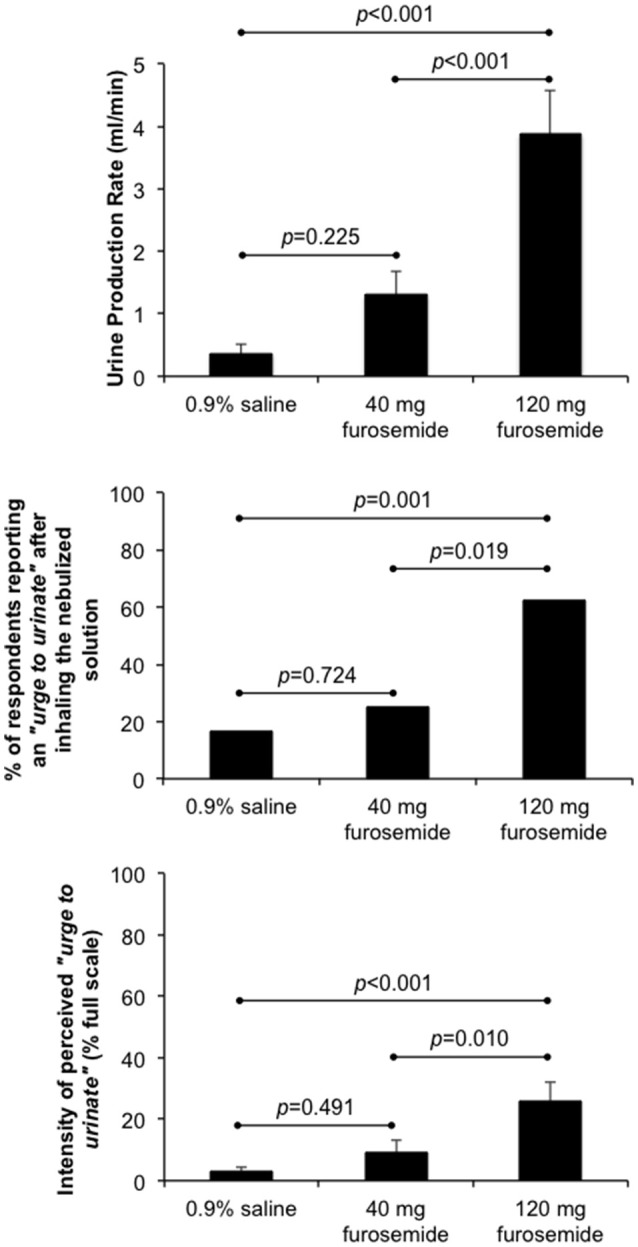
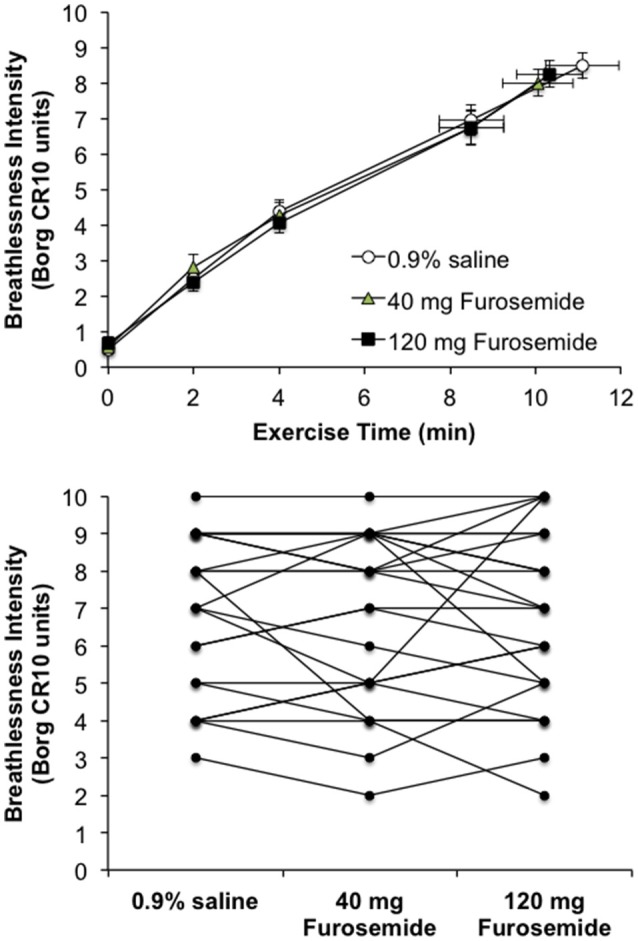
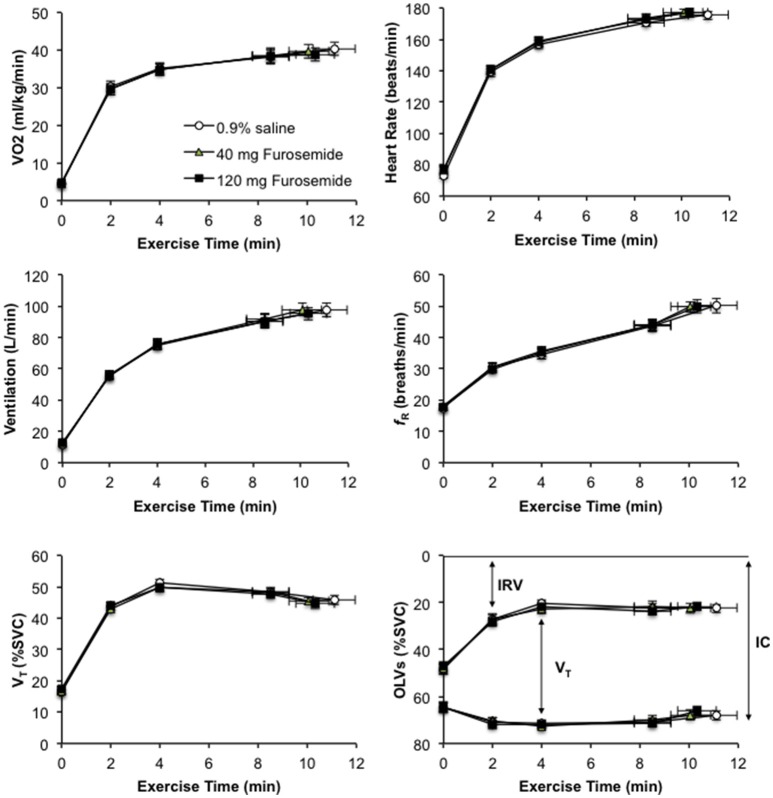
Inhalation of nebulized furosemide has been shown to alleviate breathlessness provoked experimentally in health and disease; however, it remains unclear whether the efficacy of nebulized furosemide on breathlessness is dose-dependent. We tested the hypothesis that inhaled nebulized furosemide would be associated with a dose-dependent relief of breathlessness during exercise testing in the setting of abnormal restrictive constraints on tidal volume (V) expansion. In a randomized, double-blind, crossover study, 24 healthy men aged 25.3 ± 1.2 years (mean ± SE) completed a symptom-limited constant-load cycle endurance exercise test in the setting of external thoracic restriction chest wall strapping to reduce vital capacity by ~20% following single-dose inhalation nebulized furosemide (40 and 120 mg) and 0.9% saline. Compared with 0.9% saline, neither 40 nor 120 mg of inhaled nebulized furosemide had an effect on ratings of perceived breathlessness during exercise or an effect on cardiometabolic, ventilatory, breathing pattern, or dynamic operating lung volume responses during exercise. Urine production rate, the percentage of participants reporting an "urge to urinate" and the intensity of perceived "urge to urinate" were all significantly greater after inhaling the 120 mg furosemide solution compared with both 0.9% saline and 40 mg furosemide solutions. We concluded that, under the experimental conditions of this study, inhalation of nebulized furosemide at doses of 40 and 120 mg did not alleviate breathlessness during exercise in healthy men.
雾化吸入速尿已被证明可缓解健康人和患病者实验性诱发的呼吸困难;然而,雾化吸入速尿对呼吸困难的疗效是否存在剂量依赖性仍不清楚。我们检验了这样一个假设,即在潮气量(V)扩张受到异常限制性约束的情况下,吸入雾化速尿与运动测试期间呼吸困难的剂量依赖性缓解相关。在一项随机、双盲、交叉研究中,24名年龄为25.3±1.2岁(均值±标准误)的健康男性,在单次吸入雾化速尿(40毫克和120毫克)和0.9%生理盐水后,通过外部胸廓限制(胸部束缚带)使肺活量降低约20%的情况下,完成了一项症状限制的恒定负荷循环耐力运动测试。与0.9%生理盐水相比,40毫克和120毫克的吸入雾化速尿对运动期间的主观呼吸困难评分均无影响,对运动期间的心脏代谢、通气、呼吸模式或动态有效肺容积反应也无影响。与0.9%生理盐水和40毫克速尿溶液相比,吸入120毫克速尿溶液后,尿量生成率、报告有“排尿冲动”的参与者百分比以及感知到的“排尿冲动”强度均显著更高。我们得出结论,在本研究的实验条件下,40毫克和120毫克剂量的雾化速尿吸入并不能缓解健康男性运动期间的呼吸困难。