Yang Shu-Fei, Salamonson Yenna, Burns Elaine, Schmied Virginia
1School of Nursing and Midwifery, Western Sydney University, Penrith, NSW Australia.
3Department of Nursing, Chung Hwa University of Medical Technology, Tainan, Taiwan.
Int Breastfeed J. 2018 Feb 20;13:8. doi: 10.1186/s13006-018-0153-1. eCollection 2018.
Breastfeeding support from health professionals can be effective in influencing a mother's decision to initiate and maintain breastfeeding. However, health professionals, including nursing students, do not always receive adequate breastfeeding education during their foundational education programme to effectively help mothers. In this paper, we report on a systematic review of the literature that aimed to describe nursing and other health professional students' knowledge and attitudes towards breastfeeding, and examine educational interventions designed to increase breastfeeding knowledge and attitudes amongst health professional students.
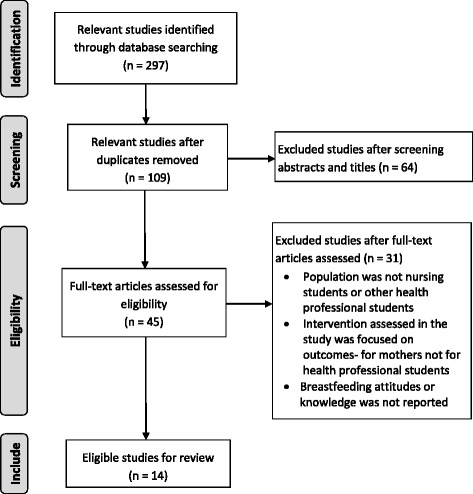
A systematic review of peer reviewed literature was performed. The search for literature was conducted utilising six electronic databases, CINAHL, MEDLINE, ProQuest, PubMed, Scopus, and Cochrane, for studies published in English from January 2000 to March 2017. Studies focused on nursing students' or other health professional students' knowledge, attitudes or experiences related to breastfeeding. Intervention studies to improve knowledge and attitudes, were also included. All papers were reviewed using the relevant Critical Appraisal Skills Programme (CASP) checklist.
Fourteen studies were included in the review. This review indicates that in some settings, health professional students demonstrated mid-range scores on breastfeeding attitudes, and their knowledge of breastfeeding was limited, particularly in relation to breastfeeding assessment and management. All of the studies that tested a specialised breastfeeding education programme, appeared to increase nursing students' knowledge overall or aspects of their knowledge related to breastfeeding. Several factors were found to influence breastfeeding knowledge and attitudes, including timing of maternal and child health curriculum component, previous personal breastfeeding experience, gender, cultural practices and government legislation.
Based on this review, it appears that nursing curriculum, or specialised programmes that emphasise the importance of breastfeeding initiation, can improve breastfeeding knowledge and attitudes and students' confidence in helping and guiding breastfeeding mothers.
来自健康专业人员的母乳喂养支持可有效影响母亲开始并维持母乳喂养的决定。然而,包括护理专业学生在内的健康专业人员在其基础教育课程中并不总是接受足够的母乳喂养教育,从而无法有效地帮助母亲。在本文中,我们报告了一项文献系统综述,旨在描述护理专业及其他健康专业学生对母乳喂养的知识和态度,并研究旨在提高健康专业学生母乳喂养知识和态度的教育干预措施。
对同行评审文献进行系统综述。利用六个电子数据库(CINAHL、MEDLINE、ProQuest、PubMed、Scopus和Cochrane)检索2000年1月至2017年3月以英文发表的研究。研究聚焦于护理专业学生或其他健康专业学生与母乳喂养相关的知识、态度或经历。还纳入了旨在改善知识和态度的干预性研究。所有论文均使用相关的批判性评价技能计划(CASP)清单进行评审。
该综述纳入了14项研究项目。本综述表明,在某些情况下,健康专业学生在母乳喂养态度方面得分中等,且他们对母乳喂养的知识有限,尤其是在母乳喂养评估和管理方面。所有测试专门母乳喂养教育计划的研究似乎都提高了护理专业学生的整体知识或与母乳喂养相关的知识方面。发现有几个因素会影响母乳喂养知识和态度,包括母婴健康课程组成部分的时间安排、以前的个人母乳喂养经历、性别、文化习俗和政府立法。
基于本综述,似乎护理课程或强调母乳喂养启动重要性的专门课程可以提高母乳喂养知识和态度,以及学生帮助和指导母乳喂养母亲的信心。