Chon Jung-Whan, Seo Kun-Ho, Bae Dongryeoul, Park Ji-Hee, Khan Saeed, Sung Kidon
Division of Microbiology, National Center for Toxicological Research, U.S. Food and Drug Administration, Jefferson, AR 72079, USA.
KU Center for One Health, College of Veterinary Medicine, Konkuk University, Seoul 05029, Korea.
J Vet Sci. 2018 May 31;19(3):368-374. doi: 10.4142/jvs.2018.19.3.368.
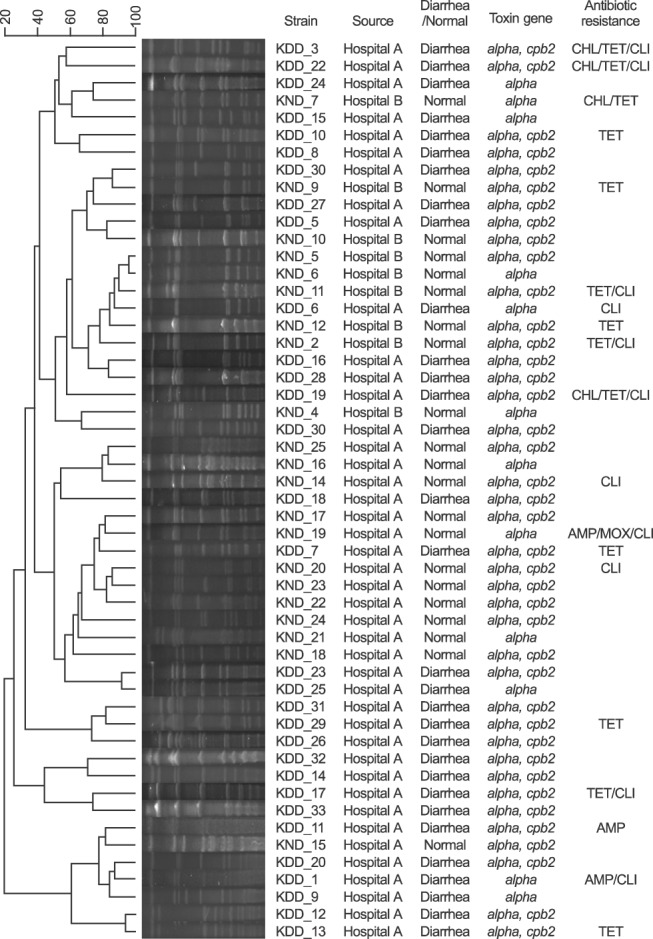
causes diarrhea and other diseases in animals and humans. We investigated the prevalence, toxin gene profiles, and antibiotic resistance of isolated from diarrheic dogs (DD) and non-diarrheic dogs (ND) in two animal hospitals in Seoul, Korea. Fecal samples were collected from clinically DD (n = 49) and ND (n = 34). was isolated from 31 of 49 DD (63.3%) and 21 of 34 ND dogs (61.8%). All strains were positive for the α toxin gene, but not for the β, ε, or ι toxin genes; therefore, all strains were identified as type A . All isolates were -negative, whereas the β2 toxin gene was identified in 83.9% and 61.9% of isolates from DD and ND, respectively. Most isolates were susceptible to ampicillin (94%), chloramphenicol (92%), metronidazole (100%), moxifloxacin (96%), and imipenem (100%). However, 25.0% and 21.2% of isolates were resistant to tetracycline and clindamycin, respectively. Molecular subtyping of the isolated strains was performed by using pulsed-field gel electrophoresis. Fifty-two isolates were classified into 48 pulsotypes based on more than 90% similarity of banding patterns. No notable differences were observed among the isolates from DD and ND.
可导致动物和人类腹泻及其他疾病。我们调查了从韩国首尔两家动物医院腹泻犬(DD)和非腹泻犬(ND)中分离出的[具体病原体未给出]的流行情况、毒素基因谱及抗生素耐药性。从临床诊断为腹泻的49只犬(DD组)和34只非腹泻犬(ND组)采集粪便样本。从49只腹泻犬中的31只(63.3%)和34只非腹泻犬中的21只(61.8%)分离出了[具体病原体未给出]。所有[具体病原体未给出]菌株的α毒素基因均为阳性,但β、ε或ι毒素基因均为阴性;因此,所有菌株均被鉴定为A型[具体病原体未给出]。所有分离株均为[具体检测项目未给出]阴性,而DD组和ND组分离株中β2毒素基因的检出率分别为83.9%和61.9%。大多数分离株对氨苄西林(94%)、氯霉素(92%)、甲硝唑(100%)、莫西沙星(96%)和亚胺培南(100%)敏感。然而,分别有25.0%和21.2%的分离株对四环素和克林霉素耐药。采用脉冲场凝胶电泳对分离菌株进行分子分型。基于条带模式90%以上相似度,52株分离株被分为48个脉冲型。腹泻犬和非腹泻犬的分离株之间未观察到明显差异。