Jaros Antonin, Sroya Hafiz A, Wolfe Venita K, Ghai Vikas, Roumelioti Maria-Eleni, Shaffi Kamran, Wang Kai, Pankratz Vernon Shane, Unruh Mark L, Argyropoulos Christos
Department of Internal Medicine, Division of Nephrology, University of New Mexico Health Sciences Center, Albuquerque, NM, USA.
Department of Internal Medicine, University of New Mexico Health Sciences Center, Albuquerque, NM, USA.
BMC Nephrol. 2018 Feb 27;19(1):47. doi: 10.1186/s12882-018-0842-4.
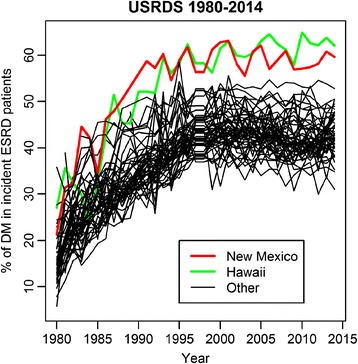
Rural areas in the state of New Mexico have been the "ground-zero" for the epidemic of diabetic Chronic Kidney Disease (CKD) in the United States. However, there is limited research about risk factors of diabetic CKD in this area and scarce data regarding the performance of emerging markers of renal filtration and epigenetic biomarkers of renal function and diabetes in this area with its unique ethnic/racial population. We designed the COMPASS study as a community-based program in rural New Mexico aiming to screen for CKD and to discover CKD-related translational biomarkers.
METHODS/DESIGN: The study involves a prospective, longitudinal cohort design involving individuals living in rural New Mexico. Participants undergo a screening for kidney disease using markers of abnormal renal filtration (impaired glomerular filtration rate) or damage (albuminuria). Those found to have CKD on the basis of these tests or those at risk for CKD are enrolled in a prospective longitudinal cohort. We measure markers of renal function, insulin resistance and epigenetics (microRNAs) on patients. Individuals are invited to participate in interviews and focus groups in order to characterize their attitudes towards research and barriers or facilitators to participation in future research studies about kidney disease.
This study will provide important data about the local epidemiology of kidney disease in a high-risk rural setting and the utility of emerging renal filtration markers (Beta 2 Microglobulin and Cystatin C), while generating data and methods for the analyses of microRNA biomarkers. The qualitative research subproject will identify factors associated with increased willingness to participate in future translational research projects. With its geographical focus, this study will address a critical disparity in kidney disease research, while generating novel epigenetic data that are relevant for future studies in the general population.
在美国,新墨西哥州的农村地区一直是糖尿病慢性肾脏病(CKD)流行的“重灾区”。然而,关于该地区糖尿病CKD危险因素的研究有限,且针对该地区独特的种族/民族人群,有关肾脏滤过新标志物以及肾功能和糖尿病表观遗传生物标志物性能的数据也很匮乏。我们设计了COMPASS研究,作为新墨西哥州农村地区一项基于社区的项目,旨在筛查CKD并发现与CKD相关的转化生物标志物。
方法/设计:该研究采用前瞻性纵向队列设计,研究对象为居住在新墨西哥州农村的个体。参与者使用肾脏滤过异常(肾小球滤过率受损)或损伤(蛋白尿)标志物进行肾脏疾病筛查。基于这些检测被发现患有CKD或有CKD风险的人将被纳入前瞻性纵向队列。我们对患者测量肾功能、胰岛素抵抗和表观遗传学(微小RNA)标志物。邀请个体参加访谈和焦点小组,以了解他们对研究的态度以及参与未来肾脏疾病研究的障碍或促进因素。
本研究将提供有关高风险农村地区肾脏疾病当地流行病学以及新出现的肾脏滤过标志物(β2微球蛋白和胱抑素C)效用的重要数据,同时生成用于分析微小RNA生物标志物的数据和方法。定性研究子项目将确定与未来参与转化研究项目意愿增加相关的因素。鉴于其地理重点,本研究将解决肾脏疾病研究中的一个关键差距,同时生成与一般人群未来研究相关的新表观遗传数据。